








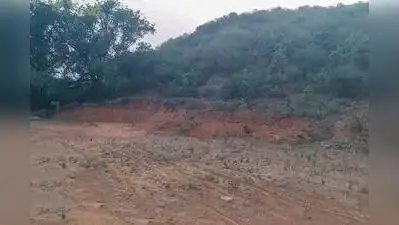
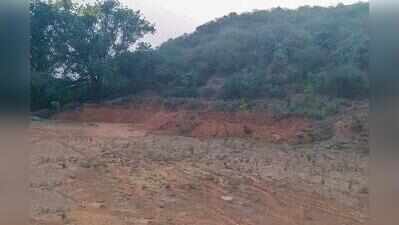
Gurgaon: A section of an Aravali hillock has been flattened in Mangar, one of the most ecologically sensitive zones of the ranges and home to the eponymous Mangar Bani grove. The cleared patch measures around an acre.Local residents reported activities at the hillock around 7pm on Tuesday and alerted police, who found an earthmover abandoned at the site. No FIR has been filed so far. The forest department also inspected the area. “It looks like some part of the hill was damaged. We are investigating,” said Jhalkar Uyake, Faridabad divisional forest officer.Fresh earth cuts were visible on Wednesday along the edges of the cleared patch, with the natural hill slope rising immediately behind it. A damaged mesh fence was also found at the site.The land is classified in revenue records as ‘magda’ — rainfed agricultural land — even though it is partly hilly. According to environmentalist S S Oberoi, repeated attempts have been made to alter the natural landscape here — trees and shrubs have been cut in the past before this attempt to level it with an earthmover.Construction and mining have done large-scale damage to the Aravalis. In Rajasthan, entire tracts of the hills have been flattened. In south Haryana districts like Gurgaon, Faridabad and Nuh, despite a ban on mining and laws restricting construction in the Aravalis, hills continue to sustain damage. In Dec 2024, a hillock in Nuh’s Rava was blown to pieces by stone miners.In its Mangar order, National Green Tribunal had recorded the Haryana govt’s own submission that there had been past instances of gair mumkin pahar (rocky, hilly or uncultivable wasteland) being wrongly labelled as agricultural land in revenue records by a patwari.The tribunal’s order directed state authorities to act against “unauthorised cutting of trees or breaking of the land or any non-forest activity in the forest, including gair mumkin pahar,” which it recognised as deemed forest under notifications issued under Punjab Land Preservation Act (PLPA) and Supreme Court’s declarations.Mangar is no ordinary tract of land. Spread across 4,262 acres, including around 3,810 acres of gair mumkin pahar, it is among the richest biodiversity pockets of the Aravalis in NCR. Within it lies Mangar Bani, spread over 677 acres, regarded as NCR’s last surviving grove and possibly its only remaining patch of primary forest. Of Mangar’s hill area, 1,132 acres are protected under sections 4 and 5 of Punjab Land Preservation Act and required to be treated as forest.Conservationists have long argued that the remaining forested acres should also be recognised as deemed forest under Supreme Court’s 1996 T N Godavarman Thirumulpad judgment, which held that “forest” includes any area meeting the dictionary definition or recorded as such in government records, regardless of ownership. Despite meeting these criteria, large parts of Mangar remain unclassified by the Haryana govt.“This has always been forest land. Every few years someone tries to change its character. Villagers have repeatedly objected because once the hills are cut, they cannot be restored,” said Ram Singh, a Mangar resident.In 2013, NGT restrained fencing, fragmentation and land-use change in Mangar. The matter resurfaced in 2014 when realtor M3M claimed parts of the land were agricultural. In 2016, NGT rejected this after a joint Forest Survey of India–Haryana forest department survey found the land densely vegetated. That June, Haryana declared Mangar Bani and a 500-metre buffer a no-construction zone.