








Concrete has a major environmental cost, while human waste creates another difficult waste-management challenge. Researchers have now brought the two problems together in an unusual laboratory experiment. A team converted treated faecal sludge into biochar and used the resulting material to replace part of the cement in concrete. The researchers tested mixtures containing 5%, 10% and 15% biochar and compared them with conventional concrete. The results varied depending on how much was added. After 91 days of curing, the 10% mixture recorded a 42% increase in flexural strength, while other tests showed benefits at lower replacement levels. The findings point towards a surprising possible use for processed waste.
How human waste was turned into biochar for concrete
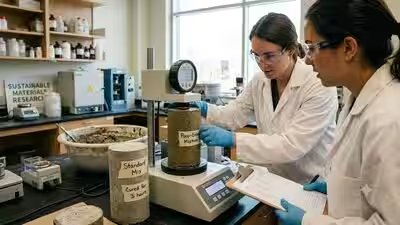
The material used in the experiments did not come straight from a sewage system and was not simply mixed into wet cement.The researchers, led by civil engineer Raghuvesh Tiwari of Manipal University Jaipur, obtained faecal-sludge biochar from a treatment facility in Warangal. The sludge is first dried before being heated in an oxygen-limited environment at roughly 350 to 450°C. That process, known as pyrolysis, converts the organic material into a carbon-rich solid.Afterwards, the resulting biochar is ground and passed through a sieve to produce a fine powder. The team then used it as a partial substitute for cement in concrete mixtures. They tested three replacement levels: 5, 10 and 15 %. A conventional mixture was kept as a comparison.The aim was to see how much of a conventional cement component could be replaced while retaining, or possibly improving, useful properties.
5% biochar showed strong results in laboratory concrete tests
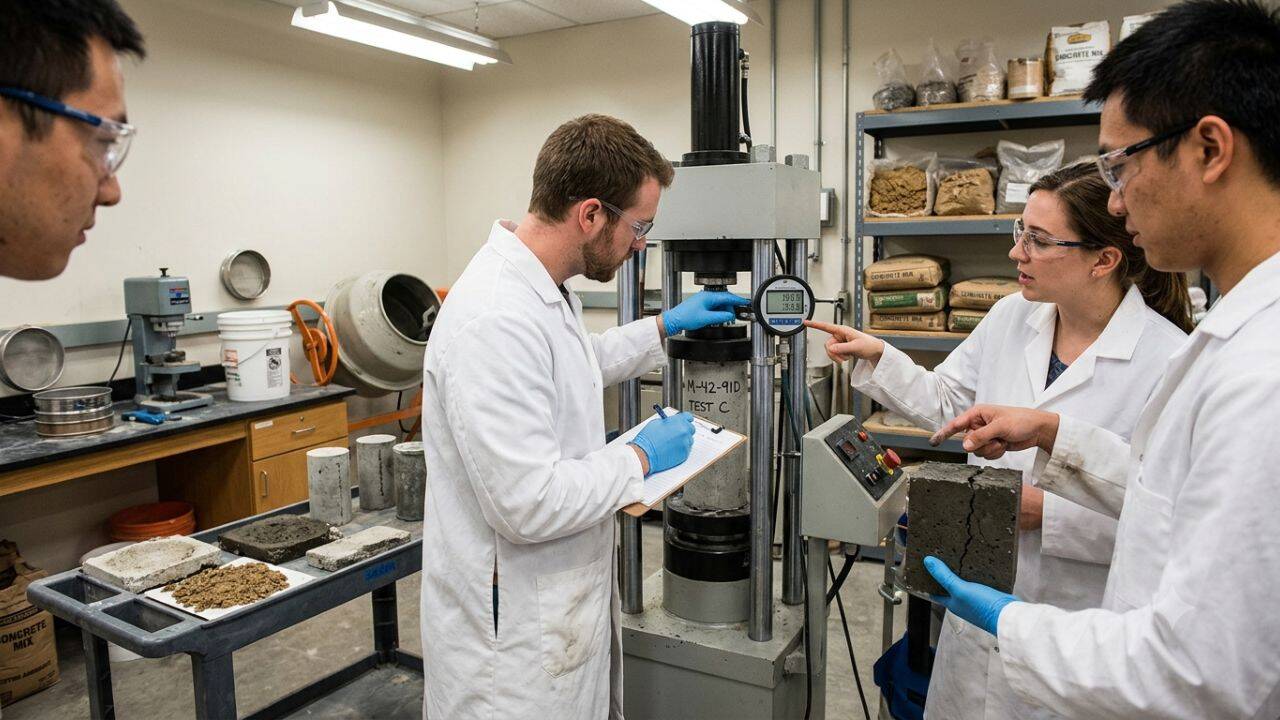
The concrete samples were put through several tests, including measurements of compressive strength, flexural strength, shrinkage, water absorption and porosity. The results changed depending on how much biochar was included. The 5% mixture emerged as the strongest of the mixes in several measurements, suggesting that a relatively small substitution may be more useful than simply adding as much waste material as possible.The samples were also tested after different curing periods. Concrete does not reach its final strength immediately, so the researchers examined specimens at 28, 56 and 91 days.According to the study published in Scientific Reports, titled ‘Mechanical, durability, and microstructural performance of biochar-modified concrete using faecal sludge–derived biochar’ reveals that by the 91-day mark, the five % biochar mixture had recorded an average 20 % increase in compressive strength and a 36 % increase in flexural strength compared with the conventional concrete.The 10% mixture produced even larger gains in those two measurements, with compressive strength rising by about 21 % and flexural strength by 42 %.The figures do not mean every form of concrete would become 42 % stronger simply by adding faecal-sludge biochar. They relate to the particular mixtures and laboratory conditions used in this study.
Waste material changes what happens inside the concrete
Part of the explanation appears to lie in the physical structure of the biochar itself. Under magnification, the particles contain a network of very small pores. Those spaces can take in water and release it gradually. Inside curing concrete, that can provide additional moisture for the chemical reactions involved in cement hydration.The biochar also contains silica. During curing, silica can participate in reactions with cement-derived compounds and contribute to the formation of calcium silicate phases associated with concrete strength.There is a third effect as well. Finely ground particles can occupy some of the small spaces between other ingredients, allowing the material to pack more closely. Microscopic examination of the samples supported this explanation, with the five % mixture showing a denser internal structure than the conventional concrete.
At 15 %, the advantage began to disappear
When the replacement level reached 15 %, the picture changed. The concrete continued to gain strength during curing, but it did not match the performance of the lower-biochar mixtures. Microscopic images showed more pores, cracks and areas where the internal material was less well bonded.The same pattern appeared in the wider testing. A modest quantity of biochar could improve some characteristics, while a larger substitution began to interfere with the structure needed for strong concrete.This is a familiar problem with partial cement replacements. The material being introduced has to work with the rest of the mixture rather than simply occupy more of it.
Water absorption and shrinkage also changed
Strength was not the only property examined. The 5% mixture generally absorbed less water than the ordinary concrete and had lower measured porosity. Its drying shrinkage was also reduced. At ten % replacement, the results remained broadly comparable with conventional concrete for these properties.Those findings are important because a construction material cannot be judged by compressive strength alone. How it responds to moisture and changes in volume can influence its long-term behaviour.Still, the work remains at the laboratory stage. The concrete has not yet demonstrated how it would behave after years of exposure to the conditions found on an actual building site.