









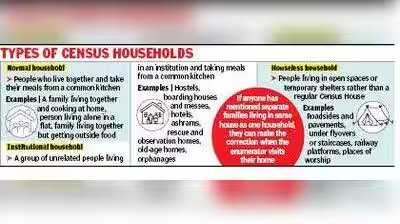
Kolkata: In the Census exercise, a single house is not always a single household — and an address is certainly not a household number. What matters in Census is not simply who lives under the same roof but who eats from the same kitchen.As enumerators started the door-to-door verification for the house-listing process, Bengal Census director made it clear on Monday that one simple rule to identify a household will be the kitchen.“A single address can have several Census households. Take the case of three brothers living in different portions of the same building. If all three families cook separately in three kitchens, the Census will treat them as three households, even though they may share the same address. If they share one common kitchen and meals, they can be treated as one household,” said Nikhil Pavan Kalyan, director of Census operations for West Bengal.In other words, the official said Census is looking beyond walls, doors and postal addresses to understand how people actually live. “If unrelated people live in the same house but do not share meals from a common kitchen, they are not treated as one household. As in case of a hostel or an orphanage,” said the director.Officials clarified if anyone has mistakenly mentioned separate families living in the same house as one household, they can make the necessary correction once the enumerator visits their home in person over the next four weeks. The door-to-door visit for house-listing operation will continue till Sept 14.According to the officials, a ‘Census house’ is a building or part of a building that is treated as a separate unit because it has a separate main entrance from a road, common courtyard, staircase or similar access. It may be occupied or vacant and may be used for residential or non-residential purposes, another official said.A ‘house’, on the other hand, is about the people living there and their living arrangement. It is usually a group of people who normally live together and take their meals from a common kitchen. The members may be related, unrelated or a mix of both. Hence ‘census household’ and a normal house are different, the official explained.This also means that a Census household number is not the same as an address. The address identifies the location. “The household number identifies the household recorded there for Census purposes. One address can therefore have multiple household numbers,” said the official.Officials have broadly identified three types of households for the exercise: Normal, Institutional and Houseless.A Normal Household is generally a group living together and sharing meals from a common kitchen. There are exceptions. A person living alone is still counted as a household, even if the person does not cook. Similarly, a family may continue to be treated as a Normal Household if it lives together but gets cooked food from outside.An Institutional Household consists of unrelated people living in an institution and sharing a common kitchen. Hostels, boarding houses, messes, hotels, jails, rescue homes, ashrams, old-age homes and orphanages are among the examples.Houseless Households are people living in open spaces or temporary locations such as roadsides, pavements, under flyovers or staircases, railway platforms and places of worship. These households will be covered during Population Enumeration phase rather than house-listing phase.“The distinction will become particularly important when enumerators start numbering homes and other structures in high-rises, hostels, offices, jails and large institutional complexes,” the official added.