








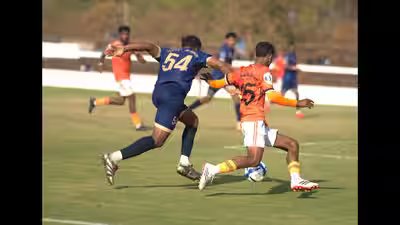
Panaji: The Goa Football Association (GFA) has handed indefinite bans to 13 players and one official, a police constable attached to a club, for their role in alleged fixing of matches in the top tier Goa Professional League.All players were charge-sheeted last December after a preliminary report by GFA’s integrity officer and retired deputy superintendent of police Sandesh Chodankar said “there is ample evidence of match-fixing”. The players were given a chance to explain themselves, and after nine months of investigations, all of them have been handed bans.“They are banned from all football activities, till the conclusion of this investigation by the ethics committee,” GFA president Caitano Fernandes told reporters on Tuesday. “They are suspended from all football activities. From today onwards, they cannot even enter any ground where football matches are being played. Match-fixing has been the scourge of Goan football for almost a decade. It’s one of the reasons why fans are not turning up for games.”The suspended players are Rohan Krishna Pednekar, Akash Amrut Kudnekar, Akash Sanadi, Bhaskar Jalmi, Krishnanath Shirodkar, Vinayak Rane, Chaitan Dabholkar, Sachidanand Satelkar, Aman Govekar, Minesh Kunkolkar, Satish Kankonkar, Suraj Hadkonkar and Ronaldo Oliveira. GFA said Mouzzan Shaikh, a police constable who was previously registered as player and assistant coach with Geno SC, was the “main man”.Nine of the players were last registered with Chapora Yuvak Sangh, two are from Calangute Association and one from Pax of Nagoa. Despite the cloud of suspicion and suspension by their own clubs, all of them continued to feature in inter-village tournaments.GFA is acting on a complaint by Chapora president Praveen Dabholkar who named nine of his players for their involvement in “match-fixing for monetary benefits”. All of them had met a suspected match fixer— only identified as ‘masked man’ Sandy, arriving in a tinted car — a day before their GPL clash against Clube de Salgaocar, where they were offered money to lose the game by three goals.“All players are guilty, at the least, of violating clause 22.3 of the GFA Code of Conduct. They did not inform the integrity officer when they were approached to fix a game. During integrity workshops, we make it clear to the players that whenever they are approached, their first duty is to inform,” said vice president Jonathan de Sousa.In view of the seriousness of the findings, the GFA executive committee decided to refer the matter to the Central Bureau of Investigation (CBI) for further investigation, as recommended by the integrity officer.“Match-fixing in Goan football started around 2015-16 and was absolutely rampant between 2018 and 2022,” said De Sousa. “At one time, within a span of 10 days, six games were red-flagged (for suspicious betting patterns indicative of match fixing). Since we took over (in 2022), from about 162 matches last season, only two were red flagged.“The entire executive committee has done a fantastic job because we made sure that every year, we organise integrity workshops and educate players about match fixing. All of them have to sign a declaration that they will not be involved in match fixing or they will immediately report any approach. Without signing the declaration, they are not allowed to be registered for the Pro League.”Had it not been for the complaint of Chapora president Dabholkar and his own investigation into the suspicious actions of his players, the match-fixing would have never come to light.“Praveen dared to act despite the allegations involving members of his own team,” said Caitano. “GFA would like to appreciate and acknowledge Praveen for acting upon such malpractices and reporting the issue. Usually no one points out to their own team, but Praveen, when he learnt about the incident at his team, immediately reported it to GFA.”