









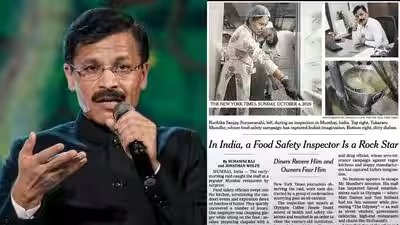
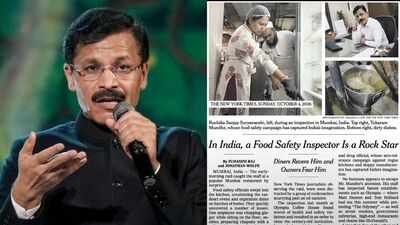
NEW DELHI: Maharashtra Food and Drug Administration chief Tukaram Mundhe has been dubbed a “rockstar” by The New York Times for his aggressive crackdown on food safety violations, with the American newspaper featuring the IAS officer on its front page and highlighting how his surprise inspections have turned routine regulatory enforcement into a highly visible campaign.The NYT described Mundhe as a “food safety celebrity” and highlighted the contrast between diners who revere him and restaurant owners who fear his inspections. The international attention comes as the Maharashtra FDA steps up action against restaurants, food businesses, pharmacies, warehouses and other establishments across the state.Mundhe, however, sought to shift the focus from the international recognition to the larger purpose of food safety enforcement. Sharing the report on X, he said, “Good governance is not about making headlines. It is about making a difference.”“Food safety is ultimately about protecting people, upholding standards and building public trust,” he said, adding that fair, fearless and consistent enforcement helps strengthen the credibility of institutions.
More than 12,000 food inspections
The international recognition comes amid a major enforcement push by the Maharashtra FDA. Between June 1 and August 31, the department conducted 12,083 food inspections and collected 37,604 food and drug samples. It issued 5,269 improvement notices and suspended 603 food licences during the period.The department also seized food stock worth Rs 67.2 crore and reported 875 arrests in food-related cases. On the drug side, it carried out 2,902 inspections and seized illegal medicines and cosmetics worth Rs 11.41 crore.The crackdown also targeted banned gutkha and pan masala. The FDA registered 644 FIRs, made 867 arrests and seized stocks worth Rs 19.62 crore.During a separate festive-season crackdown between September 23 and 27, the department suspended food licences and seized 50,601.78 kg of food stock worth Rs 1.19 crore across several divisions.
Using technology to expand enforcement
The FDA is also turning to digital systems and AI to deal with manpower constraints. Its sanctioned strength is 1,271, while a roadmap submitted by the commissioner estimates that nearly three times as many personnel would be required to meet regulatory needs across Maharashtra.Its online system tracks complaints, assigns them to officers and sets response deadlines, with higher authorities alerted when action is delayed. The system also creates an audit trail so senior officials can monitor cases in real time.The department is looking at combining inspection records, laboratory results, complaints, licensing information and previous violations to identify establishments and products requiring greater scrutiny.Mundhe has described AI as a tool to help the existing workforce “see more, respond faster”, rather than replace officers.
Crackdown extends beyond restaurants
The FDA’s enforcement drive has also extended to pharmacies, with action against the sale of antibiotics without prescriptions and hundreds of pharmacy licences cancelled or suspended. Mundhe has also raised concerns over high margins on hospital consumables and recommended bringing such products under regulated pricing.On the food side, the department has imposed a one-year ban on the manufacture, storage, distribution and transportation of analogue paneer. It is also working on measures to improve food packaging, including a proposal for food-grade, non-toxic ink in newsprint used to wrap street food.The FDA has also brought weddings, community gatherings and other large events under greater food-safety scrutiny, requiring caterers and event operators to comply with registration and safety requirements.Alongside enforcement, the department is pushing awareness among consumers. Under its “Safe Food for Every School Child” initiative, it conducted 270 workshops involving 60,990 schools across Maharashtra between April 1 and September 11.Mundhe’s broader strategy is built around three pillars — Empower, Enable and Enforce — with the stated aim of making food and medicine safety a continuing public-health priority rather than something addressed only when violations are detected.