









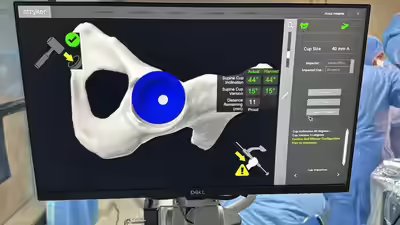
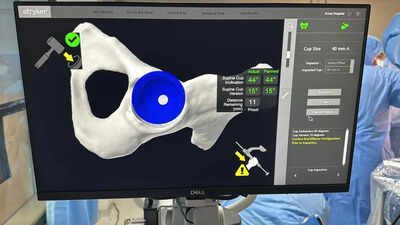
Pune: Two years ago, when a 40-year-old businessman, struggling with morbid obesity, underwent hip replacement surgery, he expected it to be “life-changing.” Instead, it turned into a “nightmare.“Within a week of the surgery, the ceramic implant shattered under his weight, leaving him bedridden for three weeks, requiring multiple blood transfusions, and leaving behind a traumatic 36-cm scar. The patient recently sought help at a city hospital for replacement of his other hip, but his previous experience had left him with deep-seated mental trauma.Dr Rohit Luthra, orthopaedic surgeon at Arcus Hospital, explained the failure of the initial procedure performed elsewhere. “The patient underwent a left-side total hip replacement where a ceramic-on-ceramic liner was used. Due to the patient’s weight (124 kg and a BMI of 41), the implant broke just eight days later. While a second corrective surgery was performed using a poly liner, the physical and emotional damage was done.“When the patient presented to Dr Luthra for his right-side hip replacement, the surgical team opted for a novel, tech-driven approach to ensure success and safety.Dr Luthra utilised CT-based robotic planning to perform a robotic-assisted direct anterior aproach (DAA) using an X3 liner. Unlike traditional methods, the robotic scan provides a virtual 3D model of the hip, allowing surgeons to pinpoint the exact implant size and placement.“The patient suffered from severe bilateral hip osteoarthritis,” said Dr Luthra. “Traditional posterior techniques require cutting tendons and muscles, which can lead to a 50% loss in muscle strength and higher risks of dislocation, especially in patients with a BMI over 35. The DAA is a front-access approach that spares the muscles entirely.”The results were immediate. While the patient’s previous surgery left a 36cm scar, the robotic DAA required only an 8 cm incision. Within four hours of surgery, the patient was walking; within three days, he discarded his walker; and within 15 days, he was back at work.The procedure also simplified the process for the clinical team. Dr Rajesh Kothavale, the attending anaesthetist, noted that the DAA allows the patient to remain in a supine position.“Traditional procedures require a lateral (side) position, which can be difficult for airway management in patients weighing 124 kg,” Dr Kothavale said. “Despite his weight and history of complications, the positioning and airway management were incredibly smooth.”Dr Luthra said surgeons must account for a patient’s weight when selecting materials. “Using a ceramic-on-ceramic liner for a patient of this weight was a grave mistake. The friction and pressure caused it to shatter. This time, we used a poly liner inside a ceramic implant to reduce friction and increase durability.”The patient, who was admitted on March 12, 2026, and discharged just 48 hours later, described the difference as night and day. “The first surgery left me terrified. It affected my business and my mental health. This time, I had minimal pain and no need for blood transfusions. By the time I went for my follow-up in May, I felt completely recovered.”Validating the success of the procedure, senior orthopaedic surgeon Dr Ramkinkar Jha noted that ceramic-on-ceramic implants carry a real risk of fracture under high joint reactive forces in obese individuals.“Muscle preservation and precision robotics are exactly what these complex patients need,” Dr Jha said. “The DAA procedure allows surgeons to bypass common complications, easing the job for the surgeon and significantly improving the long-term outcome for the patient.”