










Hyderabad: Even in an El Nino year, Telangana is expected to remain a rice-surplus state, but the extent of that surplus will depend largely on water availability during the coming irrigation season.Flagging the risks, Professor Jayashankar Telangana Agricultural University (PJTAU) has recommended a real-time rice-water dashboard to closely monitor reservoir levels, irrigation releases, and their impact on rice production during 2026-27.
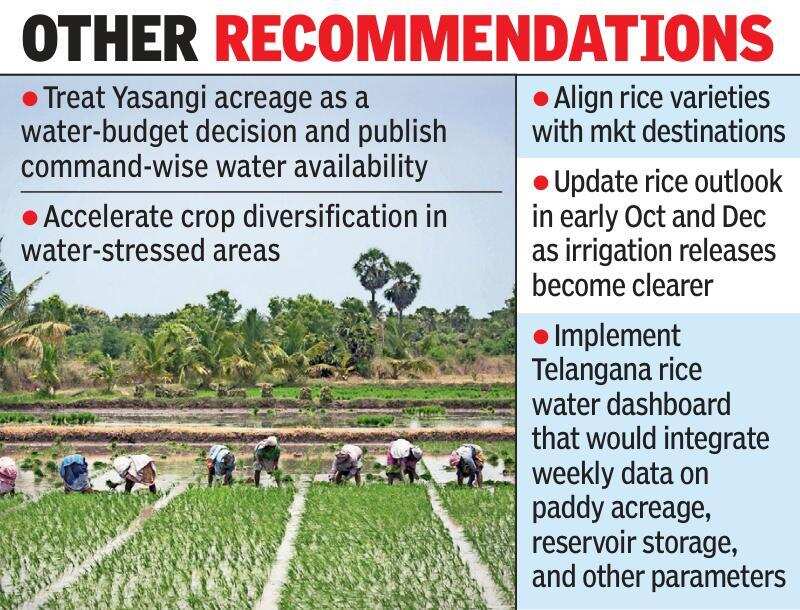
The university’s assessment estimates combined paddy production from the kharif and yasangi seasons at 198 lakh metric tonnes (LMT) under a low-water scenario, 209 LMT in the base case and 219 LMT if water availability improves. Assuming a milling recovery rate of 67%, this would translate into milled rice output of 133 LMT, 140 LMT, and 147 LMT, respectively.The recommendation gains significance considering Telangana’s experience during the previous El Nino year. In 2014-15, rice production fell by 31%, from 98.72 LMT to 68.18 LMT, following a 25% decline in rainfall and a 29% reduction in paddy acreage.For the current kharif season, paddy production is estimated at 107 LMT in the low-water scenario, 111 LMT in the base case, and 113 LMT under improved water availability. These projections are based on a paddy area of 22.62 lakh hectares, down 16.25% from 27.01 lakh hectares last year, with yields expected to be around 2% lower than the previous season.The bigger uncertainty lies in the yasangi crop. Paddy production is projected at 91 LMT under low water availability, 98 LMT in the base case, and 106 LMT if irrigation conditions improve. The corresponding acreage assumptions are 18 lakh hectares, 19 lakh hectares, and 20 lakh hectares.With Telangana requiring around 100 LMT of rice annually for consumption, public distribution and seed requirements, the state is expected to remain surplus even under adverse conditions. However, the surplus could narrow significantly if water availability weakens.The assessment identifies the Oct-March period as critical for the yasangi crop. Reservoir storage levels, Krishna basin water allocations, groundwater recharge and irrigation releases are expected to determine both acreage and yields.Prof Aldas Janaiah, vice-chancellor of PJTAU, said Telangana’s rice policy must increasingly focus on supply management alongside farmer welfare and food security. He noted that the Civil Supplies Corporation, originally designed to manage demand through the public distribution system, now needs to adapt to changing supply dynamics as well.The assessment says Telangana will continue to remain structurally rice-surplus, but the size and timing of the surplus will have implications for procurement, milling, storage, inter-state movement and exports.To aid planning, the university has proposed a Telangana rice water dashboard for 2026-27 covering both kharif and yasangi seasons. The platform would integrate weekly data on paddy acreage, reservoir storage, groundwater levels, irrigation releases, procurement and market prices, providing policymakers with a real-time picture of how water availability is shaping rice production and helping align procurement and stock-management decisions with emerging supply conditions.