









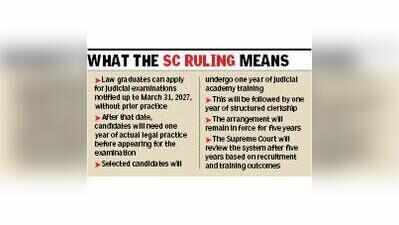
Chandigarh: Friday’s Supreme Court ruling on eligibility for judicial services examinations has brought relief and renewed hope to judiciary aspirants across Punjab, many of whom had put their preparation on hold after the introduction of a mandatory practice requirement.For months, uncertainty prevailed after the Supreme Court’s three-year practice rule was challenged. While the matter remained under consideration, operation of the rule was kept in abeyance for recruitment purposes, leaving aspirants unsure about whether they should focus on preparation or courtroom practice. Judicial recruitment processes across several states were also affected.The verdict has had an immediate impact in Chandigarh, a major coaching and preparation hub for law graduates from Punjab and neighbouring states. Many aspirants had shifted their focus to legal practice after the rule was introduced, while others stepped away from intensive preparation altogether.“After the three-year rule came, I started practising because I could not justify preparing full-time for an exam I was not eligible to take,” said Gagan Brar, a law graduate from Patiala preparing for judicial services examinations in Chandigarh. “I was studying after court, but the consistency was gone. Now I have started preparing seriously again.”Aspirants say the ruling has removed a major obstacle and allowed them to return to structured preparation plans.Rupinder Gill from Ludhiana, who had previously enrolled at a judiciary coaching institute in Chandigarh, said she scaled back her preparation after the rule was announced.“I had already invested months in preparation. Then I thought there was no point continuing at the same intensity if I had to practise for three years anyway. After the judgment, I immediately contacted my institute. I want to restart,” she said.The uncertainty had been compounded by the absence of a fresh recruitment notification in Punjab. The last Civil Judge recruitment examination in the state was conducted in 2023, and aspirants have been awaiting the next recruitment cycle while also keeping an eye on opportunities in states such as Haryana, Delhi, Rajasthan and Uttar Pradesh.“The 2023 Punjab exam is still the reference point for us because that was the last one,” said Nasreen, an aspirant from Abohar currently preparing in Chandigarh. “There is no notification yet, but after such a long gap everyone has been expecting the next recruitment. We also look at other states. Now there is a reason to prepare aggressively instead of waiting.”Coaching institutes in Chandigarh have also reported a surge in enquiries following the ruling.Urvijay Brar, who runs a judiciary coaching institute in the city, said many former students have already reached out to resume their preparation.“We have announced our new batch and so many queries are lined up,” he said. “Many students who were enrolled with us earlier left because of the three-year practice rule. Now several of them are contacting us again because they want to continue their preparation.”The Supreme Court, while delivering its judgement, acknowledged that the sudden introduction of the practice requirement without a transition period had created difficulties for graduates who had planned their careers under the earlier system.For many aspirants in Punjab, the ruling has ended months of uncertainty and brought the focus back to preparation, with expectations now turning towards the next judicial recruitment notification.BOX: What the SC ruling meansLaw graduates can apply for judicial examinations notified up to March 31, 2027, without prior practiceAfter that date, candidates will need one year of actual legal practice before appearing for the examination.Selected candidates will undergo one year of judicial academy training.This will be followed by one year of structured clerkship.The arrangement will remain in force for five years.The Supreme Court will review the system after five years based on recruitment and training outcomes