









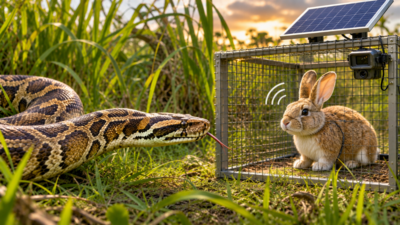
Florida is turning to an unusual piece of technology in its fight against one of the most destructive invasive predators in the Everglades: robotic rabbits designed to attract Burmese pythons. Developed through a collaboration involving the University of Florida and the South Florida Water Management District, the furry decoys are engineered to imitate native marsh rabbits, which are among the snakes’ natural prey. Equipped with solar-powered mechanisms, heaters and scent systems, they reproduce several signals that could draw a python towards them. Cameras monitor the devices and alert wildlife officials when a snake approaches, allowing trained removal agents to reach the location. The approach aims to address one of Florida’s biggest challenges in controlling the invasion: finding the well-camouflaged reptiles in dense vegetation.
Burmese pythons are being lured with robotic rabbits that mimic real prey
The devices are modified toy rabbits fitted with mechanical components that reproduce characteristics of living prey. Their systems are designed to generate heat, release a mammalian scent and create movements resembling those of a real marsh rabbit.The technology is intended to exploit the hunting behaviour of Burmese pythons, which rely on sensory cues to locate warm-blooded animals. Solar panels provide power, while remote controls allow researchers to operate the decoys without repeatedly entering the difficult wetland terrain.The rabbits are placed inside protective enclosures monitored by cameras. When a python approaches, the monitoring system alerts officials, who can send a trained python removal agent to the site. The robots do not capture the snakes themselves; their purpose is to attract and help locate them.The South Florida Water Management District announced the initiative in July 2025, describing it as a collaboration with University of Florida researchers to develop new ways of detecting and removing invasive pythons.
Why Florida needs robotic rabbits
Finding Burmese pythons is considerably more difficult than capturing them once they have been located. Their patterned skin blends into the surrounding vegetation, while their ability to remain concealed in wetlands makes conventional searches challenging.Mike Kirkland, the South Florida Water Management District’s lead invasive animal biologist, told the Associated Press in August 2025 that detection was the biggest obstacle to removing the snakes. The reptiles can remain hidden even in areas where they are known to be present.Researchers had previously explored using live rabbits as bait to attract pythons. However, maintaining live animals for this purpose proved expensive and time-consuming. Robotic alternatives offer a way to reproduce some of the same prey signals without the logistical demands of keeping live animals.The strategy is designed to bring snakes towards monitored locations rather than requiring removal teams to search large stretches of difficult terrain.
Researchers have upgraded the robot rabbits
The project has continued to evolve since its initial field trials in 2025. A progress report published in November 2026 described further modifications intended to make the artificial rabbits more effective and durable in the Everglades environment.The updated devices include improved scent-distribution systems. Small fans help spread mammalian scent around the decoys, while an additional scent source positioned several feet away is intended to extend the area over which the smell can be detected.Researchers have also worked on improving the camera systems used to monitor the enclosures. Updated software is intended to identify approaching pythons more quickly, helping alert nearby removal contractors.According to a November 2026 report by the USA Today Network, approximately 79 functional robotic rabbits were available as of the summer of 2026. This followed an earlier deployment of 120 devices reported by the Associated Press in August 2025. The project has therefore moved beyond its initial trial, with researchers modifying and maintaining the equipment as they evaluate its performance.
How Burmese pythons became a threat to Florida
Burmese pythons (Python bivittatus) are native to Southeast Asia but have established a breeding population in southern Florida, particularly in and around the Everglades.Their presence in the state is largely associated with the exotic pet trade. Some snakes escaped from captivity, while others were released by owners who could no longer care for them as they grew larger.The Everglades provides suitable conditions for the snakes to survive and reproduce. Adult Burmese pythons can grow to more than 15 feet, and females can lay between 50 and 100 eggs in a clutch.As opportunistic predators, they feed on a wide range of native animals, including rabbits, raccoons, opossums, birds and reptiles. Their expanding population has placed pressure on wildlife species that are important to the Everglades ecosystem.
The impact on native wildlife
Burmese pythons have become a major concern for conservation officials because they consume animals that form an important part of Florida’s natural food web.Research in the Everglades has documented substantial declines in several native mammal populations following the establishment of the invasive snakes. Species affected include raccoons, opossums and marsh rabbits.The loss of these animals also affects native predators, including Florida panthers, bobcats and birds of prey, which depend on smaller mammals as food.The South Florida Water Management District has identified the protection of native birds, mammals and reptiles as a central reason for investing in python detection and removal programmes.
Robot rabbits are part of a wider removal effort
Florida’s fight against Burmese pythons involves several methods, including organised removal programmes, trained hunters, tracking technology and public participation.The annual Florida Python Challenge encourages trained members of the public to search for and remove the invasive snakes during a designated competition. The state also works with professional contractors who search for pythons across public and privately managed lands.Radio telemetry is another important tool. Researchers attach tracking devices to selected snakes and monitor their movements to understand where they travel and how they use the landscape. This information can help locate other pythons, including breeding animals.The robotic rabbit initiative adds another approach by attempting to attract snakes to locations where cameras and removal teams can monitor them. Together, these efforts are intended to improve detection and reduce the pressure invasive pythons place on Florida’s native wildlife.