









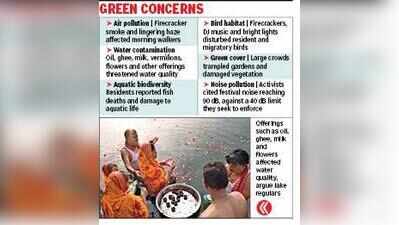
Kolkata: Morning walkers and environmentalists say the ban on Chhath Puja rituals at Rabindra Sarobar has transformed the lake’s air quality and helped protect its biodiversity, warning that allowing celebrations again could undo years of ecological recovery.The toxic haze that once hung over the lake after Chhath Puja, the acrid smell of firecrackers, dead fish floating in the water and birds fleeing the noise are nightmares regular users do not want to revisit. With the possibility of reviving Chhath rituals at the lake being discussed, they have warned that any dilution of National Green Tribunal’s restrictions would undermine their right to clean air and a healthy environment.The controversy erupted after urban development minister Agnimitra Paul indicated on Wednesday that govt was open to allowing Chhath rituals at Rabindra Sarobar with pollution-control safeguards. She later acknowledged the tribunal’s restrictions and said no final decision had been taken.“The difference before and after the ban is striking. Earlier, a thick haze of toxic smoke would hang over the lake after Chhath Puja. We morning walkers had no option but to inhale it. Now the air is significantly cleaner,” said Sumita Banerjee, a regular morning walker. “Any alteration of the NGT order would tantamount to robbing us of our right to breathe clean air.”Lake users said the impact was not confined to air pollution. Immersion of offerings such as oil, ghee, milk and flowers affected water quality, while firecrackers and blaring music disturbed the fragile ecosystem, said environmentalist Somendra Mohan Ghosh.Banerjee recalled dead fish, trampled gardens and birds fleeing “because of the DJ music and explosions”. An earlier environmental impact assessment by West Bengal Pollution Control Board had identified large gatherings, ritual offerings, firecrackers and high-intensity noise during Chhath Puja as threats to the lake’s biodiversity, water quality and vegetation.Pritam Upadhyay said migratory birds had already begun arriving. “Rabindra Sarobar currently hosts many migratory birds, and Kolkata has other sites for water rituals. Please avoid destroying the city’s remaining green spaces,” he said.Ghosh demanded strict enforcement during festivals, including a ban on fireworks within 100 metres of the Sarobar boundary, restrictions on loudspeakers and DJs, pollution monitoring, police deployment and NGT compliance notices at all 12 gates. He said noise levels had earlier reached 90 decibels, far above the 40-decibel limit he cited for the sensitive zone.Debjit Mukherjee, an IT professional who has documented around 140 tree varieties at the lake, including rare trees like parul, said Sarobar had rejuvenated over the past seven years. “When the Chhath celebrations happened, the lake was left scarred and it would take weeks to recover,” he said.He said shrubs were damaged when large crowds entered the lake premises. Bird sightings have since improved, with more Painted storks and Grey herons seen on the islands. Mukherjee also cautioned against over-beautification: “Let around 20% remain wild, while the rest is manicured.”