









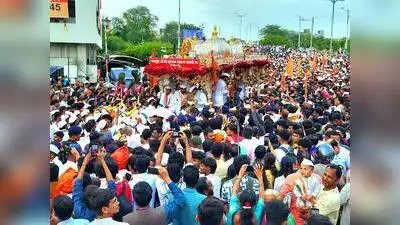
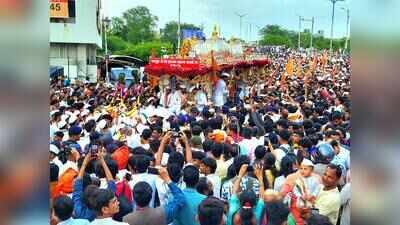
Pune: As a bleak dawn broke over the rain-soaked skies of Pimpri Chinchwad on Thursday, every road, decorated with colourful rangolis, seemed to lead towards Pune city, welcoming the palkhis of Sant Tukaram Maharaj and Sant Dnyaneshwar Maharaj.By Thursday afternoon, the cacophony of vehicular horns, construction drills and machinery had fallen silent on most arterial roads as police enforced extensive traffic restrictions to allow the massive processions to pass. Yet, few appeared to mind the inconvenience as the city’s relentless routine paused to make way for a centuries-old pilgrimage.The atmosphere in the city had transformed completely by evening. The usual bustle on key roads gave way to a sea of devotees dressed in traditional attire. Moving in disciplined dindis, they sang abhang in unison to the rhythmic beats of cymbals, mridang and veena. At the heart of each procession is an ornate palkhi (palanquin) carrying the sacred paduka (wooden sandals) of the saint.First-time spectators Anushka Pandit, Saee Meher and Samruddhi Shinde, a group of college friends, said they were amazed by the sheer scale and discipline of the procession.“I am astonished that they walk so many kilometres carrying heavy loads on their heads, yet none of them looks even remotely tired, regardless of age,” Pandit said.While the wari is undertaken largely by Maharashtra’s farming community, it also attracts participants from diverse professions who believe experiencing the pilgrimage at least once is a must.Nitin Bhosale, an IT professional, said he sets aside two to three weeks of leave each year to participate in the wari, along with several friends from different professions.With heavy rains lashing many parts of the state, Namdev Ganpat Sakat, a senior citizen from Ahilyanagar, said, “We have entrusted sowing activities to our children and relatives so that we could complete the pilgrimage.”While lakhs walk alongside the palkhis, thousands more line the roads for hours, unable to join the pilgrimage but unwilling to miss the experience. Residents distribute water, tea and food packets or stand in silence to witness the centuries-old tradition.“‘I cannot walk with them anymore, so I come here every year to feel like I am still a part of this devotional procession,” said city-based architect Chetana Vishwasrao, who has watched the wari since childhood.The two palkhis will halt for two nights in Bhavani Peth and Nana Peth before resuming their journey to Pandharpur on Saturday.Sanjeevani Pawar (80) and her husband, Vishnu (84), have been witnessing the wari for the past six decades. “Earlier, we used to walk from Alandi to Pune. Now age has made that difficult. The number of devotees and visitors has increased tremendously over the years, but the devotion remains unchanged,” Pawar said.Comfortable stay for devoteesPune Municipal Corporation (PMC) has, under its ‘Seva Wari’ initiative, significantly expanded facilities at the halting sites to ensure a comfortable stay for warkaris.The space available at the Sant Dnyaneshwar Maharaj Palkhi halt has been increased fivefold to about 5,000sqft, with separate arrangements for male and female warkaris. For the first time, a German hangar tent has been erected, while free physiotherapy and massage services are being provided by physiotherapy students.PMC has also installed 195 waterproof tents across the city and opened 101 municipal schools to provide accommodation for warkaris. Medical teams have been stationed at these locations to offer round-the-clock health check-ups, treatment and medicines. Hundreds of mobile toilets have been deployed along the procession route and at halting sites, with dedicated sanitation staff.Foreign students experience wariForeign students joined the palkhi procession from Alandi to Pune to experience one of Maharashtra’s most cherished spiritual traditions.Among them were Samantha Sawhney from Rhode Island, USA and Mary Jackson from Colorado, USA. The two are studying Sanskrit at Deccan College Post Graduate and Research Institute. The two walked alongside warkaris, interacted with devotees, photographed the procession and learnt about the philosophy and traditions of the pilgrimage.“It is an incredible experience. I had read about the wari, but being here and witnessing thousands of people walking together with such devotion is completely different. The sense of community and shared faith is inspiring,” Sawhney said.Jackson said the Wari offered a unique glimpse into Maharashtra’s spiritual and cultural heritage. “Everything is new and exciting for us. People welcomed us warmly and explained the meaning behind the traditions, songs and rituals. It has helped us understand the culture beyond what we learn in books,” she said.Several other foreign visitors were also seen interacting with devotees, joining in the chanting and documenting the colourful procession.Metro frequency increasedMaha Metro operated trains every six minutes on Thursday to facilitate the movement of thousands of devotees. With several roads closed for the procession, Metro authorities increased train frequency to reduce inconvenience to commuters. Additional staff was deployed at major stations to assist passengers, particularly first-time Metro users.Traffic curbs trigger protest in AlandiHigh drama unfolded in Alandi on Thursday morning when a woman driving a driving school car lay down on the road to protest against police after being stopped from using a route reserved for the palkhi procession.Despite repeated requests by police personnel to move, she eventually returned to her car, rammed a barricade and drove away. A video of the incident quickly went viral on social media.The Alandi police said the incident occurred at PCS Chowk, where traffic restrictions had been imposed for the procession. The woman insisted on taking the restricted route despite repeated warnings.In the viral video, the woman is heard saying: “My work is as important as yours. I have taken people’s money, and I need to go.”A police officer said legal action would be initiated against her. “Our investigation is underway,” the officer said.London to Pandharpur pilgrimageA group of IT professionals from Pune welcomed participants of the Global Wari, an initiative launched by devotees in the UK to take the centuries-old Pandharpur pilgrimage beyond India’s borders.The IT Dindi, a collective of professionals from the IT sector and other fields that participates in the annual wari, felicitated the Global Wari participants in Pune.This year, the London to Pandharpur pilgrimage began in England, travelled through several European countries and reached Pune before continuing to Pandharpur.“We started Global Wari so that people in Europe can experience the warkari tradition. The number of participants is small this year, but we hope it will grow steadily in the coming years,” said Anil Khedkar, who leads the initiative.(With inputs from Swati Shinde Gole, Sarang Dastane, Mihir Tanksale and Prasad Kulkarni)