







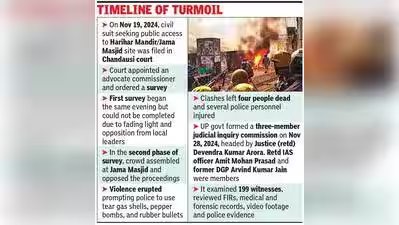
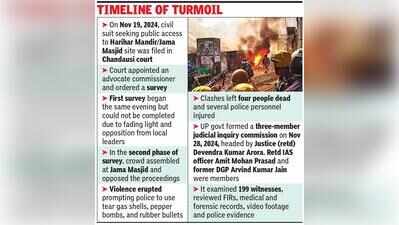
Lucknow: A substantial portion of the report, tabled by the judicial commission constituted by the Uttar Pradesh govt to probe Sambhal violence in 2024, focuses on Sambhal’s history and the disputed mosque site.The commission noted that Sambhal has long been regarded as a religiously significant town and is associated in Hindu tradition with Kalki, the future incarnation of Lord Vishnu.The report cites historical records and gazetteers describing the existence of the Harihar Mandir at the site where the Shahi Jama Masjid now stands.Referring to historical records, the commission said that the mosque is believed to have been constructed in 1526 during Babur’s reign and is a centrally protected monument under the Archaeological Survey of India (ASI).The structure has enjoyed protected status since 1920 under heritage conservation laws.The report said that ASI officials faced resistance during an inspection conducted in June 2024 and alleged that certain structural modifications had been made to the monument over time.The commission clarified that the question of whether the mosque was constructed over the ruins of a temple remains the subject matter of the pending civil suit and that no findings were recorded on that issue.The commission traced multiple episodes of communal violence in Sambhal from the 1930s onwards, including riots in 1947, 1948, 1958, 1962, 1976, 1978, 1980, 1986, 1990, 1992, 1995 and during the anti-CAA protests in 2019.According to the report, Sambhal has repeatedly witnessed Hindu-Muslim clashes and periodic communal unrest, making it one of the most sensitive towns in UP from a law-and-order perspective.The report referred to long-standing rivalries among influential Muslim groups and political factions in the district, which it said contributed to local tensions.Conducting one of the most extensive inquiries, the commission visited Sambhal shortly after the violence, inspected Jama Masjid and surrounding areas and held multiple rounds of hearings in Lucknow, Sambhal and through video conferencing.In all, 199 witnesses were examined, including 29 police personnel, 12 administrative officials, 19 medical professionals, 34 civilian witnesses, 78 detainees linked to the violence, media personnel, members of the Jama Masjid management committee, complainants, forensic experts and political figures.The commission reviewed FIRs, medical reports, postmortem records, forensic reports, ballistic evidence, CCTV footage, media recordings, drone footage and affidavits submitted by witnesses.According to the report, the controversy began on Nov 19, 2024, when Hari Shankar Jain and seven others filed original suit before the Civil Judge (Senior Division), Chandausi.The same day, the court allowed an application seeking appointment of an advocate commissioner to conduct a survey of the disputed site and directed that photography and videography be undertaken during the exercise.Advocate Ramesh Chandra Raghav was appointed survey commissioner and approached the Sambhal district administration for security arrangements.The first phase of the survey began on Nov 19 but could not be completed that day because of fading daylight and growing opposition from local political figures and supporters.The report said that when the remaining survey was conducted on Nov 24, thousands gathered around the mosque to oppose the exercise.Police and administrative officers repeatedly informed the crowd that the survey was being conducted under court orders, but tensions escalated. Stone pelting, arson and firing broke out, leading to clashes with security personnel.Police responded with tear gas shells, chilli grenades, rubber bullets, pump-action guns and other crowd-control measures.The violence left four people dead and several police personnel injured.The state govt constituted a judicial commission comprising Justice (retd) Devendra Kumar Arora as chairman, retired IAS officer Amit Mohan Prasad and retired DGP Arvind Kumar Jain as members.