








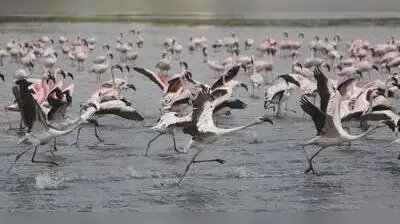
Navi Mumbai: Polluted creek water entering DPS Flamingo Lake during high tide emerged as another major threat to one of Navi Mumbai’s key wetlands, part of the Ramsar-listed Thane Creek Flamingo Sanctuary ecosystem, recent studies showed. The latest water sample from the tidal inflow channel revealed high levels of contamination, raising concerns over the sharp decline in flamingo sightings at the wetland this season.Laboratory analysis of the inflow water recorded Total Dissolved Solids at 19,600 mg/l, more than nine times the permissible limit of 2,100 mg/l under IS 2490:1974 inland surface water standards. The sample did not conform to prescribed water quality norms. The test was commissioned by Navi Mumbai Environment Preservation Society and NatConnect Foundation.The findings at DPS Flamingo Lake reflected a wider global concern. The UNEP-DHI Centre for Water and Environment, in its report Wetlands: The Unsung Heroes of the Planet, warned that wetland loss accelerated since 2000, with pollution, habitat degradation and unsustainable human activity driving rapid declines in wetland-dependent species.Flamingos were particularly vulnerable because they depended on a narrow range of water chemistry and salinity conditions that sustained the algae, diatoms and microscopic invertebrates forming their food base. The findings reinforced concerns raised by earlier tests commissioned by NatConnect.A sample collected from the lake in March recorded TDS at 21,720 mg/l, while a drain discharging into the wetland showed TDS levels of 7,950 mg/l in April. The April sample also recorded Biochemical Oxygen Demand of 36.4 mg/l, exceeding the permissible limit. All three samples failed to meet inland water quality standards.NatConnect director B N Kumar said the toxic mix of polluted tidal inflows and extensive blue-green algal mats appeared to have pushed DPS Flamingo Lake towards an ecological tipping point. “Flamingos can tolerate natural salinity, but they cannot thrive in waters carrying a cocktail of sewage, urban runoff and other contaminants. The deteriorating water quality is steadily eroding the lake’s ecological balance and shrinking its food base,” said Sandeep Sareen of NMEPS.“The continuing pollution underscores the urgent need to expedite the final Govt Resolution granting Conservation Reserve status to DPS Flamingo Lake and ensure stronger legal protection,” said greens. The National Wildlife Federation noted that flamingo habitats worldwide continued to face mounting pressure from development and pollution.Scientific studies, including research published in Nature Geoscience, highlighted the long-term risks of altering estuarine hydrology, showing that human interventions in tidal systems could trigger feedback loops that intensified ecological stress by affecting water quality, sediment dynamics and biodiversity.For Navi Mumbai, the diminishing presence of flamingos at DPS Lake was more than the loss of a seasonal attraction. It was an early warning that one of the region’s most fragile wetlands was under growing stress, environmentalists said.