







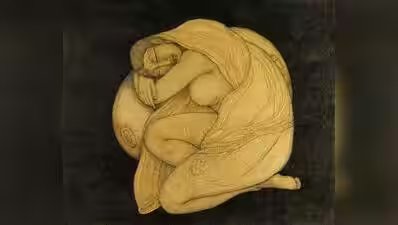
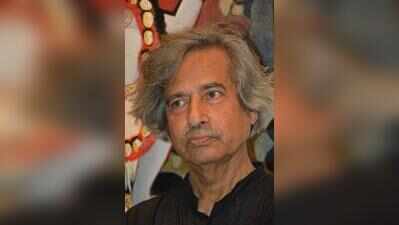
Kolkata: Painter Jogen Chowdhury, hailed as a master of line both on canvas and on paper and celebrated for his portrayal of human frailty, died at a city hospital on Sunday, leaving behind an unmatched legacy in contemporary Indian art.Beyond his distinctive visual language and pioneering aesthetics, the 87-year-old creator of ‘Day Dreaming’, ‘Tiger In The Moonlit Night’, ‘Reminiscences of a Dream’, ‘Moonstruck’, ‘The Wound’, ‘Mona Lisa in my Dream’, ‘Her Silver Throne’ and ‘The Blue Sari’ will also be remembered for mentoring and supporting emerging artists.Chowdhury, who was professor emeritus at Kala Bhavana in Visva-Bharati, passed away after battling a rare type of blood cancer for 14 months. Paying his respects to the artist, CM Suvendu Adhikari described Chowdhury as a “maestro whose distinctive strokes redefined Indian modern art” and “a towering pillar of our cultural world” whose contributions brought global recognition to Bengal.Chowdhury’s canvases were characterised by his mastery of the continuous, fluid line — unbroken strokes that defined the psychological character of his subjects and reshaped the human form. His linear precision served the primacy of the silent human figure, which remained the central focus and was often set against white backgrounds devoid of specific environments so the body could communicate in silence.“There was tremendous power in his sharp lines that sometimes even seem to penetrate the surface of the canvas. The lines embody a linearly defined space and that space is often attacked and assaulted by a scar or a thrust. In the process, the precarity of the space is underscored,” said Samik Bandyopadhyay, teacher, publisher, writer, translator and art commentator.Through an expressionist style, creative X-ray vision, and signature distortion, his subjects emerged as caricatures with imaginary faces that conveyed authentic psychological traits through a tension between the known and the unknown. These technical choices articulated deep expressions of isolation, functioning as a potent social commentary that blended reality with imagination to reflect collective human consciousness while rejecting monolithic notions of Indianness and rigid traditions.Partition left an impact on his life. “It deeply influenced his perception of interpersonal relations, love, cruelty and hatred, forming the root of his lifelong exploration of the grotesque as an extension of the inner world,” said art scholar Pranab Ranjan Ray.Born in Bangladesh’s Faridpur in 1939, Chowdhury graduated from Government College of Art & Craft in 1960. In 1965, backed by a scholarship and with a crowd-funded ship ticket to Paris priced Rs 800, Chowdhury arrived at École nationale supérieure des beaux-arts. “During his time there, he crossed paths with Jimi Hendrix and sketched his portrait, delighting the legendary musician so much that Hendrix signed and penned a compliment on it,” said artist Hiran Mitra.Following his return from France, Chowdhury joined Handloom Board in Chennai before serving as Keeper of Art at Rashtrapati Bhavan from 1972 to 1987.“It was during this time that an interrupted presidential portrait session — halted by a forgotten pair of dentures — sparked a profound realisation about human fragility without bone and teeth. This became his central thought for a series he did on politicians,” Mitra said. Decades later, when he returned to the corridors of power as a Trinamool Congress Rajya Sabha MP, his sketchbook was never far: he drew portraits of personalities such as Manmohan Singh, Sitaram Yechury and Smriti Irani, among others.He also remained dedicated to nurturing others — supporting students at Santiniketan by buying their work and ultimately establishing Jogen Chowdhury Centre for Arts in Kolkata in 2019. “He promoted many at Gallery Charubasona (part of Jogen Chowdhury Centre) in Lake Gardens and even helped some newcomers financially, too,” Mitra said.Culturist Sundeep Bhutoria remembers Chowdhury as the man with a small camera in his pocket, “forever capturing candid moments of fellow artistes”. Bangladesh revered him as a living bridge of undivided Bengal, he said.Not many know that Chowdhury possessed a gift for poetry and prose. “Nobody has ever tried to link his poetry to his works. I think it is worth exploring,” Bandyopadhyay said. In 1998, he wrote “Bhalobashar Katha” — a four-line poem reflecting on how matters of the heart, though timeless and ancient, remain eternally fresh and impossible to live without.