









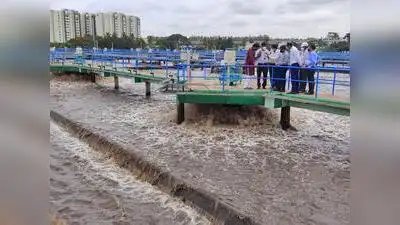

Bengaluru: After missing earlier deadlines by several miles, Karnataka govt has now set Dec 2029 as the final date to keep Bengaluru fully prepared to treat every drop of sewage it generates.While achieving 100% sewage treatment remains a tough challenge, only about 50% of Bengaluru’s 2,580 million litres of sewage generated daily is treated as of now. The task is now to build capacity expansion to double the treatment rate in the next three-plus years.Bangalore Water Supply and Sewerage Board has drawn up a phased plan to commission new sewage treatment plants and upgrade existing facilities in the coming years.The earlier targets were 2020, 2023 and 2025. The latest roadmap comes amid concerns over polluted water flowing into Cauvery river.After reviewing the latest compliance report submitted by BWSSB during a meeting at Karnataka State Pollution Control Board, forest, environment and ecology minister Ramalinga Reddy said all planned STPs would be built and commissioned by Dec 2029.The minister directed KSPCB to inspect all private STPs across Bengaluru operated by commercial establishments such as tech parks, hospitality establishments and educational institutions, as well as commercial and residential complexes, and ensure that they meet prescribed national standards.“I’ve directed KSPCB to launch a centralised dashboard on the functioning of STPs and reveal, in real time, the quality of water they treat, rather than visiting every STP personally and checking samples manually,” Reddy said.Besides, the minister instructed BWSSB to identify households and properties that divert sewage into stormwater drains despite the availability of sewerage. Such properties, officials said, may be avoiding BWSSB connections citing pro-rata charges and deposits.

STP
BWSSB asked to fix lapses in 30 daysBengaluru’s sewage-treatment system appears to have serious compliance gaps, with several of BWSSB-operated STPs failing to meet the standards prescribed by National Green Tribunal and KSPCB. The state govt has now given the erring plants 30 days to comply. Among the parameters found wanting are crucial indicators of wastewater quality. The failure to meet these prescribed norms raises questions over the effectiveness of treatment at these facilities and the quality of water ultimately released from the plants.