








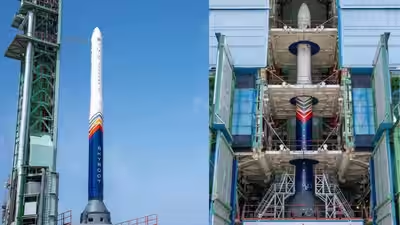
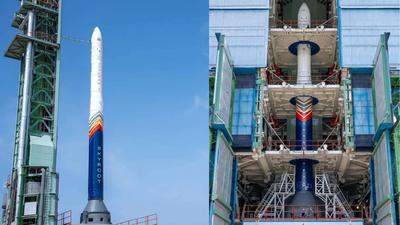
HYDERABAD: Skyroot’s landmark launch has given India’s private space ambitions their biggest boost yet. But can one successful mission transform Hyderabad into the country’s spacetech capital, or is the harder journey only just beginning?When Skyroot Aerospace’s Vikram-1 pierced the skies above Sriharikota on July 18, it did far more than place four satellite payloads into a 450-km low-Earth orbit. For the first time, a privately developed Indian orbital rocket successfully reached orbit, placing India among a small group of countries, including the United States and China, where private companies have independently designed, built and launched orbital rockets.For Hyderabad, however, the significance stretched well beyond a historic countdown. The city’s largest spacetech startup had delivered India’s most consequential private space milestone, prompting a larger question: is Vikram-1 merely a breakthrough for one company, or has it accelerated Hyderabad’s emergence as the country’s private space capital?The answer lies not just in a rocket that flew successfully, but in the ecosystem that made it possible.
More than a launch, a signal
The symbolism surrounding Mission Aagaman was impossible to miss. Vikram-1 lifted off exactly 46 years after ISRO’s SLV-3 placed the Rohini satellite into orbit, marking India’s arrival as a spacefaring nation in 1980. This time, history repeated itself under very different circumstances.Instead of a government laboratory, the mission was led by a startup founded only eight years ago by former ISRO scientists Pawan Kumar Chandana and Naga Bharath Daka. Built around an all-carbon composite airframe, equipped with in-house propulsion systems and 3D-printed engines, Vikram-1 demonstrated that Indian private industry had matured from building components to developing complete launch vehicles.Its success also reflected the changing structure of India’s space programme. Until a few years ago, orbital launches remained the exclusive domain of ISRO. Today, private companies are beginning to share that responsibility, targeting the rapidly expanding market for small satellite launches.As Skyroot CEO Chandana put it after the mission, the launch proved that India possesses “the talent, the technology and the industrial strength to build launch vehicles that meet the world’s standards and serve the world from here.”The achievement was not merely technical. It validated years of policy reforms aimed at opening India’s space sector to private participation, while giving investors, customers and policymakers confidence that Indian startups can compete in one of the world’s most technologically demanding industries.
Why Hyderabad?
It is tempting to view Skyroot’s success as the achievement of one ambitious startup. But Vikram-1 is also a story about geography.Unlike India’s traditional space establishment, centred largely around Bengaluru and ISRO’s network of research centres, much of the country’s emerging private launch ecosystem has taken shape in Hyderabad. The city’s credentials extend well beyond one company. It hosts Skyroot Aerospace, satellite manufacturer Dhruva Space, Pixxel’s growing presence, specialised component manufacturers, defence and aerospace suppliers, research institutions and one of India’s most active startup ecosystems.
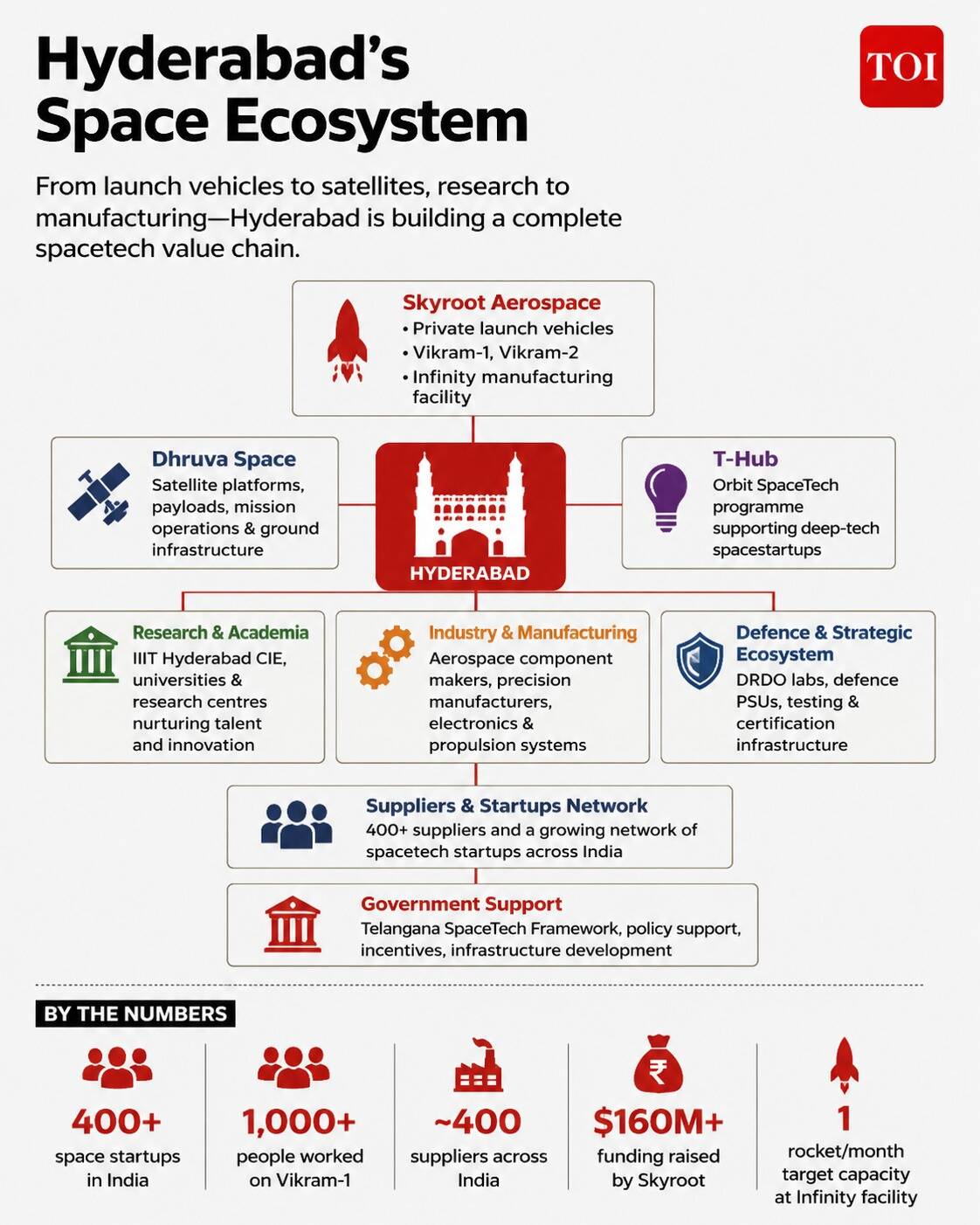
Hyderabad’s space ecosystem
According to the IIIT Hyderabad Centre for Innovation and Entrepreneurship’s SpaceTech Ecosystem Report, Hyderabad has steadily evolved into one of India’s leading spacetech clusters, driven by a combination of research institutions, manufacturing capability, venture capital, startup incubation and government support. Rather than relying on a single anchor institution, the city has developed an interconnected network linking startups, academia, investors and industry.The report identifies Hyderabad as one of the country’s fastest-growing hubs for downstream and upstream space technologies, with strengths ranging from launch vehicles and satellites to propulsion systems, electronics, data analytics and earth observation applications.This ecosystem is significantly different from the government-driven model that defined India’s space sector for decades.
Skyroot’s rise mirrors Hyderabad’s ambitions
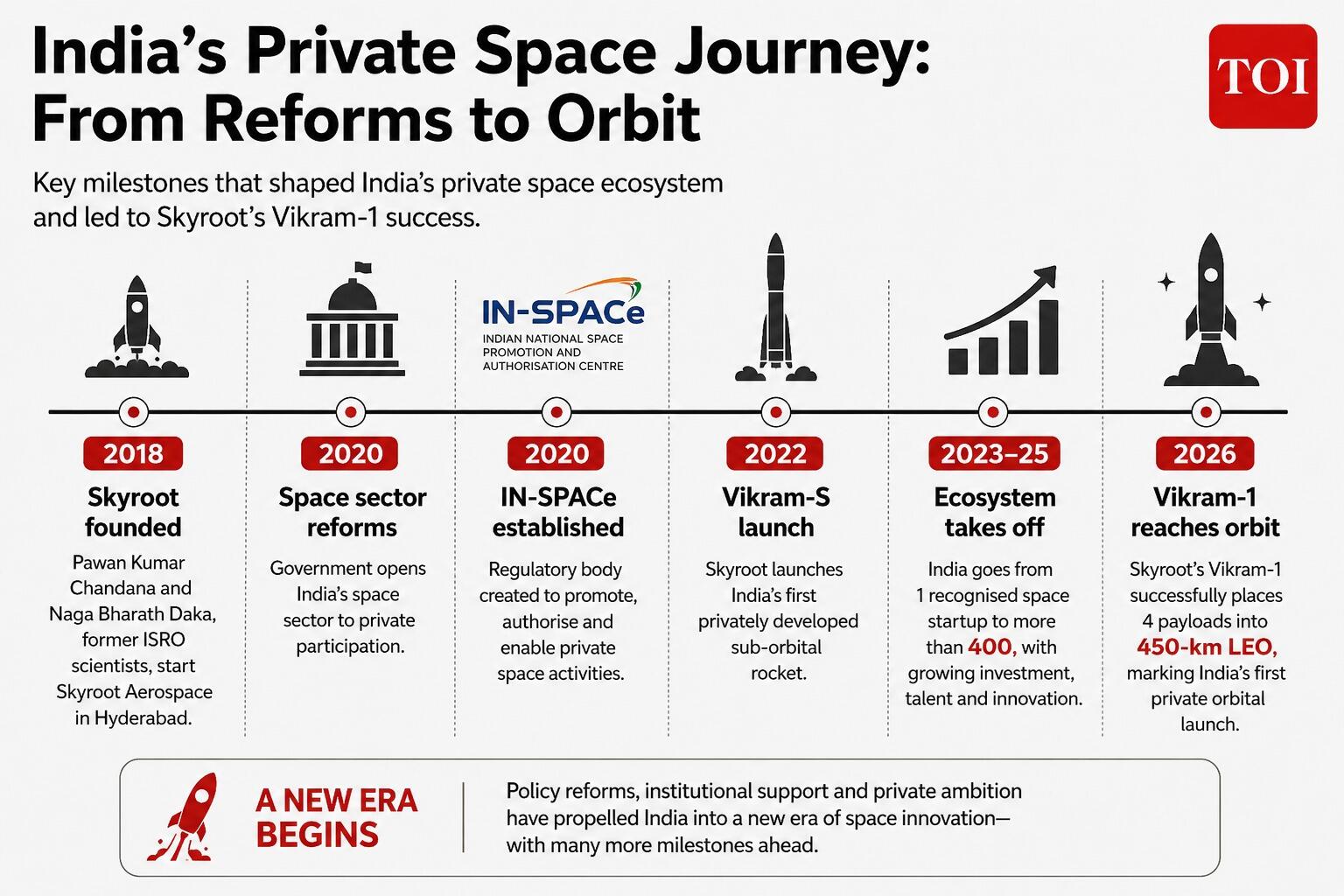
Founded in 2018, Skyroot Aerospace emerged at a time when India’s private space ecosystem was still finding its footing.Its founders had spent years at ISRO before deciding that India’s future space ambitions required private launch capability alongside government missions. Their first milestone came in 2022 with Vikram-S, India’s first privately built sub-orbital rocket. Vikram-1 represents a far bigger leap: from reaching space briefly to successfully entering orbit.That journey has been accompanied by rapid institutional growth. The company has attracted more than $160 million in funding from investors including GIC, Temasek, BlackRock and Sherpalo Ventures, while becoming India’s first spacetech unicorn. Its newly established Infinity manufacturing facility near Hyderabad airport is expected to eventually support a production cadence of one rocket every month.According to Skyroot Aerospace, the company is also developing the heavier-lift Vikram-II launch vehicle, capable of carrying up to 900 kg to low-Earth orbit (600 kg to Sun-Synchronous Orbit), alongside reusable launch technologies designed to reduce launch costs while scaling manufacturing at its Infinity campus. Together, these reflect its ambition to move from demonstration missions to regular commercial launches.Equally important is what Skyroot has created beyond its own factory floor. The company’s maiden orbital mission involved more than 1,000 employees and nearly 400 suppliers across India, illustrating how private launch vehicles require extensive domestic supply chains spanning precision manufacturing, electronics, materials, software and testing.For Hyderabad, that supplier network could prove as important as the rocket itself.
Dhruva Space gives the ecosystem another pillar
If Skyroot represents Hyderabad’s launch ambitions, Dhruva Space reflects the city’s growing strength in satellite manufacturing.According to Dhruva Space, the Hyderabad-headquartered company has evolved into an end-to-end space engineering firm, offering satellite platforms, payload integration, launch support, mission operations and ground-station infrastructure, illustrating how the city’s spacetech ecosystem now extends well beyond launch vehicles.Unlike launch companies that operate mission by mission, satellite manufacturers participate across the broader lifecycle of space programmes, from design and integration to operations.Dhruva’s growing manufacturing capabilities, multiple customer missions and continued expansion suggest Hyderabad’s spacetech ambitions are not dependent on a single success story.That distinction matters. Globally successful space clusters rarely emerge around one flagship company alone. Silicon Valley is not defined only by Apple, nor Seattle only by Boeing. Sustainable ecosystems are built when specialised companies operate across complementary segments of the value chain. Hyderabad increasingly appears to be moving in that direction.
Policy, capital and research converge
Industry observers often argue that successful innovation clusters require three ingredients: talent, capital and policy support. Hyderabad appears to be assembling all three.The Telangana government’s SpaceTech Framework positions the sector as a strategic growth area, focusing on infrastructure creation, startup support, industry partnerships, research collaboration and skill development. The framework aims to build an ecosystem capable of supporting companies across manufacturing, launch services, satellite technologies and downstream applications.Chief Minister A Revanth Reddy has repeatedly described aerospace as one of Telangana’s priority sectors, arguing that companies like Skyroot demonstrate the state’s growing capabilities in advanced manufacturing and deep technology. The government has also linked aerospace expansion with broader ambitions of positioning Telangana as a global innovation hub by 2047.Research institutions are playing an equally significant role. The IIIT Hyderabad report notes that universities and research centres have become increasingly important in nurturing spacetech entrepreneurship by producing skilled engineers, supporting applied research and connecting startups with investors and industry partners. Instead of operating in isolation, startups benefit from access to a wider innovation ecosystem that encourages experimentation and commercialisation.That ecosystem is further strengthened by Hyderabad’s existing strengths in information technology, defence manufacturing, electronics and precision engineering, industries that naturally complement spacetech development.
Building beyond rockets
If Skyroot has become the face of Hyderabad’s spacetech ambitions, the city is equally betting on the ecosystem that nurtures companies long before they reach the launch pad.Among the most prominent enablers is T-Hub, which has increasingly focused on deep-tech ventures, including spacetech. Through its Orbit SpaceTech programme, launched in collaboration with industry and ecosystem partners, T-Hub aims to help startups working across satellite technologies, downstream applications, manufacturing and space-enabled services move from prototype to commercialisation. While only a handful of startups may eventually build launch vehicles, the broader value chain, from components and electronics to software, analytics and earth observation, offers far greater opportunities for new companies.That approach aligns with Hyderabad’s larger strategy of creating an integrated ecosystem rather than relying solely on a few flagship startups.
Reforms that changed the landscape
Even the strongest startup ecosystem would have struggled without a policy shift at the national level.The opening of India’s space sector in 2020 fundamentally altered the industry’s trajectory. The creation of the Indian National Space Promotion and Authorisation Centre (IN-SPACe) provided private companies with a regulatory framework to access ISRO facilities, seek launch authorisations and participate in activities that were previously reserved almost entirely for the national space agency.
From reforms to orbit
Skyroot’s own founders have acknowledged that ISRO and IN-SPACe played an important role in supporting Mission Aagaman through technical guidance and timely clearances.Following Vikram-1’s successful mission, ISRO Chairman V Narayanan described the launch as “the outcome of years of innovation, perseverance and engineering excellence” and said it reflected “the growing maturity of India’s private space sector.” He added that ISRO and IN-SPACe remained committed to building a globally competitive ecosystem alongside private industry.IN-SPACe Chairman Pawan Goenka echoed that sentiment, calling the launch “an India moment” and noting that more than 1,000 people and nearly 400 suppliers contributed to the mission. The achievement, he said, demonstrated the industrial capability India had developed over the past few years.The pace of growth has been remarkable. According to government data cited by PIB and IN-SPACe, India has gone from having just one recognised space startup at the beginning of the reforms to more than 400 today. While these companies are spread across the country, Hyderabad has emerged as one of the largest beneficiaries of the liberalised policy environment.
Can Hyderabad overtake Bengaluru?
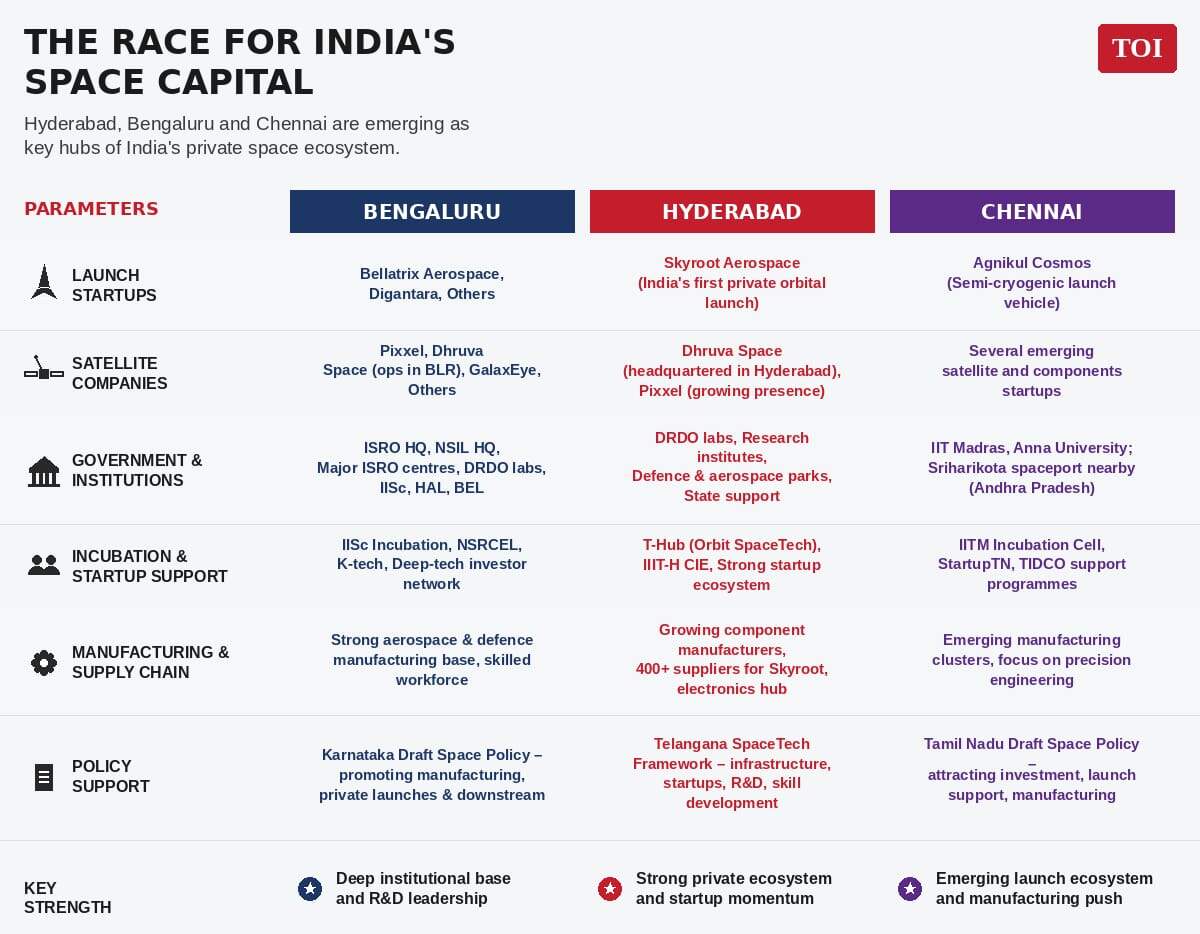
Yet calling Hyderabad India’s space capital today would be premature.Bengaluru remains the country’s undisputed institutional centre for space activity. It houses ISRO headquarters, several major ISRO centres, the headquarters of NewSpace India Limited (NSIL), numerous defence laboratories, public-sector aerospace companies and decades of accumulated engineering expertise. Much of India’s satellite development, mission planning and advanced research continues to be anchored there.Karnataka’s draft Space Policy also seeks to strengthen Bengaluru’s long-standing aerospace ecosystem by encouraging commercial manufacturing, private launch capability and downstream space services, underscoring the growing competition among states to attract spacetech investments.The city also benefits from an established aerospace manufacturing base, a mature venture capital ecosystem and one of the country’s deepest pools of engineering talent.Chennai, meanwhile, has begun carving out its own niche through companies such as Agnikul Cosmos, which successfully tested its semi-cryogenic Agnibaan launch vehicle.
Race for India’s space capital
Tamil Nadu’s draft Space Policy further signals the state’s intention to attract manufacturing, launch support services and private investment.Against these competitors, Hyderabad’s strengths are different. Rather than inheriting a legacy government ecosystem, the city has built momentum around private enterprise. Skyroot, Dhruva Space and several emerging startups represent a younger ecosystem that is being shaped alongside policy reforms rather than decades before them.The IIIT Hyderabad report notes that this concentration of startups, investors, incubators and academic institutions gives the city a distinct advantage in commercial innovation. At the same time, it cautions that sustaining growth will depend on strengthening manufacturing capacity, talent pipelines, financing and collaboration across institutions.
The challenges ahead
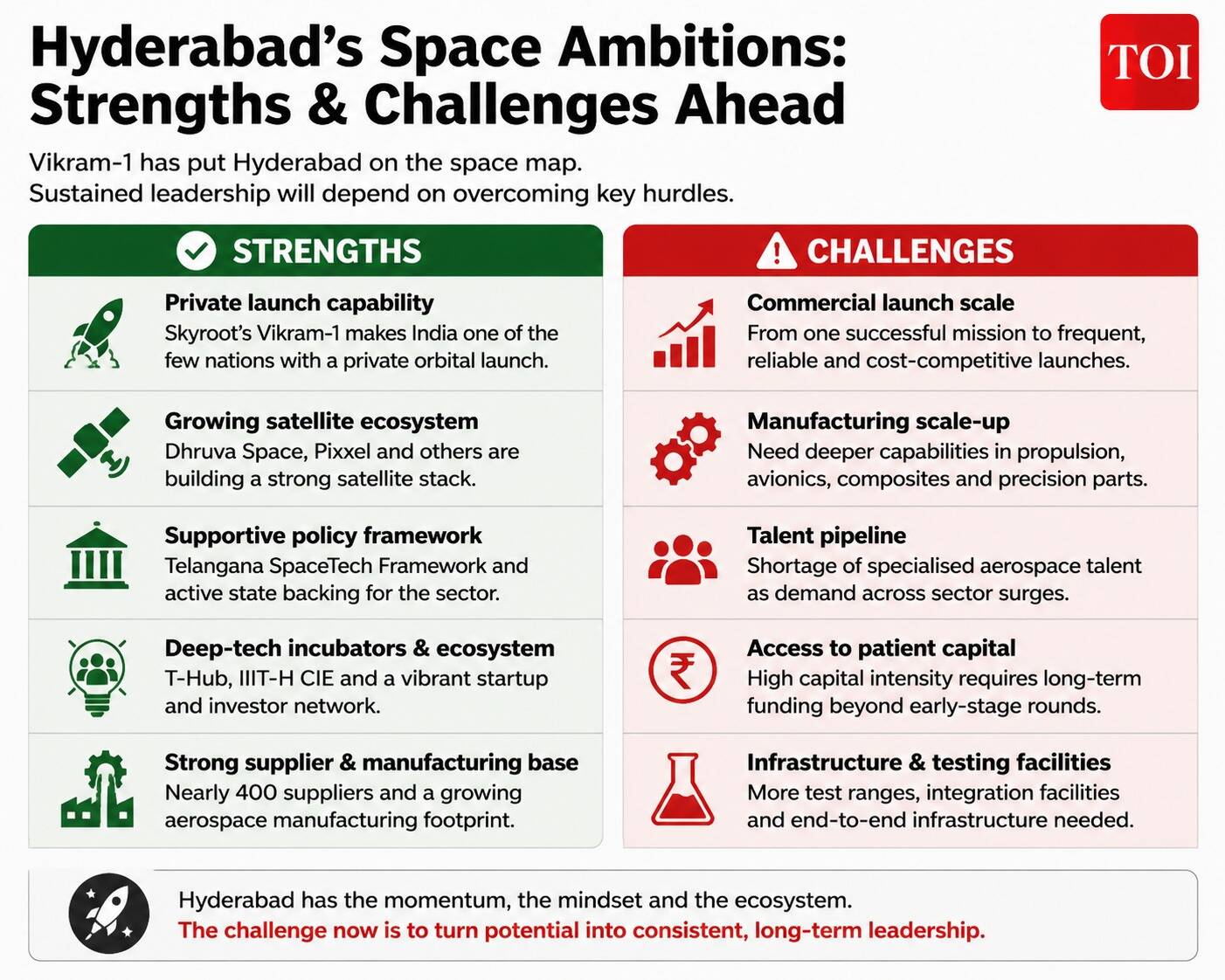
For all the optimism generated by Vikram-1, Hyderabad’s ambitions still face significant hurdles.The first is scale, a single successful launch, however historic, does not establish a commercially proven launch provider. As Skyroot itself has acknowledged, Vikram-1 remains a technology validation mission. Commercial confidence will depend on repeated successful launches over the coming years.
Strengths and challenges
Manufacturing presents another challenge. While Hyderabad has developed strengths in aerospace, defence and electronics, building a globally competitive launch ecosystem requires specialised suppliers capable of producing propulsion systems, avionics, composite materials and precision components at scale. Expanding that industrial base will take sustained investment beyond a few high-profile startups.Funding is another critical factor. Space technology remains among the most capital-intensive industries in the world. Developing rockets, satellites and associated infrastructure demands long investment cycles with uncertain returns. Although Skyroot has attracted significant global funding and achieved unicorn status, maintaining investor confidence across the wider ecosystem will depend on commercial success rather than technological milestones alone.Talent, too, will become increasingly important. As more companies enter the sector, competition for experienced aerospace engineers, propulsion specialists, software developers and systems engineers is likely to intensify. Hyderabad’s universities and research institutions will have to expand their role in producing specialised talent if the ecosystem is to sustain long-term growth.Infrastructure will also determine whether momentum translates into leadership. Testing facilities, manufacturing clusters, supply-chain resilience, regulatory support and stronger industry-academia partnerships will all be necessary if Hyderabad hopes to compete with established global space clusters.
A launch that changed the conversation
Perhaps Vikram-1’s greatest contribution lies not in the payloads it carried into orbit but in the questions it has forced the industry to ask.Until recently, India’s private space story centred largely on aspirations. Companies spoke about building rockets, attracting investment and competing globally. Vikram-1 transformed those ambitions into demonstrated capability.For Hyderabad, that distinction matters.The city is no longer simply home to promising spacetech startups; it is home to India’s first private company to place an orbital rocket into space, a growing satellite manufacturer in Dhruva Space, a supportive policy framework, active startup incubators, globally recognised research institutions and an increasingly sophisticated network of suppliers and investors.Whether that combination ultimately earns Hyderabad the title of India’s space capital remains uncertain.Bengaluru still possesses unmatched institutional depth, while Chennai is steadily strengthening its own launch ecosystem. Leadership in the space economy will not be determined by a single mission or a single company, but by the ability to continuously innovate, manufacture, attract talent and serve a rapidly expanding global market.Vikram-1 has undoubtedly given Hyderabad unprecedented momentum. But the city’s claim to becoming India’s space capital will ultimately rest not on one historic launch, but on whether it can build an enduring ecosystem where many more such missions become routine rather than remarkable.