










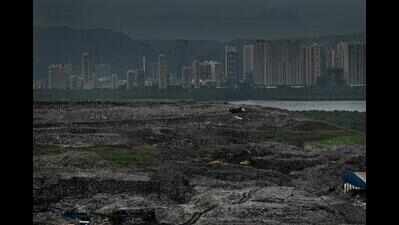
Mumbai: The Bombay high court on Wednesday noted that odour levels have reduced in the vicinity of the Kanjurmarg landfill treatment facility, but sought strict compliance from the BMC and the operator of the municipal waste processing centre for violations flagged by the Maharashtra Pollution Control Board (MPCB).A division bench of Justices Girish Kulkarni and Aarati Sathe observed that steps seem to have been taken to mitigate concerns raised by local residents, but directed senior counsel Anil Sakhare, for BMC, and Saket Mone, counsel for the operator, to submit by July 15 compliance report so that Kannamwar Nagar residents’ complaints are taken care of.Mone said complaints regarding odour via email and dedicated phone lines dropped from 700 a month to 218 recently. Abhijit Rane, for the petitioner, cited an international standards requirement to show MPCB had set no upper limit on certain pollutants as yet. The HC said it would ask for monitoring of hydrogen sulphide and PM 2.5 and PM 10 as well.The HC also asked MPCB counsel Jaya Bagwe what was the reason for the odour, while orally observing that the board has stepped up its act and initiated action by issuing show-cause notices.Mone said MPCB issued 15 show-cause notices rapidly, while not waiting for compliance replies or verification. Bagwe interjected to say MPCB issued interim directives earlier this month again since compliance was still lacking. Sakhre and Mone pointed out that this World Environment Day they planted 5,000 saplings, and 10,000 more will be planted in future. “What is important is that they survive. How many will?” the bench asked. Rane, citing a TOI report, said on an average 15% do barring in one area. Justice Kulkarni, who along with Justice Sathe had earlier visited the site, said it contains salinity and asked if experts were roped in since tree species like Gulmohar, Ashoka, and Chapha were on the list, which look good at the first blush. Jyoti Chavan, additional government pleader for state, suggested another visit where the judges can “enjoy the chapha”.Sakhre said horticulturists are consulted and Mone assured the HC that all care would be taken to ensure trees do survive.MPCB, in a detailed affidavit, said it has carried out audits and Ambient Air Quality Monitoring pertaining to ammonia and hydrogen sulphide and the review results between Dec 2025 to May 2026 and issued 20-odd directions for compliance from BMC including filtration system for the site. Sakhre, citing the BMC affidavit, said measures were taken.S K Chari, who heads the operator company Antony Lara, in his affidavit, said MPCB had in 2015 decided to give its nod for the processing centre, but is now again demanding a consent letter. Bagwe said it was a requirement under 2026 rules and Mone submitted he would show it was not.The HC allowed the petitioner’s counsel to file a rejoinder to BMC and MPCB, and said it was a public interest litigation not treated adversarial by any side.BMC, in its affidavit, said the “data collected from the third-party monitoring activity, the officers of the Corporation as well as the Air Quality Monitoring van” were placed before the experts, Dr Bhave (Professor, VJTI) and Dr Garg (Professor, IIT Bombay). The experts have submitted a report, dated 25/05/2026, which records that the monitored observations are not exceeding the National Ambient Air Quality Standards and ambient Air Quality Monitoring standards for Solid Waste Management Rules, 2026 but have given recommendations to improve the monitoring activity for which NEERI will carry out the day to day air monitoring during the night hours for 24 months including sensor based monitoring for hydrogen sulfide (H2S), Ammonia (NH3), Formaldehyde, Total Volatile Organic Compounds and mercaptans.