






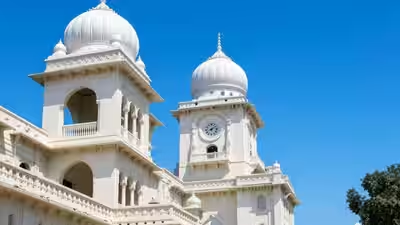
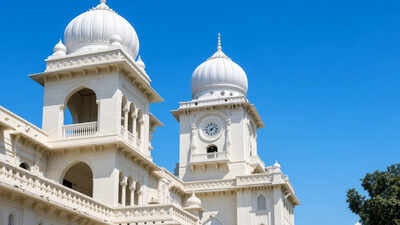
NEW DELHI: Last week, Lucknow University invited eligible students for its Urdu course and said they could walk in for enrolment.Desperate times had called for desperate measures.Of its roughly 120-130 postgraduate seats, only 45 had been filled this year. At undergraduate level, just 25-30 of 80 seats had found takers.The vacancies are longstanding.Around 70% of PG seats were empty in 2024-25; 60% in 2025-26 and nearly two-thirds this year. UG admissions have been abysmal too.The numbers sit uneasily with Lucknow’s literary inheritance.The university began teaching Urdu in 1936—its alumni include former presidents Zakir Husain and Shankar Dayal Sharma, Urdu novelist Qurratulain Hyder, and writer-critic Anis Ashfaq.There was a time, recalls Dr Abbas Raza Nayyar, professor and head of the department, when Urdu was so popular that the department “expanded from a single room to a building with 20-22 rooms.”Today, the student pool is spread across Khwaja Moinuddin Chishti Language University, Maulana Azad National Urdu University’s Lucknow campus and Shia PG College.MANUU offers scholarships, while Shia PG waives fees for Urdu, Arabic and Persian students, whose degrees remain affiliated to Lucknow University.For poorer Urdu-medium and madrasa students, uncertain jobs make professional courses such as MBA more attractive, Nayyar said, pointing to unfilled govt posts, translators doing other work, declining Urdu newspapers.He said the problem begins before university. For decades, Urdu-medium schools, madrasas and school-level Urdu study fed students into higher education. “That base has steadily weakened in UP, leaving fewer students familiar enough with Urdu to pursue BA or MA courses.”Urdu is UP’s second official language, while NEP 2020 allows greater choice of Indian languages and credit courses.Yet Nayyar says the UP Board largely keeps Urdu at an intermediate level within the Arts stream, leaving Science and Commerce students little opportunity to study it alongside main subjects.“If a Physics student reads Urdu,” he says, “the flavour of the classroom changes.”Urdu teacher Jawed Akhtar Ali, at Delhi’s Hamdard Public School for over a decade, has watched the link between home and classroom disappear. “Earlier, people used to speak Urdu in homes, teaching children tehzeeb and saliqa.”Now, “people are increasingly distancing themselves from Urdu”.“When parents don’t want their children to study Urdu, how will the children develop an interest? Nowadays, children can’t write even the easiest Urdu words and sentences.”For some others, Ali said, Urdu has become “just a formality”.And yet, outside classrooms, Urdu has found an unexpected new audience.Urdu poet and performer Azhar Iqbal said social media has given Urdu “something like a new birth”, making it visible across digital platforms.Gen Z, he added, has embraced Urdu poetry but increasingly consumes it in Devanagari or Roman script rather than Urdu rasm-ul-khat.The revival, he said, is heavily tied to ghazal and shayari, while Urdu’s wider literary sphere has struggled to expand.He recalled Raghupati Sahay ‘Firaq’ Gorakhpuri’s observation that Urdu had never created its own “Shakuntala”, “Meera” or “Radha”, a criticism of its failure to sufficiently widen its cultural sphere from one of modern Urdu ghazal’s tallest figures.At the same time, Iqbal said, Urdu’s religious label has weakened considerably. “Hundreds of non-Muslim poets continue to write sher-o-adab in Urdu, it is a welcome development.”