









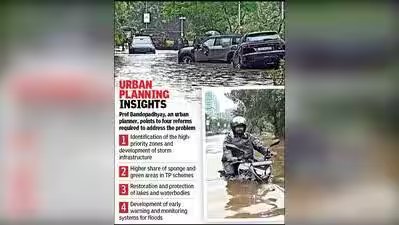
Slug: Making of a DelugeAhmedabad: Every monsoon maroons residents of Shela, Bopal, and Ghuma. Last week’s torrential rain inundated many areas beyond the SG Highway in the newly integrated areas.Flooding is inexorable because urban growth outpaces the infrastructure needed to support it, according to experts.Prof Saswat Bandopadhyay, an urban planning expert, said that real estate growth in the Shela-Bopal-Ghuma corridor has been explosive over the past decade. Thousands of apartments have been approved by combining base FSI (floor-space index) with additional TDR (transferable development rights).Built-up area has, therefore, increased, and permeable open land has shrunk. Yet stormwater infrastructure has lagged far behind, Bandopadhyay said.“The intensity of the rainfall was unprecedented. Any city in the world would have been impacted,” he said. “All govt machinery with public support did its best.” He said now the effort is to ensure that the effect of rain is mitigated in the future.While the city is celebrated for one of the most successful TDR markets with nearly 95% of TDR issued by 2025 absorbed, the majority has fuelled the growth in western city areas, Bandopadhyay said.“The problem is not TDR itself. The problem is where and how much development rights have been concentrated,” he said. “The overall benefits gained from TDRs will be negated by the recurring loss of assets and income due to flooding year after year.”Experts said that the drainage network designed in these fast-developing areas is not adequate for 1.5 lakh residents. A large part of these developing areas still lacks adequate stormwater systems, they added.Other urban experts spoke of measures to reduce the impact of extreme events. N K Patel, patron of Institute of Town Planners, India, said that efforts must be made to ensure that private premises can contain water through percolating wells or storage.“The development of Shela started about seven years ago. At that time, the built-up area was 10%, which has now increased to over 50%,” Patel said. “Thus, the share of open land to absorb water will go down.”Nitesh Shah, a city-based consulting civil engineer, said that a major flood in the late 1970s had washed out an entire society in Vasna, after which authorities were more mindful of low-lying areas.In 2000, the authorities decided to break a part of SG Road to ensure natural drainage of rainwater after major floods.“Today we have technology to assess the vulnerable areas in TP schemes,” Shah said. “These areas can use measures such as hollow pits and sponge zones to absorb water.”Officials said that Shela entered Auda’s jurisdiction in 2009. Yet, for almost 15 years, no comprehensive stormwater drainage network was built, even while more than 50 residential and commercial projects were approved. Only afterwards did authorities begin constructing large drainage projects costing over Rs 240 crore.According to estimates, heavy rain and flooding can cause damage upwards of Rs 500 crore for the city annually.BOXUrban planning insightsProf Bandopadhyay, an urban planner, points to four reforms required to address the problem– Identification of the high-priority zones and development of storm infrastructure– Higher share of sponge and green areas in TP schemes– Restoration and protection of lakes and waterbodies– Development of early warning and monitoring systems for floods