









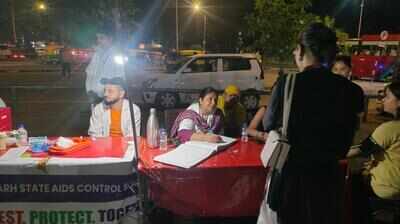
Chandigarh: Launching a nocturnal offensive against hidden health risks, Chandigarh’s state aids control society (CSACS) has started tracking and screening the city’s most elusive, high-risk populations for HIV and Syphilis. Operating under the cover of darkness, the innovative “RAAS” campaign—Ratri AIDS Suraksha Abhiyan—has successfully penetrated previously unreachable hotspots, including hotels, spas, late-night markets, and abandoned buildings, revealing a high concentration of men who have sex with men (MSM) and injecting drug users (IDUs) in these locations. By providing critical on-the-spot counselling and comprehensive health check-ups in the field, the initiative bypassed the rigid limitations of traditional clinic hours to deliver immediate, life-saving care. The strategy specifically aims to connect with populations that are traditionally elusive during daylight hours due to professional commitments, lifestyle patterns, or the fear of social stigma. “The idea stemmed from recognising that many individuals in high-risk groups are significantly more active at night,” said Dr Sadbhavna Pandit, project director, CSACS. She explained, “We realised that a segment of the population was not coming forward through our routine daytime walk-in services, and we had reached a point of saturation with our standard data collection. To bridge this gap, we decided to launch a pilot initiative designed around a distinct nighttime theme.” The initiative targeted previously identified hotspots, operating under strict confidentiality to respect the privacy of participants. Dedicated teams from several NGOs mapped out vulnerable areas, conducting extensive reaches into bus shelters, secluded spots, discotheques, and the newly-mapped environments. Out of 20 planned site visits, 17 have been completed across multiple areas Around 5,000 individuals have been screened under the campaign, which was launched in April. Through focused risk assessment, 1,480 at-risk individuals were tested for HIV and Syphilis. The campaign led to the identification of 59 HIV-reactive individuals and 8 Syphilis-reactive individuals “The distinct model, which marks a premier night intervention of its kind in the country, has already prompted health authorities in New Delhi to replicate the operational design,” said Dr Sadbhavna. Encouraged by these initial outcomes, local teams are currently preparing to expand the campaign to investigate 20 more such hotspots.