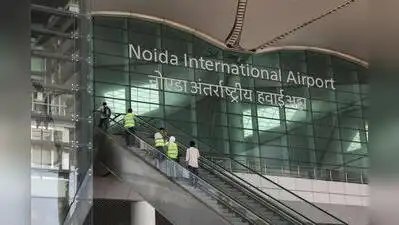










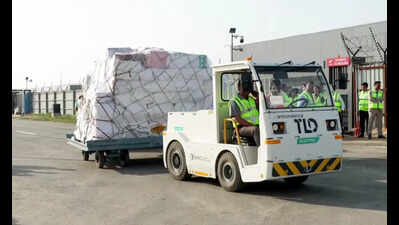
Noida: Cargo flight operations at Noida International Airport are expected to reshape the logistics landscape of not only Noida and Greater Noida but also western Uttar Pradesh by providing exporters and manufacturers with a dedicated airfreight gateway closer to industrial clusters. Sectors such as electronics, mobile manufacturing, automotive components, garments, pharmaceuticals, perishables and e-commerce are likely to benefit from reduced transportation time and lower logistics costs.Industry stakeholders believe Noida’s cargo hub will offer significant advantages over Delhi’s IGI Airport by reducing transportation delays, logistics costs and cargo processing time. Unlike Delhi, where trucks face no-entry restrictions for 10 hours daily and cargo movement is often affected by heavy traffic congestion, Noida offers smoother connectivity to major industrial clusters. Businesses also expect faster customs clearance and lower warehousing costs.UP also has an ambitious ODOP scheme in which each district has one unique product. They will also get a boost in exports. While IGI Airport handled over 11 lakh tonnes of cargo last year, the huge flow of cargo often leads to delays in customs clearance and delivery of goods. In comparison, Noida International Airport has no such cargo flow and it has an initial cargo handling capacity of 2.5 lakh tonnes per year, which is roughly one-fourth of IGI’s current cargo throughput.Manoj Kumar Jain, managing director of a logistics firm, Deep Blue Xpress, said that Noida will fare better as compared to Delhi in terms of cargo transport. “Due to heavy volume of traffic on Delhi roads, there is no entry of trucks in Delhi during peak hours, 7 am-11 am and then 5 pm-11 pm. That means for 10 hours trucks can’t ply in Delhi and they are stranded at different locations. But there are no such restrictions for Noida. Normally, the logistics cost is 12% of the product and the govt is trying to reduce it to 7%-8%. The Noida Airport’s cargo facility will help in reducing the logistics cost and swift delivery of goods,” he said.Noida and Greater Noida have developed into industrial hubs with nearly 12,000 industrial units dealing in electronics, garments, mobile manufacturing, footwear, plastic, etc. These industries are involved in import of raw materials and export of products. Vipin Malhan, president of Noida Entrepreneurs Association, said that these industries usually transported their goods to IGI to export. “However, Delhi airport has some key issues, heavy cargo flow, traffic jams and high warehouse charges. Earlier, people had no options and hence they visited IGI for services. Now, Noida Airport has started the service, so industries in Noida and Greater Noida and Yamuna would like to send their goods through Noida Airport,” he said.Sudhir Srivastava, who runs a company dealing in electronic and electrical goods in Sector 59, said that Delhi’s cargo hub is developed and it has a significant volume. “Due to heavy traffic, we need to wait for additional days to import or export goods. For example, if we are importing some raw materials from China, the product comes in three days but it takes three additional days for customs clearance and paperwork. But as Noida Airport has no such volume, the goods will be released without delay,” he said. Although, Noida Airport is presently operating only domestic flights, international flights and cargo services are likely in six months.The airport will not only benefit these industries but also thousands of people involved in MSMEs and ODOPs in different districts of UP. Shailendra Bhatia, NIAL nodal officer, said that the cargo facility will transform the logistics not only in Noida but in western UP. He said that Noida, Greater Noida and YEIDA are already industrial hubs and these industries need logistics to export goods. “In addition to this, the UP govt has an ambitious One District One Product (ODOP) programme, which aims to promote traditional products and industries that are unique to each district. So, people from Noida, Ghaziabad, Meerut, Hapur, Aligarh, Agra, etc, will use the airport to dispatch their goods,” he said.Ramanathan Rajmani, chief executive officer, AISATS, said that the successful handling of the first freighter flight at the integrated cargo terminal marks the beginning of a new chapter in India’s cargo and logistics journey. “As supply chains become increasingly time-sensitive and interconnected, the need for integrated logistics infrastructure has never been greater. The cargo terminal has been developed to bring cargo handling, warehousing and multimodal connectivity onto a single platform, enabling faster, smarter and more efficient movement of goods,” he said. He added that this logistics gateway will strengthen trade flows, support businesses across North India and contribute meaningfully to India’s growing role in global commerce.