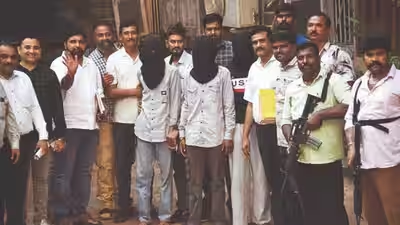











Mumbai: A special court on Monday rejected the bail plea of Aakash Sriwastav, accused of being associated with the alleged organised crime syndicate behind the murder of NCP leader and former state minister Baba Siddiqui. Special Judge under the MCOC Act Satyanarayan R Navander said the material against Sriwastav could not be viewed as showing mere acquaintance with the alleged shooters or conspirators. “The material on record prima facie connects him with the principal accused and the persons alleged to be members of the organised crime syndicate and indicates his alleged involvement in the conspiracy and in providing assistance to the principal accused after commission of the offence.“Therefore, this is not a fit case for grant of bail,” the judge said. The judge further said that there are no reasonable grounds for believing that the accused is not guilty of the offences alleged against him.On Oct 12, 2024, around 9.30 pm, Baba Siddiqui had visited the office of his son in Bandra East, when unknown persons opened fire at him. Siddiqui suffered firearm injuries and later died. Two alleged shooters were caught while trying to flee from the spot. During the investigation, police said that the roles of several others emerged, leading to the arrest of 27 accused. The Maharashtra Control of Organised Crime Act was later invoked.Sriwastav was caught on Nov 10, 2024, along with alleged principal accused Shivkumar Gautam and other co-accused from Uttar Pradesh. The prosecution said the group was taken to Kaisarganj police station and then brought to Mumbai. Sriwastav has been in custody since then.The advocate appearing for Sriwastav argued that he had no link with the principal accused or with those who allegedly planned the murder. The defence submitted that Sriwastav did not take part in the actual shooting and was not a member of any organised crime syndicate. The defence also argued that confessional statements of co-accused had been retracted and could not be safely used to deny bail.The defence further raised an objection to the arrest, saying Sriwastav was apprehended on Nov 10 but was not produced before a local judicial magistrate before being brought to Mumbai. The defence also submitted that there was no material showing payment of money to Sriwastav, no clear proof of harbouring, and only limited WhatsApp call material without details of contents, date or place.Special Public Prosecutor Mahesh Mule opposed bail and relied on the investigating officer’s report. The prosecution argued that Sriwastav was found with Shivkumar Gautam and other co-accused while allegedly moving towards the Nepal border after leaving their native place to avoid arrest. The prosecution said this conduct, along with confessional statements and witness material, showed Sriwastav’s connection with the conspiracy.The prosecution relied on the confessional statement of Shivkumar Gautam recorded under MCOCA, claiming that Gautam had referred to Sriwastav’s role in giving aid and harbour after the incident. The prosecution also relied on the confessional statement of accused Harish Kumar Kashyap, which allegedly referred to meetings, discussions, association between the accused and the activities of the alleged organised crime syndicate.The court said that at the bail stage, a detailed appreciation of evidence was not required, but the court had to consider whether there were reasonable grounds to believe that the accused was not guilty, as required under MCOCA.The judge said, “Retraction (of confession) by itself does not warrant complete exclusion of the statements from consideration at the stage of bail. The voluntariness, admissibility, evidentiary value and effect of the alleged retractions are matters which can be appropriately examined during trial.”The court said the two confessional statements had to be considered with witness statements, call records and the circumstances of apprehension. The order noted that the confession of Shivkumar Gautam was relied upon for the alleged role of Sriwastav in providing assistance and harbour, while the confession of Harish Kumar Kashyap was relied upon for alleged meetings, association, discussions and later movement towards the Nepal border.The judge observed, “These are distinct aspects of the prosecution case which, at this stage, lend support to each other.”The court also considered the prosecution’s claim that witnesses had spoken about Sriwastav’s association with Shivkumar Gautam and other accused, and that some of them used to meet and discuss plans at the shop of co-accused Akhilendra Sureshsingh. The court said the evidentiary value of these statements would be tested during trial, but they were relevant at the bail stage.On the argument that no money trail was shown, the court held that absence of monetary consideration did not by itself defeat the prosecution case because the alleged role was based on association, conspiracy and assistance after the offence.The judge said, “For the present purpose, absence of proof of monetary consideration cannot be treated as conclusive in favour of the applicant.”On the arrest objection, the court said the prosecution had explained that Sriwastav and others were apprehended, taken to the local police station and then brought to Mumbai, where formal arrest was recorded. The court held that the legality of arrest and any evidentiary consequences could be examined at the appropriate stage, but the objection did not neutralise the material collected during investigation.