



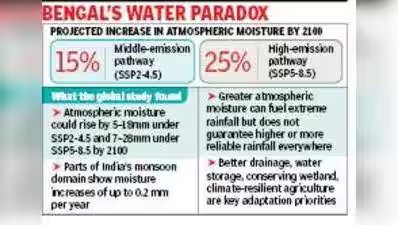
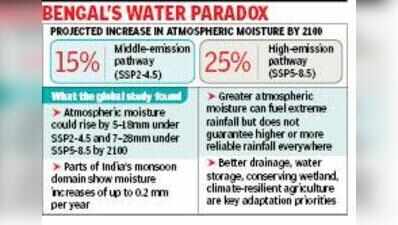
Kolkata: Kolkata could face a future of devastating downpours and prolonged water shortages as global warming increases atmospheric moisture by as much as 25% by the end of the century, according to an IIT Kharagpur study warning of an increasingly volatile global water cycle.By 2100, atmospheric water vapour over Kolkata and West Bengal could increase by roughly 15% under a moderate-emission pathway and 25% under a high-emission pathway, said Prof Jayanarayanan Kuttippurath of IIT Kharagpur’s Centre of Ocean, River, Atmosphere and Land Sciences (CORAL), who led the research.The projections suggest that Kolkata could experience heavier rainfall and severe waterlogging even as rising temperatures and erratic rainfall put greater pressure on freshwater availability.“Kolkata could see heavier rain when it rains, but greater water stress when it does not,” Kuttippurath told TOI.The warning follows a study titled “Global changes in precipitable water vapour during 1980–2100 and its spatial, temporal, radiative and causal insights for enhanced climate warming,” published in the Journal of Hydrology. Using CMIP6 climate models, researchers examined atmospheric moisture changes between 1980 and 2020 and projected their evolution through 2100.Kuttippurath clarified that the research was global in scope and did not involve separate city-specific modelling for Kolkata. The estimates for Kolkata and Bengal are regional interpretations of its broader findings.The study found that atmospheric moisture could increase by 5–18 mm under moderate emissions and 7–28 mm under high emissions across different regions. However, a wetter atmosphere does not necessarily mean more evenly distributed rainfall.For Bengal, the implications extend beyond Kolkata’s waterlogged streets to its agricultural heartland. “West Bengal’s agriculture could face a difficult water paradox in the coming decades: more water in the atmosphere, but not necessarily more water available to crops,” Kuttippurath said.Heavier downpours could increase flooding and crop losses across low-lying South 24 Parganas, Nadia and parts of North 24 Parganas. Conversely, longer dry spells and growing irrigation demand could intensify water stress in Purulia, Bankura, western Birbhum and Jhargram.Rice cultivation could become particularly vulnerable to both excessive rainfall and prolonged dry spells. In the Sundarbans, rising salinity and limited freshwater availability could further threaten agriculture.“The future of Bengal’s agriculture may therefore depend not simply on how much rain the state receives, but on when the rain comes, how intensely it falls, and how much of that water can be stored for the dry periods,” Kuttippurath said.The findings underline the need for Kolkata and Bengal to prepare simultaneously for flooding and water scarcity through better drainage, wetland conservation, rainwater harvesting and improved water storage.