








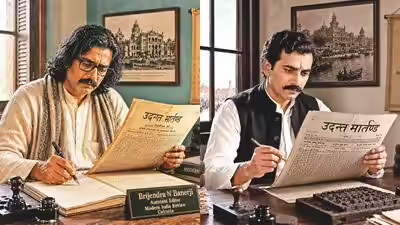
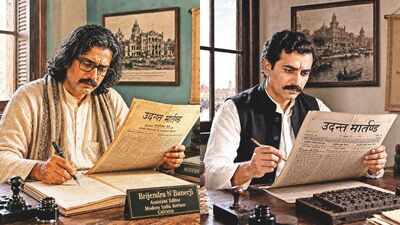
LUCKNOW: Year 2026 marks the 200th year of ‘Udant Martand’ (meaning the Radiant Sun of News), the first Hindi newspaper which was started by a native of Kanpur, Jugal Kishore Shukla, who worked as a lawyer in Calcutta.Though the newspaper received rave reviews, it was shut down due to shortage of funds and receded into oblivion, with not many knowing that it was the first Hindi newspaper.The newspaper again came to light when sometime in the latter half of 1930 or Jan 1931, Brijendra Nath Banerji, an assistant editor with ‘The Modern Review’, the influential monthly started by Ramananda Chatterjee at the turn of the 20th century began research for an assignment. His task was to document the history of Bengali newspapers. But what began as a deep-dive job eventually changed the history of Hindi journalism in India.As he sifted through voluminous archives and rare collections in personal libraries, evidence began to point to a forgotten truth: that ‘Udant Martand’ was India’s first weekly Hindi newspaper (Devnagari script), contrary to what was widely believed at the time.Till Banerji’s path-breaking research, the Hindi belt believed that ‘Banaras’ brought out by Shiv Prasad Sitara-e-Hind (started in 1845) was India’s first Hindi newspaper.
Before the sunrise
The saga of newspapers in India began in 1780 with Irishman James Augustus Hicky launching the ‘Bengal Gazette’. Though Hicky’s paper was short-lived, it created ripples across India.Newspapers like ‘Bombay Herald’ and ‘Bombay Courier’ came up in 1789 and 1790, respectively, followed by ‘Bombay Gazette’ in 1791 and entered the market. Vernacular newspapers followed with Calcutta emerging as their cradle.In such times, a young Jugal Kishore Shukla decided to take his leap of faith and head to Calcutta. He left his native home in Kanpur to pursue higher education. Though connected to his roots, he remained in Calcutta to work as a proceedings’ reader in the Sadar revenue court.In due course, Shukla was recommended to become a lawyer.Probably touched by the brewing nationalist sentiments and aware of the power of newspapers, he decided to start ‘Udant Martand’ in Jan 1826.“Calcutta had many newspapers in those days… Bengali, Hindi, Urdu and even Farsi. As a resident of the city living in the 1810s, Shukla would have witnessed the birth of several newspapers including the ones with which Raja Ram Mohan Roy was associated. Those stimulating times may have inspired Shukla to think about ‘Udant Martand’,” says Anoop Kumar Shukla, an amateur historian and chronicler based in Kanpur.
Lost and found in time
Shukla reveals that Banerji got the entire file of ‘Udant Martand’, except for one edition, from the personal library of Raja Radha Kant Dev.He summed up his research on ‘Udant Martand’ in a three-part article called ‘Hindi ka Pratham Samachar Patra’ published in Vishal Bharat editions of 1931.“Banerji found that the newspaper that started with fanfare eventually closed down in Dec 1827 as it could not sustain itself economically. It remained lost under the sand of time till Banerji restored its importance and glory,” says Shukla.Banerji’s research paper is still available in the archives. TOI accessed the paper and found that Banerji had taken a jibe on the Hindi intelligentsia for not knowing the correct history.Noting that ‘authors like Bal Mukund Gupta (editor Bharat Mitra) and litterateur Radha Krishna Das have called ‘Banaras’ as the first Hindi newspaper of India, he wrote: “But this suggests that they are oblivious to the truth.”Then he informed the readers that ‘Udant Martand’ was Hindi’s first newspaper published in 1826. He add edthat in those days, anyone willing to start a newspaper had to take a licence from the East India Company.Those bringing out the newspaper brought out a prospectus (a kind of public notice) in other relevant papers to draw subscribers. The advertisement for ‘Udant Martand’ was published on March 11, 1826, in Bangla newspaper ‘Samachar Chandrika’. Banerji also cited a news item carried by Bangla newspaper ‘Samachar Darpan’ on the new newspaper on the block.Published on June 17, 1826, the article titled ‘Naagari Ka Samwad Patra’ introduced Shukla besides referring to the home department order on it. “Haal hi mein Calcutta nagar se Udant Martand namak ek naagari ka nootan samachar patra prakashit hua hai. Is se hamare ahlad ki seema nahi hai (Recently, a new newspaper in the Nagari script, titled ‘Udant Martand’, has begun publication from the city of Calcutta. The joy this has brought us is beyond measure),” said the newspaper article.Banerji’s research was endorsed by Banarasi Das Chaturvedi, the editor of Vishal Bharat in his editorial note. “Until now, we believed that the first Hindi newspaper was ‘Banaras’, which was published from Kashi in 1845. However, Banerji’s research has brought to light a Hindi newspaper that was published as early as 1826,” he wrote in Hindi.
Radiant sun of news
Experts say that the literal translation of ‘Udant Martand’ is “the radiant sun of news” and true to its name, the newspaper offered a lot of content to its readers.The first part of Banerji’s article gave full details on Udant Martand’s editorial objectives, ownership, cost and subscription details.The line, ‘iva-kaanta kaanti vina dhvaandam antam na chaapnoti, tadvaj jagaty ajna lokah. Samachaar sevaamrite jnyatvam aaptaam na shaknoti, tasmaat karomi iti yatnam’, meant just as darkness cannot be dispelled without the light of the sun, people cannot attain knowledge without the service of news and information.Therefore, I undertake this effort. Scholars believe that Shukla had himself penned the ‘shloka’. Citing various references, history buff Anoop Shukla says that the paper contained news items of various categories. Specimens of advertorials such as ‘sarp dansh utarne ki aushadhi’ are also available.
Poetic farewell
‘Udant Martand’ faced severe financial difficulties. The newspaper received little official support and struggled to attract enough subscribers to strike the break-even.On Dec 4, 1827, after 18 months of publication, Jugal Kishore announced its closure in a poignant editorial note, likening the setting of the newspaper to the setting sun.“Aaj divas laun ugi chukyo, ‘Martand Udant’ astachal ko jaat hai, dinkar din ab ant (meaning the sun of ‘Udant Martand’ has shone until today; now it moves towards the horizon, and its day comes to an end,” he wrote.The development was reported in several Bangla papers. In one such article published by ‘Samachar Darpan’ on Dec 15, 1827, it was said that “Udant Martand, atiuttam patra grahakon ke abhaav se kaal ko prapt ho gaya (An excellent newspaper met its end due to the lack of readers).”
Timeline
- 1826
- Jan: Application to start the newspaper submitted
- Feb 16: Permission granted
- Mar 11: Public notice inviting subscribers published
- May 30: First edition published
- June: Reviews of ‘Udant Martand’ published
- 1827
- Dec 4: Last edition published
- Dec 15: Bengali newspapers carry article announcing closure of ‘Udant Martand’
Fact file
- ‘Udant Martand’ was brought out by a lawyer Jugal Kishore Shukla from Calcutta
- Born in 1788 (approximate date), Shukla was a native of Kanpur who went to Calcutta for studies but decided to live there
- Manna Thakur was the printer
- The weekly paper was published and printed from 37, Amratala Lane, Calcutta
- The first edition had 500 copies
- It was brought out in 12 x 8 inches size and released on Tuesdays
- Subscription cost was Rs 2 per month (four editions)
- After publishing 79 editions, ‘Udant Martand’ closed down following paucity of funds
- He made a second attempt in 1850 and launched ‘Samyadant Martand’ (also known as ‘Samdant Martand’) from Calcutta. But could not sustain that too and closed it in 1852
- Shukla died in 1853 at 65
For the love of ‘Hindostanis’
In the inaugural edition, Jugal Kishore Shukla spelt out the reason that fueled his endeavour.Though published material in those days lacked punctuations, it was able to convey his sentiments despite regular challenges in deciphering the script and misprints. “Yeh Udant Martand pahle pahal Hindustaniyon ke hit, jo aaj tak kisi ne nahi chalaya, ke liye laya gaya hai,” he wrote.Adding that reading news in other dialects or languages was equal to an attempt to find one’s own happiness in someone else’s joy; feeling rich with someone else’s money or seeing the world with borrowed eyes, he noted that despite this many people try their luck on Bangla or Farsi, probably indicating that he decided to rise above the ‘compromise’.He also mentioned that there were risks of not being able to read in non-native languages. In the article, he also wrote about the licence and other details. Referring to the cost of the newspaper, he said that it was fixed to Rs 2 per month, which was one-third the actual cost of production.
Nawab, Awadh and ‘Udant Martand’
The first edition of ‘Udant Bharat’ published a ‘sabha varnan’ or detailed eyewitness account of governor general Lord Amherst in Yandabo village located on the banks of Irrawaddy River in present day Myanmar.The assembly was organised to mark the signing of the Treaty of Yandabo that followed end of first Anglo Burma War with East India Company defeating the king of Burma.The news item had an Awadh connection. Ruled by King Ghazi-ud-Din Haider, Awadh had a ‘mutually beneficial’ relationship with the East India Company which was naturally skewed to favour the shrewd foreign power.The nawabs who bankrolled the company’s campaigns at that time also tried to remain relevant among company’s affairs which was also visible in the news item titled “Shri Shriman Governor General Bahadur Ka Sabha Varnan”.After a brief introduction, the article in Hindi said: “This durbar was held in the presence of His Lordship Lord Amherst, Governor-General Bahadur, on the occasion of Maulvi Muhammad Saliuddin Khan being entrusted with the work of representation (‘wakalat’) on behalf of the ‘Awadh Bihari Badshah’, (Nawab of Awadh).It further described how the delegation sent by the Nawab presented expensive gifts (‘khilat-o-ghiza’) including jewellery, textiles, and weapons to be engaged in negotiations or implementation of the treaty.