







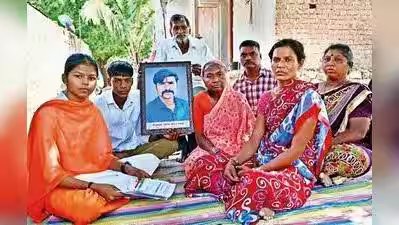
Dharashiv: When his soyabean crop failed, Milind Rokade lost his lifeline. After injuring his leg in an accident two years ago, the 43-year-old farmer had taken a Rs 6 lakh loan from a finance company to buy a transport van. He used it to ferry farm produce to supplement his income. But after the fierce drought destroyed most of the crops in Dharur village, he was left with nothing to transport, and a barren soyabean field.He missed the Rs 14,750 monthly instalment on his loan which was due on Oct 15.“The next day, the agents from the finance company called. They kept calling and were very insistent. The calls continued daily. He was stressed and became totally quiet,” said his wife, Rukmini. Four days later, on Oct 19, he spent the day in his unharvested field. After midnight in the early hours of Oct 20, he went home and hung himself with his wife’s sari.Whenever Rokade did not meet a deadline, the finance company would keep calling and send its collection agent to sit outside their house for hours, the family alleges.“We felt ashamed. The whole village could see. It was very insulting. They would threaten to take away the van,” said Rukmini. “They would sit outside the house until we took money from neighbours and paid them,” she added.This case is just one of a string of suicides in Marathwada that are linked to the strong-arm tactics of micro-finance companies which have aggressively expanded their reach to the most vulnerable segment in rural Maharashtra.On Oct 24, a Nanded-based farmer who had unpaid dues worth Rs 10,000 was found hanging from a ceiling fan in the office of micro-finance company K F Enterprises. The same month, the police registered a case against four micro-finance companies following the suicide of a 26-year-old farmer in Latur. One of these is a finance app.Loan repayments have become difficult with the state facing one of its most widespread droughts; more than 85% of its talukas have been affected. Marathwada is among the worst-hit, with all 76 talukas affected. Milind Rokade had spent Rs 30,000 to plant his 2-acre soyabean field. He recovered only Rs 4,000.The suicides have also turned the spotlight on the steep interest rates being charged by the companies to the state’s poorest. In Rokade’s case, the annual interest rate works out to 29.5%. In the Nanded farmer’s case, the family has alleged that he was being charged Rs 70,000 on a loan of Rs 10,000.“It is difficult to get bank loans because the farmers’ CIBIL score is low. So, farmers turn to micro-finance companies even though the interest rate is very high,” says Tanaji Gaikwad who is part of the village’s conflict resolution committee. There are multiple apps and micro-finance companies operating. Some of these are fronts for other companies, he says.In the past two years, Rukmini has sold three of the family’s goats to meet loan instalments. She has also sold all her jewellery.Her mangalsutra was sold a month before her husband’s suicide. “He needed it pay the instalment. I felt that as long as I have my husband, I have everything,” said Rukmini.Her daughter Prachi (15) and son Sudarshan (14) both want to join the army, in the footsteps of their grandfather Shrimant Rokade, a retired army sepoy who was in Pakistan, on the China border and in Kashmir.“My father could not pass the test for the army and it was his dream that I should join. But now I am not sure we will be able to afford the fees,” says Prachi, despondently. A 10th standard student, she is among the top three in her class. “My dream was to join the training academy to prepare to enter the army,” she says.What is govt doing to regulate the micro-finance sector? After the Nanded case, chief minister Devendra Fadnavis instructed police officials to book senior officials of the microfinance companies if they harass farmers to pay back their dues. Fadnavis said he has asked RBI to tell microfinance companies not to take coercive steps.“We have held a meeting with representatives of finance companies and told them they cannot force farmers to pay instalments, given the drought,” said Dharashiv collector Kirti Kiran Pujara.Yet, the number of farmers desperate for loans is growing. In Dharur village itself, we meet another farmer who has taken a 2.25 lakh loan from a micro-finance company. “The last time I didn’t pay on time, the agent refused to leave my house. They told me I should not have taken the loan if I did not have the ability to pay,” said a farmer who was too scared to give his name.