







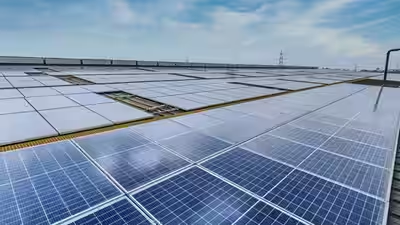
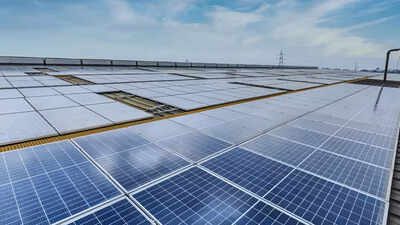
Lucknow has become the first district in the country to cross 88,000 rooftop solar installations under the PM Surya Ghar: Muft Bijli Yojana, a mark it reached by April 2026. In doing so it overtook Surat in Gujarat, which had long been the benchmark for urban solar adoption.By the latest figures the capital district has 1,24,167 systems and holds the No. 1 position in India. For a state that began the scheme well behind Gujarat and Maharashtra, it is a striking turnaround, and it says a good deal about how the Uttar Pradesh government under Chief Minister Yogi Adityanath has approached the programme. UP now leads other states in Rooftop solar installations.The scheme itself is a central initiative, launched in February 2024 with the goal of installing rooftop solar on one crore homes by FY 2026-27. The Centre designs it and pays the central subsidy, so credit for the national outcome is shared. What the Uttar Pradesh government can fairly claim is its execution in the country’s most populous state, and the results of that execution are now visible in the numbers.The state’s climb has been steep. In July 2025 Uttar Pradesh had about 1,20,866 installations, third behind Maharashtra and Gujarat. By March 2026 it had 4,20,823 systems, with Rs 2,753.63 crore in subsidy released. By July it had crossed 6.5 lakh systems and roughly 2,350 MW of rooftop capacity. In September 2026 it ranked first in the country for monthly installations, adding 74,796 systems, about 2,493 a day and roughly 17 per cent of the 438,815 installed nationwide that month. On 30 September alone it recorded 3,389 installations. As per official figures, the cumulative solar installations had crossed over 9.53 lakh number by November 5,2026 taking Uttar Pradesh past Gujarat into first place, with installed capacity around 3000 MW. These are largely state-released figures, and national portal data will be the final test, but the direction is not in doubt. The state had earlier become the first to cross 1 GW under the scheme, benefiting about 2.93 lakh families.Several choices explain this rise. The first was money. On top of the central subsidy, which reaches Rs78,000 for systems of 3 kW and above, the state pays Rs 15,000 per kW up to a maximum of Rs30,000. A household installing a 3-kW system can therefore receive up to Rs 1.08 lakh in combined support. The state backed the policy with budget, approving a supplementary allocation of Rs500 crore in December 2025 for the state subsidy. Because many households are deterred by upfront cost, the top-up made a real difference to the economics of going solar.The second was administrative pressure. The Chief Minister set district-specific targets for all 75 districts and monitored progress himself. According to the state, regular district-level reviews, inspection and monitoring of metering at the DISCOM level, banking follow-up, vendor coordination and the clearing of pending cases became routine. The Director of UPNEDA, the state’s implementing agency, has attributed the results to district-wise monitoring and clearly defined, time-bound targets. That is why the success is visible at the district level and not just in the state total. Seventeen districts are now among India’s top 100 for rooftop solar, and three are in the top 15: Lucknow at first, Varanasi at tenth and Kanpur Nagar at fourteenth.The third was building a supply side. Officials say the number of vendors grew roughly a hundredfold, and UPNEDA has impanelled more than 8,000 of them, employing more than one lakh people. Training has been delivered in phases with the National Institute of Entrepreneurship and Small Business Development, and local reporting from Prayagraj describes young entrepreneurs finding work in solar installation. A national study found that Uttar Pradesh, Maharashtra and Gujarat together account for more than 9,000 vendors, which suggests the state has built real installer capacity. That supply is what allows installations to scale, since a subsidy means little without enough qualified firms to fit the panels.Lucknow’s own story shows how these pieces came together. In the scheme’s first seven months the city had 11,435 operational systems, the most in the state at that time, with Varanasi at 4,088, Kanpur at 1,909, Agra at 1,364 and Prayagraj at 1,349. By April 2026 Lucknow was past 88,000. In May 2026 alone it added 9,667 systems, and on 31 May it installed 333 units in a single day, more than any other district in the state. Varanasi, the second-highest district in Uttar Pradesh, has fewer than half of Lucknow’s installations, which shows how far ahead the capital has pulled.Varanasi’s contribution is of a different kind. With about 40,000 installations, it ranks tenth nationally, and it has become a testing ground for financing. A review chaired by an MNRE Mission Director highlighted a model there in which more than 1,000 households received rooftop systems without any upfront contribution. Financing is among the biggest barriers to adoption across India, so a model that removes the upfront payment is potentially more important than the headcount.The benefits are practical. Households that install systems cut or eliminate their monthly electricity bills. The state estimates that its installations produce more than 1.32 crore units of clean electricity every day, with substantial land savings and carbon reductions compared with conventional generation. By the end of June 2026 the state’s total installed solar capacity stood at 5,788.82 MW, and rooftop systems are now a significant part of that, built without the land acquisition that large solar parks need.A fair account must also record the weaknesses, because the evidence for them is well documented. Reporting on Uttar Pradesh has identified delays in state subsidy payments, slow net meter configuration, substandard equipment, financing difficulties and irregular power supply. Installers say consumers often receive faulty bills, and in Ghaziabad vendors and consumers have complained about approvals held up on the DISCOM side. Responsibility is also split across agencies: UPNEDA handles solar, the electricity department handles meters, and the distribution company links the plant to its systems. Earlier reporting on Varanasi found that this split, along with net metering and billing irregularities, held back its targets. Nationally, banks have been rejecting or delaying loans over documentation, and only 22.7 per cent of applications had become installations as of July 2025.Taken together, the record shows real success in scale and speed, driven by a state subsidy, strong district-level monitoring and a rapidly built vendor base. It also shows that counting installations is easier than guaranteeing a smooth experience for each household. Whether Uttar Pradesh turns this lead into a lasting success will depend on faster net metering, reliable subsidy payments, accurate billing and a deeper reach into rural districts beyond Lucknow, Varanasi and Kanpur Nagar.(District Transformation)