









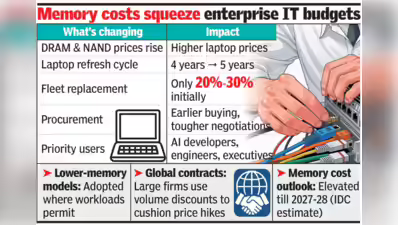
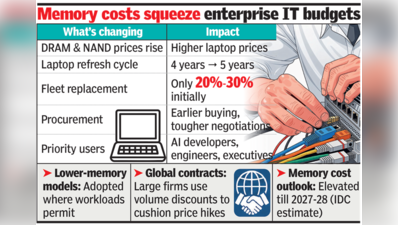
Bengaluru: Large enterprises are redrawing their laptop procurement strategies as surging DRAM and NAND memory prices threaten to increase the cost of commercial PCs. This is prompting companies to strike a balance between buying early to lock in prices and delaying non-essential upgrades to protect IT budgets.Most large firms procure laptops through annual or multi-year contracts, giving them some flexibility to navigate rising costs. While some companies are accelerating purchases — particularly of AI-ready laptops with higher memory configurations — others are adopting a wait-and-watch approach by extending device lifecycles, replacing only mission-critical systems and negotiating harder with vendors.“We have been hearing from many of our technology hardware partners that lead times and component pricing continue to be areas they are watching closely,” said Lalitha Indrakanti, CEO of Jaguar Land Rover Technology & Business Services India. “With the rapid growth we are seeing in AI infrastructure and broader demand in the technology ecosystem, many vendors are advising companies to plan their technology requirements a little earlier than they traditionally would. This helps manage availability and pricing with some predictability. It reflects how enterprises are adapting to a supply environment that has become far more dynamic over the past few years.”The trend is driven by higher memory costs, which OEMs are increasingly passing on to customers. At the same time, procurement heads are becoming far more selective. Companies are extending laptop replacement cycles from four years to five years, refreshing only devices that are obsolete or required by AI developers, software engineers and senior executives. Lower-memory configurations are also being considered wherever workloads permit, while large enterprises continue to leverage their purchasing power to negotiate better commercial terms with OEMs.According to Navkendar Singh, associate vice-president at IDC India, laptop vendors have been preparing enterprise customers for this scenario for several months. “Since Jan-Feb this year, major laptop vendors such as Dell, Lenovo and HP have been telling enterprise customers that laptop prices are unlikely to come down. They have also warned customers that if purchases are delayed by six months, vendors may not be able to honour today’s pricing,” Singh said.As a result, enterprises are under pressure to spend more on IT hardware. While global corporations with large procurement contracts can still negotiate discounts because they purchase thousands of devices under worldwide agreements, smaller organisations have far less bargaining power. Many enterprises are replacing only 20%-30% of their installed base initially, prioritising high-performance users while postponing broader refresh programmes. Singh added that component costs are expected to remain elevated until 2027 or even 2028.Technology market research firm Counterpoint Research said the impact has so far been relatively muted for large enterprises in India, thanks to procurement contracts and OEM support. “The rise in costs associated with procuring enterprise PCs in India has been relatively lower, with the price of commercial laptops rising 15%-20% year on year,” said Anshika Jain, principal analyst at Counterpoint Research. “Large enterprises are insulated by annual procurement contracts, volume discounts and OEMs absorbing part of the increased DRAM and NAND costs. Rather than expanding budgets, organisations are stretching refresh cycles, negotiating more aggressively and upgrading only where necessary. However, if memory costs remain elevated over the next 12 to 18 months, enterprise IT budgets will face much greater pressure.”PC manufacturers, however, believe enterprises remain focused on long-term value rather than reacting to short-term component price fluctuations. “We believe enterprises today are taking a pragmatic and long-term approach to technology investments,” said Sudhir Goel, chief business officer at Acer India. “While rising DRAM and NAND prices may influence procurement planning, organisations are not making decisions based on component costs alone. Some customers may optimise refresh cycles or phase deployments based on business priorities, but investments in secure, high-performance and AI-ready devices continue to remain a priority.”Goel said enterprise buyers are increasingly evaluating purchases through the lens of total cost of ownership, placing greater emphasis on productivity, security, manageability and device lifecycle than on upfront acquisition costs. “We expect enterprise demand to remain resilient, with purchasing decisions becoming more planned and value-focused rather than being driven solely by short-term component price movements,” he added.The broader outlook remains challenging. Gartner had earlier projected that combined DRAM and SSD prices would surge 130% by the end of 2026, driving PC prices up 17% compared with 2025. The research firm also expects business PC lifecycles to increase 15%, warning that delayed upgrades could expose organisations to greater security risks while slowing enterprise adoption of AI PCs. Gartner also estimates memory costs will account for nearly 23% of a PC’s bill of materials by the end of 2026, up from 16% in 2025, making it increasingly difficult for OEMs to absorb higher component costs.