










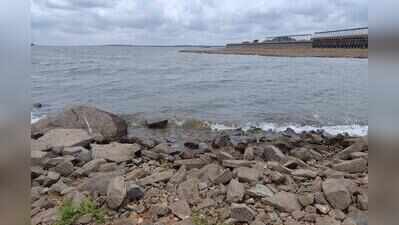
Bengaluru: First, the good news. Heavy rain has filled Karnataka’s four major Cauvery basin reservoirs enough to comfortably meet drinking water needs of Bengaluru, Mysuru and other towns in the basin till June next year.By Thursday, Karnataka also released the mandated 52,500 cusecs of water to Tamil Nadu, well before the 15-day deadline set by the Cauvery Water Regulation Committee.Now, the bad news. Although storage in reservoirs remains healthy, rainfall has weakened over Kerala’s Wayanad and Karnataka’s Kodagu, key catchment areas, over the past 48 hours, reducing inflows and again putting the spotlight on Karnataka’s ability to sustain releases to Tamil Nadu under the Cauvery water-sharing schedule through the rest of the monsoon.In a normal water year, Karnataka is required to ensure a cumulative flow of 86.3tmc at Biligundlu on the border by the end of Aug. As of 6pm Thursday, the realised flow stood at 4.9tmc.Water resources department data on Thursday showed the combined storage in Harangi, Hemavathy, Krishnaraja Sagar (KRS) and Kabini stood at 83.5tmc, or 73% of their gross capacity of 114.5tmc. Kabini is nearly full with 18.2tmc, or 93% of its capacity, while Harangi has reached 97% with 8.2tmc. Hemavathy holds 29.32tmc, or 79%, while KRS, the principal source of drinking water for Bengaluru and Mysuru, has 27.7tmc, a shade over half its capacity.Bengaluru draws a substantial share of its drinking water through different stages of the Cauvery Water Supply Scheme, while Mysuru, Mandya, Chamarajnagar, Hassan and Ramanagara also depend on Kabini and Hemavathy.Water resources minister Ramalinga Reddy told TOI, “The present storage is sufficient to ensure uninterrupted drinking water supply for Bengaluru, Mysuru, Mandya and other urban and rural habitations dependent on the Cauvery system.”However, the concern is over sustained inflows. Data at 6pm Thursday showed the combined inflow into the four reservoirs at 23,838 cusecs — significantly lower than the peaks witnessed earlier this week — while combined outflow stood at 8,610 cusecs.Individually, KRS received 10,060 cusecs and released 1,610 cusecs; Kabini recorded an inflow of 9,210 cusecs and an outflow of 7,000 cusecs; Hemavathy received 5,068 cusecs while releasing just 500 cusecs; and Harangi registered matching inflow and outflow of 4,200 cusecs each.Water resources officials remain hopeful that renewed monsoon activity in the Cauvery catchment will replenish inflows further, helping the state safeguard drinking water supplies while meeting irrigation needs and its downstream commitments to Tamil Nadu.