









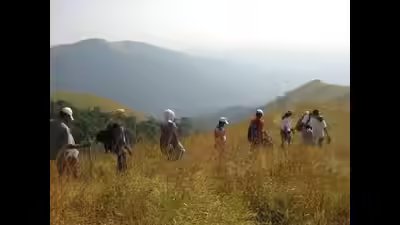
Bengaluru: Amid mounting backlash following consecutive incidents of trekkers going missing in state forests, the Karnataka forest department Friday unveiled a detailed standard operating procedure (SoP) to regulate eco-trails, hiking and trekking activities across forest areas. Forest minister Eshwar Khandre cautioned that any trekker found violating these SoPs will be blacklisted and permanently barred from participating in trekking activities in Karnataka forests.Releasing the SoP in the wake of a Kerala trekker going missing during a trek to Tadiandamol in Kodagu district, Khandre said strict caps have been introduced on group sizes. Each batch will have a maximum of 10 trekkers, with a total cap of 150 trekkers per day across the 44 recognised forest trails in the state. “For every 10 trekkers there will be one trained guide. If there is only one trekker, a guide is mandatory and it is non-negotiable,” he said, adding that local youth will be trained and recruited on a contract basis. He also noted that a significant portion of trekking revenue will be channelled towards the development of local villages.All trekking routes have been classified into three categories — easy half-day (A), moderate full-day (B), and advanced (C). The minister clarified that overnight stays will not be permitted and all treks must be completed within a single day. Officials said the longest trail stretches up to 19km, with all water sources mapped. The department will collaborate with General Thimayya National Academy of Adventure (GETHNAA) under the department of youth empowerment and sports for rescue operations. Category B and C trails will have rest points every 2km or 60 minutes of walking time, whichever is earlier, with shaded seating. For Category A, rest stops will be based on route length.The SoP mandates use of GPS-enabled walkie-talkies or two-way radios, fully charged and tested before departure. “The guides dressed in high-visibility identification jackets will carry topographic maps, a compass, a GPS-enabled smartphone with offline maps, a whistle for signalling, flashlight with spare batteries,” said Meenakshi Negi, principal chief conservator of forests (head of forest force). All trails will be marked at intervals of 200 metres using department-approved markers.Kumar Pushkar, chief wildlife warden and PCCF (Wildlife), said, “The guides will hold mandatory pre-trek briefing on route, safety rules, dos and don’ts and emergency procedures. They will take the head count at base camp, all rest points and again on return. They will maintain radio communication with the base camp control room at every 30-minute interval. If they miss out on these calls, the control room will initiate welfare check. They will also flag the base camp about presence of wildlife, possible hazards. No trekker will be allowed to leave the group or stray out of the marked trail.”Biswajit Mishra, additional PCCF (wildlife), said base camps will be equipped with essential amenities like potable water facility, water bottle filling dispenser, four toilets — 2 each for women and men — along with handwashing stations with signage in both Kannada and English. “Waste disposal rules will be strictly adhered to. There will also be makeshift resting or waiting area and a first-aid room at the base camps. The radio operators at base camps will be linked with Integrated Command Control Centre of the forest department in Bengaluru 24×7,” he said.Manoj Kumar, principal secretary (forest), said, “All trekkers must register their presence through mobile application at the base camp. Registration for trekking is only through Aranya Vihaara portal by producing valid photo ID. Trekkers under the age of 18 must have written consent from parents and trekkers above 60 years must produce medical fitness certificate. Registration closes 48 hours prior to the trek day.“No treks during wildlife movementDepartment clarified that treks will be called off if beat foresters report movement of wildlife around the trekking trails. Guides will not carry any arms as they have been hired on contract basis and lack training in handling weaponry.Lost trekker protocol * Group will stop trekking immediately and head count will be taken* Guide will inform base camp with location, situation report* Base camp alerts rescue teams* Area RFO will reach out to district administration, police for help* SDRF, GETHNAA will be involved in rescue mission* RFO to arrange thermal cameras, drones, additional man-power* Guide to monitor remaining trekkers at a resting pointTrek marking & navigation * Trekking trails to be marked in colours on trees, rocks* Arrow signs to show junctions, forks, turn-off points* Danger zones like cliff, slopes, water crossings will be marked in red colour* Department to publish trail map on website, app with downloadable offline version* QR codes at base camps linking to digital trail map* Mobile network dead zones mapped on mobile app, informed to trekkers