









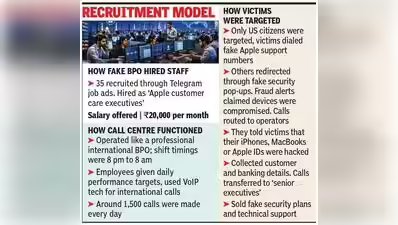
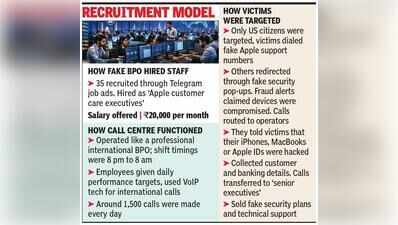
Lucknow: A day after Lucknow police busted a fake Apple customer support call centre and arrested four people, investigators on Tuesday detailed how the group allegedly ran an international cyber fraud racket by recruiting young jobseekers, training them to impersonate Apple executives and targeting American citizens at scale.Police said the operation functioned like a professional BPO unit, employing around 35 call-takers who were hired through advertisements circulated on Telegram. The posts offered jobs as “Apple Customer Care Executives” with a promised monthly salary of ₹20,000, presenting the work as a legitimate customer support process for a global technology company. Applicants were asked to have good spoken English, preferably an American accent, along with basic computer skills.The recruits came from multiple states and regions, including Uttarakhand (10), Maharashtra (9), Gujarat (3), Nagaland (3), Assam (2), Manipur (2), and two each from other states, besides one agent from Nepal, police said. Officers added that several candidates were unaware of the alleged fraud at the time of joining and were introduced to the work as an “overseas technical support process.”Investigators said the hiring process followed a structured pattern, with interviews, induction and training before new joiners were assigned workstations. During training, recruits were taught to speak fluently in English, follow fixed scripts and maintain a professional tone to build credibility while posing as Apple customer support representatives.“They were trained to handle calls professionally and build credibility with customers by following prepared scripts,” an officer associated with the investigation said.The centre reportedly operated exclusively at night to match US time zones. Employees logged in around 8 pm and worked until 8 am, with daily targets and high call volumes routed through Voice over Internet Protocol systems. Police estimate the group collectively made nearly 1,500 calls each day.Targets were primarily US citizens who either called fake Apple support numbers found online or were routed through fraudulent pop-up alerts that claimed Apple devices or accounts had been compromised. Once connected, the callers allegedly told victims their iPhones, MacBooks or Apple IDs had been hacked, infected with malware or linked to suspicious financial activity. Initial callers collected personal and account details before transferring the call to others posing as technical specialists.Victims were then pressured to buy unnecessary “security packages”, technical support plans or account recovery services, police said.DCP (East) Deeksha Sharma said investigators are tracing the digital money trail to identify financiers, while forensic teams analyse seized devices, call records, communications and financial transactions to map the network’s full reach.