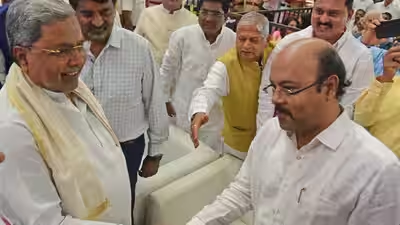






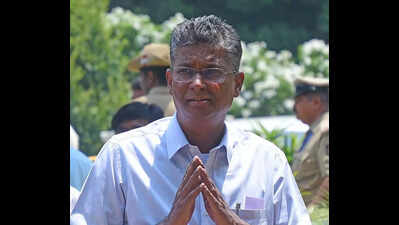
Bengaluru: With an eye on the 2028 assembly polls, public works minister Satish Jarkiholi has intensified his political engagements over the past year, increasingly positioning himself as an internal troubleshooter during moments of crisis within Congress. He has frequently held consultations with ministers and senior functionaries, signalling a more interventionist role in party affairs. In a recent instance, Jarkiholi, 63, met deputy chief minister and KPCC president DK Shivakumar, urging a reconsideration of the decision to remove KPCC minority wing chief Abdul Jabbar over alleged anti-party activities during the Davanagere South bypoll campaign. Political strategists view this as an attempt to emerge as a key face of the Ahinda (minorities, backward classes and Dalits) social coalition and a potential contender for the CM job in a post-Siddaramaiah phase within Congress. Siddaramaiah is widely seen as the principal architect of Ahinda politics. He built a broad coalition rooted in his Kuruba background and reinforced it through welfare schemes such as Anna Bhagya and Ksheera Bhagya during his first tenure, and now through the five guarantees. Analysts credit him with consolidating this into a durable vote base, establishing himself as a mass leader. Now, as Congress looks beyond the 77-year-old CM, internal discussions have turned to second-line functionaries capable of sustaining this social coalition. Political observers say Jarkiholi’s recent moves reflect a calibrated attempt to expand his acceptability within this framework. For now, he has signalled restraint on leadership ambitions, with Siddaramaiah and Shivakumar continuing their contest for the top post. “He has begun to stand out, suggesting a calculated attempt to position himself as the next-generation Ahinda leader,” said a senior Congress functionary. “The party cannot rely on a single face indefinitely. Members like Jarkiholi are trying to build wider social acceptance.” Political analyst Vishwas Shetty said: “He is expanding his base without appearing confrontational. This is crucial in a party where leadership transitions are often negotiated.” A six-time MLA from Yemakanmardi, Jarkiholi belongs to the Nayaka Scheduled Tribe community. He is from a politically dominant family, often referred to as ‘sahukars’ in the region. His brothers, Ramesh and Balachandra, are BJP MLAs, while another, Lakhan, is an independent MLC. The family retains cross-party clout in Belagavi and surrounding districts. Within the govt, Jarkiholi has maintained a measured equation with Siddaramaiah, aligning with his social coalition strategy and avoiding overt leadership assertions. Party sources describe him as a reliable organiser in north Karnataka, with coordination evident during elections and mobilisation of Ahinda support bases. The Bagalkot assembly bypoll is being seen as a test of his organisational strength. It is said Siddaramaiah tasked Jarkiholi with overseeing the campaign, with a victory expected to strengthen his standing. The contest is shaped by caste dynamics, where Congress traditionally depends on Ahinda voters. Political commentator MN Patil pointed to regional factors. “North Karnataka has long sought greater representation, and a leader from Belagavi with Ahinda credentials fits that need. In the current setup, I do not see Shivakumar or others stepping into Siddaramaiah’s role as effectively as Jarkiholi. However, Jarkiholi is yet to face a real test. While he has a strong base within his community, whether he can secure acceptance across other groups remains uncertain,” he said.