









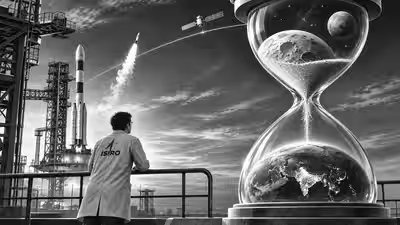
Space is back in the language of national ambition. On Nov 3, the day Americans went to the polls for the midterm elections, President Donald Trump issued a proclamation titled “The American Declaration of Freedom in Space”. It speaks of returning Americans to the Moon by 2028, establishing a permanent lunar presence and eventually sending an American to Mars. It also makes an unmistakable claim: the nation that leads in space will shape humanity’s future.The document does not create a new legal order or confer sovereignty over celestial bodies. But it does put the scale of American ambition on record.[Also read: TOI NEWS REPORT FROM LAST WEEK]Isro has earned a reputation for launching satellites for domestic and international customers and undertaking complex missions. But its 2026 launch record is a reminder of how much rests on reliable access to orbit.As of Nov 7, it has made three orbital launch attempts: two successes and one failure. GSLV-F17 placed EOS-05 in its intended orbit in Sept; GSLV-F18 launched the NVS-03 on Oct 30. PSLV-C62 encountered an anomaly towards the end of its third stage in Jan and failed to place its payloads in their intended orbits.

Chethan Kumar in Parallax.
Three launches are too small a sample to judge Isro’s overall reliability, and one failure cannot erase decades of achievement. But the record raises a larger question: can India build the launch capacity, cadence and resilience its ambitions require? A space programme cannot plan around occasional successes. It needs to launch when required, at a sustainable cost, and at a frequency that serves scientific, strategic and commercial needs.This is not a new argument. I have written before about investing in launch vehicles and why countries sometimes need capabilities they could buy elsewhere. The fundamentals have not changed; the urgency has. Recent developments underline that space is moving beyond access as an occasional achievement towards access as an industrial capability.The economics are changing too. Reusable launch vehicles, rideshare missions and large satellite constellations have altered expectations about cost, frequency and availability. The Organisation for Economic Co-operation and Development notes that participation in space has widened, but launch activity and supporting infrastructure remain concentrated. In 2025, the US accounted for more than half of global launches, with SpaceX responsible for much of that activity.That concentration matters. A country may own satellites, develop applications and buy launch services, but if it cannot secure access when it needs it, its plans remain exposed to other actors’ capacity, priorities and terms. This is not an argument for making everything at home or shutting out partnerships. It is an argument for ensuring that dependence does not become a strategic vulnerability.India’s launch vehicle portfolio must evolve. PSLV has served the country well, LVM-3 provides heavier lift capability, and SSLV is intended for the small-satellite market. But having a rocket for every payload class is not enough. These systems must be dependable, competitive and available at a frequency customers can plan around. Reusability can reduce costs, but requires sustained work on propulsion, materials, guidance, recovery and operations.Isro cannot do all this alone. India’s private space sector must supplement the agency, not be cast as its rival or treated merely as a contractor waiting for work. Isro has built the foundations; private companies can add scale, capital, specialised products, manufacturing capacity and commercial agility. They can develop launch vehicles, satellites, components and data services, while Isro advances research, strategic missions and technologies that can later move into wider use.There are encouraging signs. The govt counted more than $618 million in private investment by March 31, and 113 authorisations to non-govt entities by mid-year — consultancy firms put the investment numbers much higher. In July, Skyroot’s Vikram-1 became the first privately developed Indian rocket to reach orbit from Indian soil. The reforms that opened the sector in 2020 are beginning to produce capabilities beyond the public programme.But an ecosystem is measured by more than the number of start-ups, funding announcements or authorisations. It must deliver reliable products, win customers, retain talent, build intellectual property and develop businesses that can survive beyond a single contract or funding round.It also needs trust. Some of the developments of the past few days, including two companies choosing to air their differences in public, have been unpalatable. I do not intend to name those involved or revisit the exchanges; this column should not give the episode more oxygen.Competition is necessary, sometimes fierce. But a young sector seeking credibility must also show professional maturity. Public disputes that distract from the work risk weakening confidence in the very ecosystem everyone says they want to build.The private sector also needs a predictable regulator, access to facilities, patient capital and a domestic customer base willing to procure innovative products. Equally, companies must understand that public investment and policy support are not entitlements. They have to earn confidence through performance, transparency and the ability to deliver. A strong Isro is necessary, but a strong Isro alone will not be sufficient.India does not have to imitate the American model or match every ambition in Trump’s proclamation. Nor does it need to pursue self-sufficiency in every component. It does need to decide what capabilities are too important to leave entirely to others.The test of space power is not simply whether a country can place a satellite in orbit, or announce a mission to the Moon. It is whether it can keep going back, carry out increasingly complex work, develop technologies of its own and sustain an industry around those capabilities.The next space race may not be won by the country that makes the grandest declaration. It may be won by the one that can launch reliably, frequently and affordably, while building an ecosystem capable of turning access to space into lasting national capability. For India, the task is not just to reach space. It is to remain in the race on its own terms.Postscript:The Parallax here is that reaching space and having the power to shape what happens there are two different things. A rocket can take a country into orbit. Only a sustained national capability can keep it there, on its own terms.