








Awnings
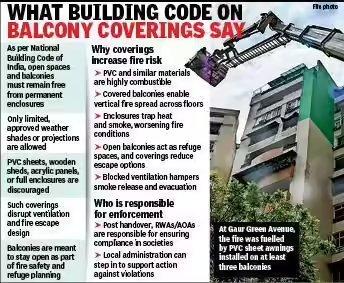
“In many cases, residents are responding to practical issues like dust and heat rather than deliberately ignoring safety norms. But the choice of material is critical. PVC is highly flammable and can significantly worsen fire incidents,” he said.Gupta suggested that if partial coverage is unavoidable, residents should consider less combustible alternatives such as aluminium decking or fire-resistant metal panels. Even these, however, are subject to restrictions related to façade uniformity and building design in group housing complexes.Open balconies, officials from the fire department said, are not merely architectural elements but form a key part of a building’s emergency response design. These act as temporary refuge areas during a fire, allowing trapped occupants access to fresh air and reducing exposure to smoke until rescue teams arrive.“Balconies are designed to remain open for a reason,” said Delhi-based architect Akash Kumar. “They serve as an escape buffer. If the main entrance is blocked during a fire, a covered balcony leaves occupants with very limited options.”Yet enforcement remains weak. Housing societies rarely conduct systematic audits of balcony modifications, and local authorities typically intervene only after complaints or fire incidents.Officials said that in Ghaziabad, once a housing society is handed over by the builder, the responsibility for enforcing building norms shifts to the resident welfare association (RWA) or AOA. However, RWAs often face resistance from residents when attempting to remove unauthorised structures.District magistrate Ravindra Mander said the administration can assist RWAs and AOAs in addressing violations. “We understand enforcement can be difficult within societies. The administration and development authority can provide support on a case-to-case basis,” he said.The April 29 fire, meanwhile, has renewed calls for stricter oversight and periodic safety audits in older apartment complexes, where unauthorised modifications have accumulated over time. Fire officials said proactive checks, combined with clearer accountability for RWAs and residents, could help reduce risks.