







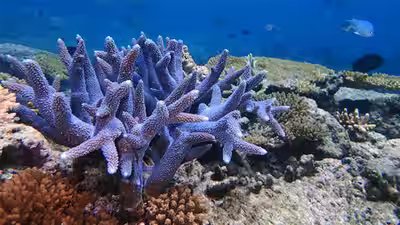
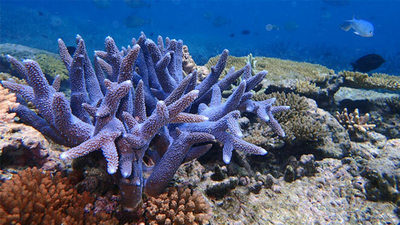
A rare coral species found nowhere else on Earth except Kaneohe Bay in Hawaii has been successfully returned to its natural habitat after completely disappearing from the wild. The recovery project was led by the Hawaii Coral Restoration Nursery, a facility run by the state Division of Aquatic Resources. In 2015, marine biologists rescued surviving pieces of knobby finger coral (Porites compressa variant / rare Hawaiian endemic strains) from Kaneohe Bay on the island of Oahu. They placed the fragments in a special living collection known as the Rare Hawaiian Coral Ark. Soon after the emergency collection was completed, natural colonies of the rare coral disappeared completely from the wild reef because of heat-related bleaching events and storm damage. Details published by the Hawaii Department of Land and Natural Resources and reported by Hawaii Civil Beat show how scientists used land-based methods to grow the rescued coral fragments before returning mature colonies to Kaneohe Bay.
Land-based nursery speeds up coral growth
The Hawaii Coral Restoration Nursery, established in 2015 at the Anuenue Fisheries Research Center on Sand Island, is a specialised land-based facility built to grow native corals faster. Under natural ocean conditions, Hawaiian corals grow extremely slowly, often adding less than one centimetre each year. To overcome this problem, nursery staff used a method called microfragmentation. Biologists cut the rescued coral pieces into tiny fragments about one centimetre in size and attached them to concrete pyramid structures called modules. The fragments were then placed in controlled tanks with suitable lighting, temperature and water flow. Under these conditions, the small pieces grew quickly across the concrete surfaces. When the growing edges of neighbouring fragments touched, they fused together and formed large adult coral colonies. This allowed scientists to produce mature corals much faster than would be possible on a natural reef.According to Christina Jayne, curator at the Hawaii Coral Restoration Nursery, who spoke to Hawaii Civil Beat, the nursery method greatly reduces the time needed to grow the corals. “Corals in Hawaii grow so, so slowly that it may take hundreds of years to recover from an event like that,” Jayne said. “Almost a quarter of our coral species are found nowhere else in the world, so if something happens to one of those species, there is no replacement.” Jayne said the faster-growing method allows the facility to produce fully mature, reef-ready colonies in one to two years. That is less than one-twentieth of the time needed for similar growth on a natural reef. “These large adult corals can instantly contribute to the ecosystem services and functions, being part of the ecosystem of that reef,” Jayne added.
Rare Hawaiian Coral Ark works as a living bank
The living collection, formally established by the Division of Aquatic Resources as the Rare Hawaiian Coral Ark, acts as an emergency biobank for rare, endemic or threatened Hawaiian coral species. The programme was created to protect unique genetic lines from major environmental threats, including rising ocean temperatures, severe storms and pollution carried into the sea from land. When wild coral populations in Kaneohe Bay were wiped out after mass bleaching events in 2015, the fragments kept inside the Rare Hawaiian Coral Ark became the only surviving representatives of that particular wild population. Before returning the grown coral modules to the ocean, nursery biologists put the corals through a strict quarantine and acclimatisation process. This was done to make sure the corals could handle natural conditions in the bay and to prevent any possible pathogens from entering the marine environment.
Coral returned to Kaneohe Bay for monitoring
After completing the growth stages in the Sand Island tanks, nursery staff transported the coral modules back to Kaneohe Bay. Divers placed the heavy concrete pyramids directly on the seabed in selected restoration areas. Field checks by the Division of Aquatic Resources found that the reintroduced corals had successfully adjusted to their natural surroundings. Monitoring teams reported that the colonies had developed strong bases and were growing their living tissue down onto the natural reef surface. They showed no signs of disease or heavy predation by marine animals. The long-term goal of the Division of Aquatic Resources is for the restored corals to become part of the existing reef and eventually reproduce naturally. “The ultimate goal is to have corals on the reef that, if you swim over it, you would have no clue that it was grown in a coral nursery, and it just looks like a natural coral reef,” Jayne noted in the report published by Hawaii Civil Beat. “And that they would contribute to maintaining that reef ecosystem, and reproduce.” The successful return of the Kaneohe Bay coral shows how land-based coral arks can help prevent the complete extinction of local marine species. The Hawaii Coral Restoration Nursery continues to keep living stocks of rare coral species while increasing module production to support future reef restoration projects across Oahu and nearby islands.