








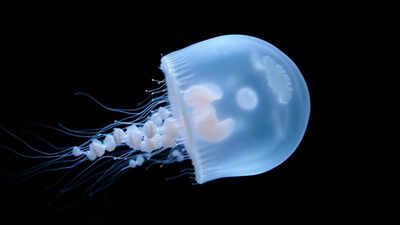
In 1991, NASA sent jellyfish into orbit as part of an experiment to understand how microgravity affects an organism’s sense of balance. The mission carried Aurelia jellyfish polyps aboard the space shuttle, where scientists induced them to develop into their next life stage while in orbit. Researchers wanted to know whether the tiny gravity-sensing structures inside a jellyfish, which work in a similar way to structures inside the human inner ear, would form normally without gravity. The jellyfish did grow and develop as expected during the nine-day mission. But once back on Earth, many of the space-raised jellyfish struggled to swim properly, offering scientists an early clue about how living in space might affect balance in more complex organisms, including humans.
Why NASA chose jellyfish to study balance in microgravity
Jellyfish may seem like an unlikely choice for a space experiment, but their biology made them useful. Inside the bell of a jellyfish sit tiny structures called statoliths, made of calcium sulfate crystals, which sit inside small hair-lined pockets and shift with gravity to tell the animal which way is up. Humans rely on a strikingly similar system in the inner ear, where small mineral structures move in response to gravity and stimulate hair cells that send balance signals to the brain. Because jellyfish are simple, fast-growing organisms whose entire life cycle can unfold within days, they gave scientists a practical way to study how a gravity-sensing system develops when gravity is missing, without needing to send more complex animals into orbit.
How the SLS-1 mission carried jellyfish into orbit
The experiment flew aboard the Space Life Sciences 1 mission on the space shuttle Columbia, a flight dedicated entirely to life sciences research. Jellyfish polyps, the early life stage before a jellyfish takes its familiar bell shape, were sealed in bags of artificial seawater and carried into orbit alongside the crew. Researchers used an iodine-based mixture to trigger strobilation, the process through which a polyp segments and each piece develops into a free-swimming ephyra, the juvenile form of the jellyfish. Some polyps were induced to strobilate before launch and others once the mission was already in orbit, allowing scientists to compare development that happened partly on Earth with development that happened entirely in microgravity.
What NASA found when the jellyfish came home
According to NASA’s own published research on the mission, titled Development studies of Aurelia jellyfish ephyrae which developed during the SLS-1 mission, the jellyfish exposed to microgravity did produce ephyrae successfully, and in some groups the rate of development was slightly higher than in the Earth-based control groups. That part of the experiment suggested jellyfish could develop through this life stage without gravity playing an essential role. The more striking result came from a companion study also carried out by the same NASA team, titled Graviceptor development in jellyfish ephyrae in space and on Earth, which examined the actual gravity sensing organs, called rhopalia, in the space-grown jellyfish. The rhopalia that developed in space looked structurally similar to those grown on Earth, complete with the statocysts, statoliths and hair cells needed to sense gravity.
Why the space jellyfish had trouble swimming
Despite forming gravity-sensing structures that looked normal, many of the space-raised jellyfish showed swimming problems once they were examined back on Earth. Researchers observed a higher rate of pulsing abnormalities among the group that developed later in the mission, including incomplete pulses, muscle spasms, arms that moved out of sync with each other, and unusual after twitches. In practical terms, the jellyfish that grew their balance organs in microgravity did not coordinate their movements the way jellyfish normally do once they were back under Earth’s gravity. The structures needed to sense gravity had formed, but something in how the jellyfish learned to use those structures appeared to depend on developing under the pull of gravity from the start.
What this experiment means for future spaceflight
The results offered scientists an early window into a much bigger question, which is what happens to organisms that develop their sense of balance somewhere other than Earth. Because the human vestibular system relies on the same basic principle as a jellyfish’s gravity-sensing organs- tiny mineral structures moving under the pull of gravity to stimulate hair cells- the swimming difficulties seen in the space-raised jellyfish carried implications well beyond marine biology. It suggested that an organism’s balance system may not simply need the right anatomy to function correctly, but may also need consistent gravitational input during development to calibrate properly. That question has only grown more relevant as space agencies plan longer missions to the Moon and Mars, where astronauts, and potentially future generations conceived or raised off Earth, would need functioning balance systems in environments with far less gravity than home.