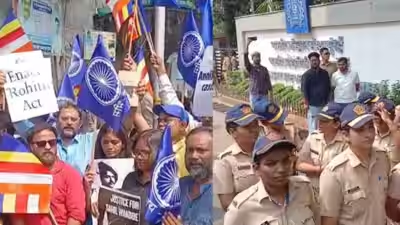







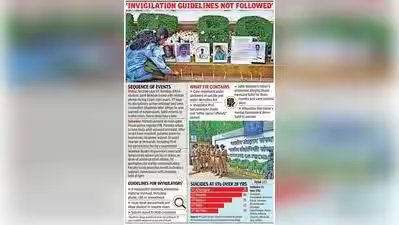
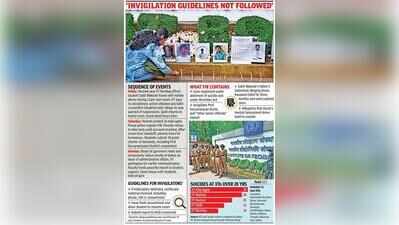
Mumbai: IIT-Bombay on Monday temporarily relieved Prof Suryanarayana Doolla of his duties as dean of administrative affairs pending an investigation, following three consecutive days of student protests over the death by suicide of second-year BTech student Sahil Wakode on Sept 18.Doolla, who has been accused by Wakode’s family of abetment, will continue as a professor in the department of energy science and engineering. Institute sources said he was being relieved of his administrative responsibilities to ensure that the investigation remained independent and unbiased. Some students who continued their protest demanded that he be relieved of his academic work too in the interim.IIT-B also apologised for its earlier communication in which it said Wakode had been found with a phone during an exam and had uploaded questions on an AI platform. It acknowledged that it was inappropriate to disclose or characterise events preceding his death before an investigation had established the facts.A crime branch team led by ACP Dharamveer Bansod searched the student’s hostel room and conducted a panchnama. An official said no summons had been issued so far.Wakode’s family in Yavatmal sought a CID investigation into the death, alleging foul play.Sources said IIT-B will constitute an independent inquiry committee to examine the circumstances surrounding the death. “We apologise for the statements contained in our earlier communication concerning the circumstances surrounding the demise of Sahil… The details and circumstances leading up to the incident remain subject to investigation by the appropriate authorities,” it said.Students have alleged that due procedure was not followed after Wakode was found with a phone, with some also alleging that he was threatened with suspension. In its first statement, issued on Friday, IIT-B had maintained that “no disciplinary action was initiated against the student”.Institute sources said Monday’s decisions were taken at a meeting of the board of governors. An open house, which had first been scheduled and then cancelled, was held in the evening, where students again raised their demands.Wakode’s family has filed an FIR against Doolla and “other institute officials”, accusing them of abetment and harassment over the preceding three months. Protesting students had demanded an apology for what they described as the “defaming” of Wakode, besides an independent inquiry committee with student representatives and external members recommended by them. No decision has yet been taken on the composition of the committee.With Doolla’s suspension among their foremost demands, a section of students said the protests will continue. Wakode’s parents were also expected to join the protest on Monday evening. Their lawyer, Nikhil Kamble, said they were seeking police permission to stage a hunger strike on campus.But opinion within IIT-B remains sharply divided, mirroring the debate outside its gates and on social media. “Among many of us in engineering, the feeling is that the institute authorities have largely done what they were required to do,” said a second-year student from hostel 4. “We also feel the director has handled the situation well. He heard students out and helped calm the anxiety on campus.” The student said the mood was different among sections of the humanities community, where demands for the director’s resignation have been far more vocal.Others cautioned against reading the protests as representative of the entire campus. “IIT-B has close to 14,000 students. Those protesting are a relatively small number compared to the total student population,” said another student.Those divisions are also playing out online. One section has sought accountability over allegations of caste discrimination and questioned whether institutional processes adequately protect students at moments of extreme distress. Another has rallied around Doolla, arguing that faculty cannot be publicly pronounced guilty for enforcing exam rules before an inquiry establishes the facts.Faculty voices have attempted to separate the two issues. Academic misconduct, they argued, must be dealt with firmly, but disciplinary systems must simultaneously have safeguards, counselling and sensitivity built into them.The inquiry will now have to establish what transpired before Wakode’s death, whether institutional procedures were followed, and where accountability, if any, lies—amid a campus where grief and anger have produced sharply competing versions of the same events.During the initial stage of the investigation, the crime branch will collect all documents and case-related paperwork from Powai police, where the FIR was initially registered. The team will examine the case records and subsequently record statements of various people.