









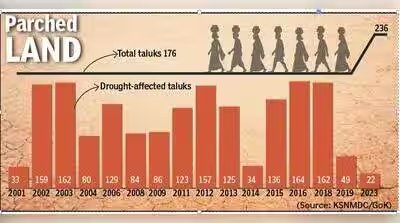
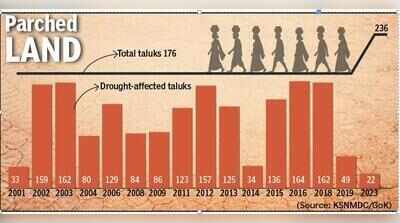
Bengaluru: Karnataka’s weak southwest monsoon has again raised the spectre of drought, with the state ending July with a 26% rainfall deficit overall and several districts reporting even higher shortfalls.Farmers and the govt have already expressed worry, especially in the wake of the Cauvery Water Management Authority asking Karnataka to release 3,500 cusecs to Tamil Nadu for 15 days.“July is the single most important month for Karnataka’s southwest monsoon, contributing around 270mm of seasonal rainfall,” said GS Srinivasa Reddy, meteorologist and former director, Karnataka State Natural Disaster Monitoring Centre (KSNMDC).Chief minister DK Shivakumar has already asked officials to prepare a report, and if drought is eventually declared, it will extend a pattern that has defined much of the state’s recent history.An analysis of KSNMDC data shows Karnataka officially declared drought in 16 of the 25 years between 2001 and 2025, which shows drought has been a recurring feature rather than an exception.But not all droughts have been equal. In 2002, 159 of the then 176 taluks were declared drought-hit, followed by 162 taluks in 2003. The state again witnessed extensive drought in 2016, when 164 taluks were affected. The worst year in the period was 2023, when 223 of Karnataka’s 236 taluks were officially declared drought-affected.Equally telling are the years without drought. Karnataka escaped an official declaration only nine times during the 25-year period. Four of those came consecutively between 2020 and 2022 and again in 2024 and 2025, making prolonged drought-free spells relatively uncommon.The data also reflects Karnataka’s inherent vulnerability. The govt said: “Nearly 79% of the state’s geographical area is drought-prone, the highest proportion among India’s major states. It also has the country’s second-largest extent of dryland after Rajasthan.”These regions, the govt says, are characterised by erratic rainfall, groundwater depletion and severe soil erosion, all of which constrain agricultural productivity. The govt estimates that yields of the state’s 10 most common crops in these areas are two to five times lower than their potential, making watershed development a key component of its drought mitigation strategy.However, an official drought declaration is based on more than just deficient rainfall. Reddy said the assessment is based on prescribed indicators, the first of which examines if there has been either a rainfall deficit of at least 60% or a prolonged dry spell during the crop-growing season. It then evaluates impact indicators such as the extent of sowing, vegetation health, soil moisture and water availability before classifying a drought as moderate or severe.Former Karnataka irrigation secretary Capt S Raja Rao said: “Karnataka does not receive any rain from the northeast monsoon. That means Karnataka must make do with whatever rain it gets in this season until June the following year. That covers dead storage, drinking water supply, irrigation, industries’ needs etc. Add evaporation losses to the equation and the situation looks grim.”