







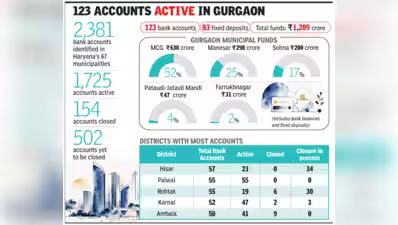
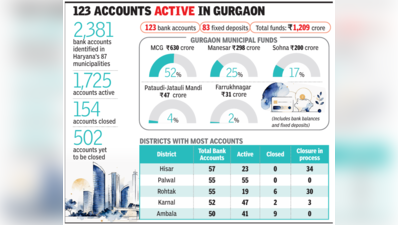
Gurgaon: Months after the alleged Rs 590-crore IDFC First Bank municipal deposit scam exposed weaknesses in the handling of public money, internal govt records show Haryana’s urban local bodies (ULB) department is still struggling to enforce basic financial safeguards across municipalities.Documents reviewed by TOI show that in May and June, the finance and ULB departments directed municipalities to shut down excess bank accounts, explain unauthorised ones, reconcile financial records, and justify why hundreds of crores in public funds remained parked in low-interest accounts.At a recent review meeting in Chandigarh, officials acknowledged the scale of the problem. Across Haryana’s 87 municipalities, the finance department found 2,381 bank accounts. Of these, 1,725, nearly 73%, were operational. Only 154, about 6%, had been closed, while another 502 remained “under process” for closure.Gurgaon district illustrates the issue. Its five municipal bodies collectively operate 123 bank accounts and 83 fixed deposits holding more than Rs 1,209 crore. MCG, the largest civic body, has the fewest accounts among the five at just 11% of the district total (13) and only 5% of its fixed deposits (four). However, these accounts hold over half the district’s money, more than Rs 630 crore, which is around 52% of the total Rs 1,209 crore.Manesar accounts for the largest share of bank accounts at nearly 30% (36), holding 35% of the district’s fixed deposits (29), worth nearly Rs 298 crore. Sohna, with 21% of the accounts (26), holds the largest share of fixed deposits at 37% (31), worth around Rs 200 crore. Pataudi-Jatauli Mandi operates 20 accounts, 16% of the district total, with around Rs 27 crore in bank balances and 10 fixed deposits worth Rs 20 crore. Farrukhnagar holds 23% of the accounts (28) but only around Rs 11 crore in bank balances and nine fixed deposits worth around Rs 20 crore.ULB does not allege that these deposits were fraudulent. But they underscore the volume of public money flowing through a banking structure the finance department has long said needs tighter control, which, records show, has existed on paper for years without being enforced.A March 13, 2018 order already required municipalities to consolidate accounts, cap themselves at one account per scheme, seek prior approval before opening new ones, and invest surplus funds in fixed deposits rather than let them sit idle.A letter the ULB department sent to the district’s municipalities, including MCG and MCM, in May cited that 2018 order directly. “Substantial funds are being held in low-interest savings, current and flexi accounts rather than being placed in higher-yield instruments such as fixed deposits,” it read, seeking clarification on who had authorised the balances and why they hadn’t been moved.“The larger the number of bank accounts, the greater the scope for financial manipulation. During routine transfers, incoming officers may be introduced only to the accounts disclosed to them. If a municipality operates 60 accounts, even two undisclosed ones can escape scrutiny and continue to be used for diverting public funds. That is precisely why the department has long insisted on minimising bank accounts, to eliminate hidden accounts and reduce the risk of fraud,” said a finance department official, requesting anonymity.The most striking finding concerns how these accounts came to exist at all. The department noted that “most bank accounts appear to have been opened without obtaining prior approval,” and has now directed municipalities to name who permitted them and produce the corresponding approval orders.The observation does not establish that every account was irregular or that public money was misappropriated, and there is no indication that officials anticipated the alleged IDFC First Bank scam before it surfaced. What the records show instead is that even after investigators began probing one of Haryana’s biggest alleged municipal banking frauds, the govt kept finding the same unenforced safeguards that had made such a fraud possible in the first place.