










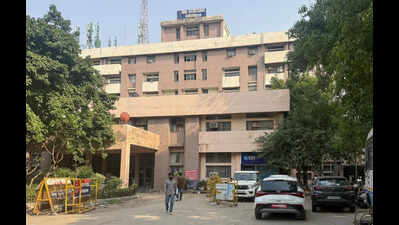
Gurgaon: The income tax department on Tuesday carried out spot verification and survey operations on Tuesday at sub-registrar offices in the city and Mohali following inputs on serious lapses in reporting of high-value realty transactions.The search by the department’s directorate of intelligence and criminal investigation in Chandigarh began early in the morning at the tehsil office at mini secretariat. Officials have so far identified property transaction discrepancies worth Rs 45,000 crore at Gurgaon tehsil.The move is part of a nationwide data-validation exercise to assess quality and accuracy of information submitted by designated reporting entities. Under the law, sub-registrar offices must furnish details of immovable property transactions above Rs 30 lakh to the department through statements of financial transactions. These filings must include PAN details of buyers and sellers so the transactions can be matched with taxpayers’ income disclosures.Officials said inspections in Gurgaon and Mohali revealed widespread inconsistencies in transaction reporting. Preliminary analysis indicated that transactions involving non-reporting, missing PAN details, incorrect PAN entries, and wrongly mapped buyer-seller information amount to nearly Rs 65,000 crore. Of this, Rs 20,000 crore pertains to Mohali tehsil. Officials said the scale of discrepancies is among the largest detected in such proceedings anywhere in the country so far.During the verification process, I-T officials examined data available in the states’ registry management systems and compared it with information submitted to the department under statutory reporting requirements. The comparison reportedly uncovered thousands of cases in which transaction records were either incomplete or inaccurately uploaded.Investigators found that PAN numbers were either missing or entered incorrectly in many cases, making it difficult to establish identities of the parties involved. “In several other cases, buyer and seller details were not properly linked in the reporting structure. Such fragmented or defective reporting substantially reduces the data’s utility for financial profiling and tax compliance analysis,” said an official.The department increasingly depends on third-party transaction reporting to identify possible concealment or under-reporting of income. “Once accurate information is received, it is electronically matched with I-T returns filed by taxpayers. Where mismatches are found, taxpayers are generally encouraged through compliance campaigns to voluntarily correct their returns,” he said.Operations were primarily aimed at improving the integrity of information flow from reporting authorities. However, once corrected information is received from the authorities, the department may examine suitable cases involving major financial discrepancies. The main objective, officials said, would remain to encourage taxpayers to file updated returns.The authorities are now expected to seek corrected and complete transaction records from sub-registrar offices in Mohali and Gurgaon so the information can be effectively used for taxpayer verification and compliance monitoring. Officials said these data-driven exercises aim at strengthening transparency in the real estate sector, improve voluntary compliance, and enhance the effectiveness of non-intrusive tax administration.The department has also intensified its outreach efforts through programmes and sensitisation meetings with reporting entities, including state revenue authorities, to ensure compliance with reporting standards prescribed under the I-T Act. Officials said this would improve voluntary compliance among reporting entities and, in turn, prompt taxpayers to revise their returns wherever necessary.