








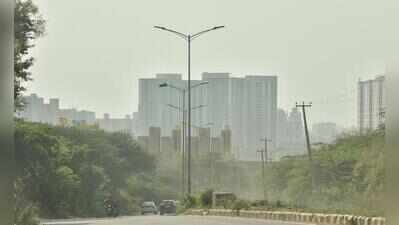
Gurgaon: Haryana is set to conduct real-time pollution source studies in three cities with funding from World Bank. The plan for the real-time source apportionment (RTSA) study — in Rohtak, Rewari and Ballabgarh — was discussed by Commission for Air Quality Management (CAQM) and World Bank Group in New Delhi on Tuesday, a Haryana State Pollution Control Board (HSPCB) official said on Tuesday.Specialised analysers will be installed at locations such as roadside, residential, industrial and background (away from all the sources and in an upwind direction). Each city is likely to have at least five to seven analyser stations. However, their number can be increased depending upon the activity profile of a particular city.The inclusion of the three cities among the locations selected for the proposed studies will help expand the assessment of pollution sources beyond the city, where the completed RTSA study is still being analysed by HSPCB. HSPCB member secretary Yogesh Kumar told TOI, “The discussion focused on establishing RTSA supersites in Delhi-NCR, sharing international best practices and technical capacity and investments required to sustain a regional monitoring network.”The instruments measure pollutants such as PM2.5 and PM10 and may also monitor gases associated with emissions from different sources. Scientists then use analytical models to estimate the contributions of different pollution sources. On completion of data collection, validation and interpretation of the assimilated information, a detailed roadmap will be drawn considering all possible measures for air quality improvement. These measures will be classified as short- and long-term, with due priority to low-cost measures that give maximum benefits. In RTSA studies, measurements and analysis are carried out at frequent intervals rather than relying only on periodic sampling or historical data.An HSPCB official said, “The study will make it easier to ascertain the relative percentage of each source. For example, how much industries are contributing to air pollution and what kind of industries are contributing to air pollution. This will help in understanding which industry should be shut, when and for how long.”The move comes against the backdrop of persistently high pollution levels across Haryana. According to an analysis by Centre for Research on Energy and Clean Air (CREA), five Haryana cities featured among India’s 10 most polluted cities in Sept, based on average PM2.5 concentrations. Panipat topped the national list at 78 micrograms per cubic metre, followed by Jind at 66 µg/m³. The city also featured in the top 10, alongside Yamunanagar and Manesar.Every winter, the air quality in Delhi-NCR plummets to dangerous levels as the region is enveloped by a blanket of toxic haze due to a combination of cold weather and local emissions like garbage burning. Also, farm fires, commonly seen in north India’s agricultural belt to clear tracts of land for another round of sowing after the paddy harvest, contribute significantly to the pollution during this period.The proposed studies in Haryana form part of the wider effort to strengthen scientific assessment of air pollution across Delhi-NCR. On Tuesday, the discussion included presentations on international practices, the status of Delhi’s source apportionment study, emission inventories and the use of RTSA and decision support systems for the region. Discussions were carried out on the actions required to establish the RTSA network, with participation from experts, state representatives and World Bank Group. The discussions were aimed at identifying the next steps for establishing the RTSA network and strengthening the technical capacity needed to support air pollution management across Delhi-NCR, an official said.The city’s study was commissioned from Automotive Research Association of India (ARAI). It began on Feb 1, 2023, and was initially expected to be completed earlier. ARAI subsequently sought a six-month extension, citing the need for more time last year. The study got completed this year, but HSPCB is still analysing its findings. A timeline for releasing the results has not been specified.Delhi has already used a real-time source apportionment system called R-AASMAN, which stands for Real-time Advanced Air Source Management Network. It was developed through a project led by IIT Kanpur for the Delhi govt.The system used two key components: A stationary supersite and a mobile air laboratory.