







For a state as large and populous as Uttar Pradesh, food security is not merely a welfare measure—it is a fundamental pillar of social stability and inclusive development. With a population of about 25 crore, ensuring that every eligible household receives its foodgrain entitlement regularly, transparently and without discrimination is a logistical challenge of enormous proportions.Over the last nine years, Uttar Pradesh has attempted to address this challenge through a combination of expanded food support, technology-led reforms, digitisation, Aadhaar authentication, electronic Point of Sale (e-PoS) machines, portability of ration cards, stronger procurement and supply-chain management, and closer monitoring of Fair Price Shops (FPSs).The result is a Public Distribution System (PDS) that increasingly seeks to move away from a traditional, paper-based model towards a technology-enabled system in which the movement of foodgrain can be tracked and the beneficiary’s entitlement can be authenticated at the point of delivery. Today, around 15 crore people in Uttar Pradesh are covered by the state’s food-security arrangements, with approximately 3.18 crore Priority Household (PHH) ration cards and more than 40 lakh Antyodaya Anna Yojana cards reported in 2025. PHH beneficiaries are entitled to 5 kg of foodgrain per person per month, while Antyodaya households receive 35 kg per family per month.
From foodgrain allocation to doorstep delivery
The transformation of the PDS has involved strengthening the entire chain—from procurement and storage to transportation, allocation, the Fair Price Shop and finally the beneficiary. Under the National Food Security Act (NFSA), the Centre provides assistance for intra-state movement and handling of foodgrains, as well as margins for Fair Price Shop dealers. The system also provides additional support for distribution through electronic Point of Sale machines. Foodgrains are transported from designated FCI depots to the doorstep of FPS outlets, helping create a more structured supply chain.For Uttar Pradesh, where millions of beneficiaries are spread across villages, towns, cities and remote areas, strengthening this supply chain is essential. The objective is not simply to allocate foodgrain on paper but to ensure that the allocated quantity reaches the shop and ultimately reaches the person for whom it was intended.This end-to-end approach has been complemented by stronger procurement of agricultural produce within the state. Government data show that between Kharif marketing year 2017-18 and 2023-24, Uttar Pradesh procured 456.86 lakh metric tonnes of paddy, paying farmers ₹88,746 crore. Procurement of millets and jowar was also expanded, creating additional channels for farmers while supporting diversification of the food basket. Thus, food security has increasingly been connected with the agricultural economy: farmers receive a market for their produce while consumers receive assured supplies through the public distribution network.
Technology facilitates PDS reform
One of the most significant changes of the last nine years has been the digitisation of the PDS. The traditional ration system was vulnerable to several problems—duplicate cards, ghost beneficiaries, manual record-keeping, diversion of foodgrain and lack of real-time information about transactions. Digitisation has attempted to address these weaknesses.Ration-card and beneficiary databases have been digitised, Aadhaar has been seeded with ration-card records, foodgrain allocation has been computerised and transactions at Fair Price Shops have increasingly moved to electronic platforms. At the national level, the Department of Food and Public Distribution reports that almost the entire PDS database has now been digitised, with more than 19.8 crore ration cards covered and around 99 percent of Fair Price Shops automated. For beneficiaries in Uttar Pradesh, this means that the ration shop is no longer simply a physical outlet. It has become a digitally connected point in a much larger supply and entitlement-management system.
E-PoS machines and transparency to the ration shop
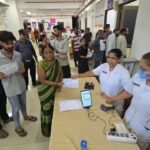
Electronic Point of Sale machines have been one of the most visible reforms at the beneficiary level. At an e-PoS-enabled Fair Price Shop, the beneficiary’s entitlement can be retrieved electronically. Authentication through Aadhaar-based biometrics or other permitted mechanisms records the transaction, helping create a digital trail. This is important because it establishes a direct link between entitlement and actual distribution.This technological intervention tells who received the ration? how much was received? when was it received? from which Fair Price Shop? what quantity was distributed? Such electronic records strengthen accountability and make large-scale diversion more difficult.The Union government’s PDS reforms also provide for alternative authentication mechanisms where biometric authentication fails because of technical problems, connectivity issues or other reasons. Official guidance specifically calls for a no-denial approach for genuine beneficiaries in such situations, with alternative identity mechanisms available.That safeguard is particularly important in a state with enormous rural and semi-urban populations, where network connectivity and biometric authentication can sometimes present practical challenges.
Aadhaar: identifying the genuine beneficiary
Aadhaar seeding has been another major component of PDS modernisation. The objective is not simply authentication at the ration shop. Linking beneficiary databases helps identify duplicate and potentially ineligible records and creates a more reliable beneficiary database.The national PDS reform programme explicitly identifies Aadhaar seeding as a mechanism to establish unique beneficiary identities and reduce duplication. For Uttar Pradesh, this is significant because the sheer size of the beneficiary base makes manual verification extremely difficult.Digitised records combined with Aadhaar authentication provide the administration with a more robust mechanism to ensure that foodgrain intended for eligible families reaches those families. At the same time, the system has increasingly recognised the need for alternatives when authentication fails. Current central guidelines provide for biometric alternatives such as iris authentication and OTP-based authentication, while genuine beneficiaries are not supposed to be denied their entitlement merely because of technical or connectivity problems.
One Nation, One Ration Card: ration beyond the village
Perhaps the most transformative reform for migrant workers and mobile families has been the One Nation One Ration Card (ONORC) system. Uttar Pradesh implemented ONORC in May 2020. State government material reports that, since implementation, foodgrains have been provided to beneficiaries from other states as well as to millions of Uttar Pradesh ration-card holders through portability.The significance of portability became especially evident during and after the COVID-19 pandemic. A worker from eastern Uttar Pradesh employed in Noida, Ghaziabad, Delhi or another state no longer needs to depend entirely on physically returning home to access the family’s ration entitlement. Under ONORC, an NFSA beneficiary can use the existing ration card at an e-PoS-enabled Fair Price Shop in another participating state after authentication.The central system describes ONORC as enabling NFSA beneficiaries to collect their full or partial entitlement from any e-PoS-enabled Fair Price Shop across the country. For a state with substantial seasonal and long-term migration, this represents a major shift in the meaning of food security: the entitlement travels with the beneficiary rather than remaining tied to a particular shop or village.
COVID-19 and the test of the PDS
The true test of any food-security system comes during a crisis. The COVID-19 pandemic created unprecedented disruption to employment, migration, transportation and household incomes. Millions of families suddenly faced the possibility of losing their regular income.During this period, the Pradhan Mantri Garib Kalyan Anna Yojan a (PMGKAY) provided additional free foodgrain support to NFSA beneficiaries. In July 2021, the Union government reported a record allocation of 109.33 lakh tonnes of foodgrain for free distribution to 14.71 crore beneficiaries in Uttar Pradesh, with the value of the allocated grain estimated at ₹40,093 crore.The importance of this intervention went beyond the quantity of grain. It provided a consumption safety net at a time when millions of workers and vulnerable households were facing income uncertainty.The experience also reinforced the importance of digital PDS infrastructure. With beneficiary databases, electronic transactions and portability systems already developing, governments had a technological foundation for delivering assistance on a massive scale.
Free foodgrain as a continuing safety net
Food security has subsequently moved from being primarily associated with subsidised grain to a system in which eligible NFSA beneficiaries receive foodgrain free of cost under the expanded national arrangement.Under the current framework, Antyodaya households receive 35 kg per month, while Priority Households receive 5 kg per person per month. Foodgrains under the scheme have been provided entirely free since January 2023, with the Union government approving continuation of free foodgrain distribution through 2028. For Uttar Pradesh, the scale is enormous.With around 15 crore people covered, even a small improvement in delivery efficiency has a substantial social impact. Every month, millions of transactions have to be completed across thousands of Fair Price Shops. The challenge therefore is not merely announcing a welfare entitlement. It is creating a system capable of delivering that entitlement repeatedly, month after month, across one of India’s largest states.
Augmenting the food basket
Uttar Pradesh has also supplemented the basic foodgrain entitlement with additional commodities for vulnerable households. According to state government material, the food-support package has included 1 kg gram, 1 kg iodised salt and 1 kg refined oil for around 15 crore poor people. Antyodaya ration-card holders have also received free sugar allocations.This broadens the concept of food security from simply providing calories through cereals to supporting a more diversified household food basket. The complementary nature of these interventions is important. Food security is strengthened when foodgrain availability is accompanied by cooking fuel, income support, housing and other welfare measures.For example, more than 1.86 crore families in Uttar Pradesh have received LPG connections under the Pradhan Mantri Ujjwala Yojana, according to state government data. The combination of ration and cooking fuel helps bridge another gap between receiving foodgrain and actually being able to prepare meals.
Monitoring, data and accountability
The modern PDS increasingly depends on data. The central Annavitran and Integrated Management Public Distribution System (IM-PDS) platforms provide transaction and distribution information. The system allows authorities to monitor e-PoS transactions and portability movements and supports reconciliation between states when beneficiaries draw ration outside their home state.The live IM-PDS platform illustrates the scale of this digital architecture, recording ration-card, beneficiary, transaction and commodity-distribution data across states. This creates the possibility of identifying unusual patterns, monitoring distribution and responding more quickly to problems.The shift is therefore from a system based primarily on registers and physical inspection to one increasingly supported by electronic records and dashboards.
Strengthening the last mile
Technology alone cannot guarantee food security. The final link remains the Fair Price Shop dealer and the local administration. Uttar Pradesh’s PDS reforms therefore have to work at the last mile—ensuring regular opening of shops, adequate stocks, functioning equipment, accurate weighing, beneficiary awareness and grievance redressal.The NFSA framework itself envisages reforms including doorstep delivery, end-to-end computerisation, greater transparency, use of technology and greater participation of institutions such as Panchayats, self-help groups and cooperatives in the management of the PDS.The government’s objective is consequently becoming broader: not simply to distribute foodgrain, but to create a transparent delivery ecosystem in which the beneficiary can claim an entitlement with minimal friction.A shift from welfare distribution to entitlement delivery has been the most important change over the last nine years may ultimately be conceptual. The PDS is increasingly being treated not as a discretionary distribution mechanism but as an entitlement-delivery system.A ration card represents a recognised household entitlement. The e-PoS transaction records its utilisation. Aadhaar authentication helps establish identity. ONORC allows portability. Digital dashboards enable monitoring. Procurement and supply-chain reforms support availability. And additional welfare interventions strengthen the household safety net.Together, these measures create multiple layers of protection. For a migrant worker, portability means ration need not stop when migration begins. For a rural household, digitisation reduces dependence on paper records. For the administration, electronic transactions provide greater visibility. For vulnerable families, free foodgrain provides protection against sudden income shocks.
Yogi government builds food-security ecosystem in nine years
Uttar Pradesh’s food-security journey since 2017 is therefore not defined by a single scheme. It is the cumulative result of NFSA entitlements, PMGKAY support, digitised ration cards, Aadhaar-linked beneficiary databases, e-PoS machines, ONORC portability, computerised allocation, strengthened supply chains, expanded procurement, additional food commodities and technology-based monitoring.The scale of the achievement is inseparable from the scale of the state. Feeding and supporting around 15 crore beneficiaries every month requires an administrative network that reaches from state-level warehouses to the smallest Fair Price Shop. The evolution of the PDS demonstrates how welfare delivery can be transformed when physical infrastructure is combined with digital infrastructure.In Uttar Pradesh, the last nine years have seen the PDS move significantly in that direction—from a conventional ration-distribution mechanism towards a technology-enabled food-security network designed around transparency, portability and last-mile delivery.For lakhs and lakhs of families—and, in reality, crores of beneficiaries—the importance of that transformation is measured not in databases or dashboards, but in something much more fundamental: the assurance that food will reach the household when it is needed.