








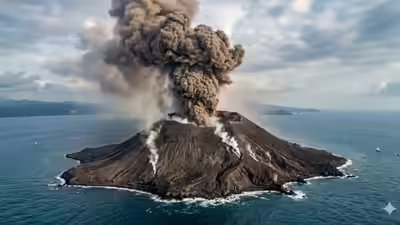
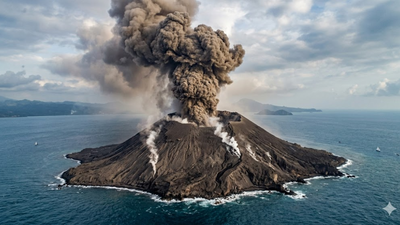
The year 1883 saw one of the deadliest eruptions in the history of volcanoes, erupting from the Indonesian volcano Krakatoa (or sometimes referred to as Krakatau). The location was the Sunda Strait that lies between the islands of Java and Sumatra. The power of the eruption was so devastating that it caused enormous tsunamis, brought darkness to half the earth, and destroyed much of the island. Years later, a new island volcano named Anak Krakatau (or Child of Krakatoa) rose from the ocean but collapsed partly in 2018. But the story of Krakatoa is not only one of devastation and disasters.
The rise of the self-destructive Krakatoa volcano and the birth of Anak Krakatau
Krakatoa existed long before its famous 1883 eruption as a volcanically active island due to tectonic forces associated with the Pacific Ring of Fire. The island was situated on top of a subduction zone characterised by movements of the Indo-Australian Plate under the EurasianPlate that created high underground pressures. Based on the findings reported in the Journal of Applied Geoscience and Engineering, prior volcanic collapses might have led to the formation of a caldera hundreds of years ago.As reported by NASA, as far back as May 1883, Krakatoa became quite active again with ash clouds, tremors, and eruptions, indicating increasing underground pressures inside the volcano. Finally, on 27th August 1883, there were four volcanic explosions which blew up most of the island in just several hours. After all calculations, scientists concluded that the eruption had ejected about 18-21 cubic kilometres of volcanic products into the air.It is worth mentioning that the eruption was so loud that it was heard several thousand kilometres away. The noise was described by NASA as “the loudest noise in human history.”
The eruption that destroyed a whole island
However, the explosion caused far more than mere destruction of rocks and ash. Huge tsunamis as high as 30 meters occurred and caused extensive damage to coastal populations of Java and Sumatra, resulting in the death of more than 36,000 individuals, who died not due to the volcanic eruptions, but because of tsunamis.According to meteorologist G. J. Symons’ publication “Erruption of Krakatau and Subsequent Phenomena,” issued in 1884, the Royal Society had formed a committee “for the collection of accounts of the erruption [sic] of Krakatau and its subsequent phenomena for their preservation and usefulness.”Later, volcanologists, via a paper in Nature, provided more information about the reasons why the volcanic eruption resulted in tsunamis. They noted that the pyroclastic flows generated by the eruption fell into the sea and facilitated the occurrence of tsunamis.Additionally, the explosions led to a temporary change in weather conditions. Ash and sulfur particles rose to the atmosphere, thus making sunsets unusually beautiful and causing cooling of the planet for a while.
Anak Krakatau: the return of the child of Krakatoa
It seems that nature had yet another trick for Krakatoa; the destruction, it seems, was not the end. A new volcanic cone started to emerge from the waters of the ocean in 1927, almost fifty years after the initial event, which locals named Anak Krakatau.The island continued to expand over decades, growing thanks to multiple volcanic eruptions and lava flows. Satellite images provided by NASA have revealed that new lava appeared as late as 2012, further expanding the coastline of the island.Unfortunately, like its progenitor, Anak Krakatau is unstable too. In December 2018, some of the material of the island fell into the ocean, creating another destructive tsunami that led to the deaths of numerous people near the coastline.Once again, the life cycle of Krakatoa proves itself to be rather cyclical. Even today, Anak Krakatau remains a very active volcanic island and serves as a witness to a unique process of creation and destruction.