






Niranjan.Kaggere
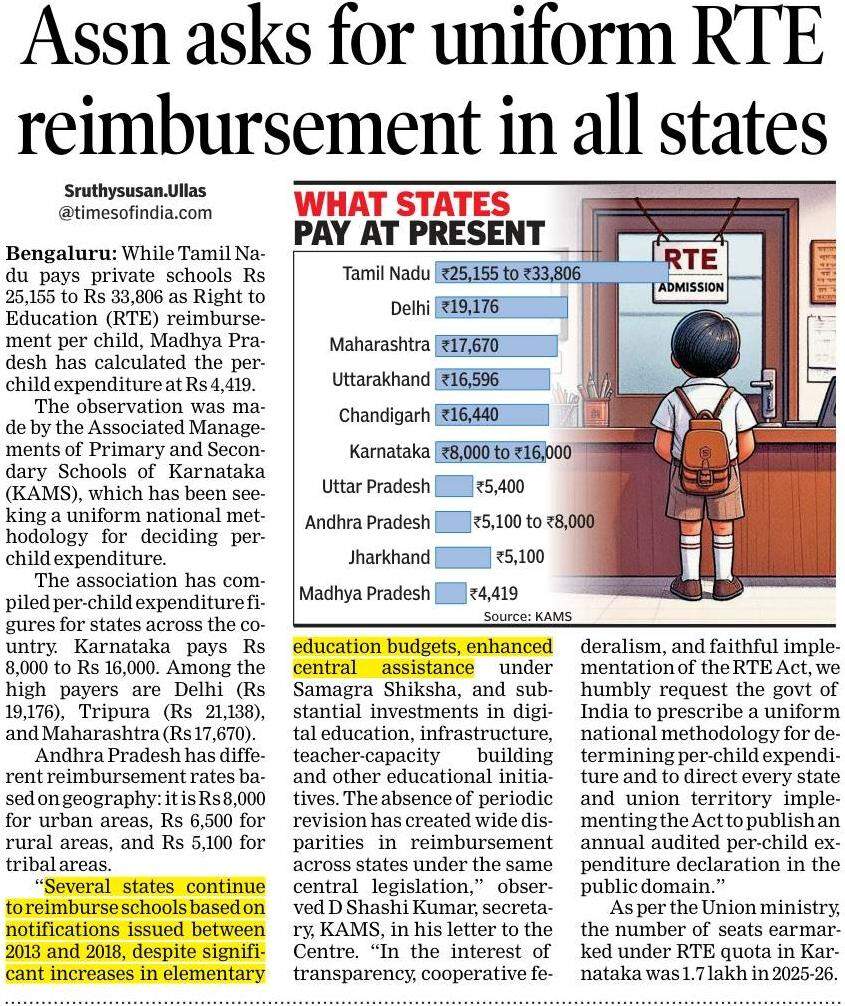
Times of India report published on Aug 5, 2026, on the private schools’ association’s demand for uniform RTE reimbursement rates across all states.
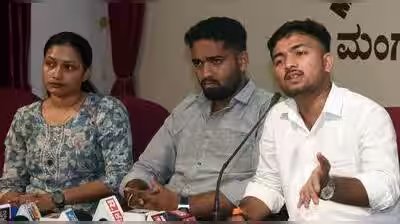
Bengaluru: How much does it cost govt to educate a child? The question is now before Karnataka high court, which has issued an emergent notice to the Union and state govts on a petition seeking a transparent formula to calculate reimbursements to private schools under the Right of Children to Free and Compulsory Education (RTE) Act.The petition by the Associated Managements of Primary and Secondary Schools in Karnataka (KAMS) also challenges state govt’s continued reliance on rates fixed eight years ago, arguing that the absence of transparent expenditure calculations has left thousands of private schools bearing an unfair financial burden.Following the high court’s notice to both govts, KAMS office-bearers described their writ petition as a first-of-its-kind national initiative seeking accountability from the Union and state govts in calculating per-child expenditure.The dispute stems from reimbursement rates of Rs 16,000 per child annually for primary classes and Rs 8,000 for nursery classes, which were notified for the 2017-18 academic year. KAMS contends that these rates have remained unchanged despite rising expenditure on teachers’ salaries, infrastructure, learning materials and digital education as well as inflation.TOI had published a detailed report on the association’s demand for uniform RTE reimbursement in all states across India in its Aug 5, 2026, edition.According to KAMS’ assessment, a scientific revision could raise the expenditure benchmark substantially, potentially to Rs 60,000-80,000 or more per child annually. The association said actual reimbursement would remain subject to the statutory ceiling — govt’s per-child expenditure or the school’s actual fee, whichever is lower.D Shashi Kumar, general secretary of KAMS, said, “Our research indicates that many budget private schools provide quality education at less than 30% of the govt’s per-child cost (Rs 30,000-40,000). Yet they are routinely branded ‘mafia’ and accused of indulging in ‘daylight robbery’ of (students’) parents. Hence, we are asking the govt, through the court, to publish the actual figures and let the country judge.”The association also cautioned govt that inadequate reimbursement for children admitted under the mandatory 25% RTE quota could force budget private schools to absorb the shortfall or indirectly pass the burden on to families paying fees for the remaining 75% of seats.“The govt cannot discharge its public obligation by leaving schools and other parents to finance the shortfall. Disclose the real expenditure, adopt an auditable methodology and pay lawful reimbursement on time,” the association demanded.Box:Closure of govt schools to impact RTE burdenWith the closure or consolidation of govt schools, more families could be forced to turn to private institutions, potentially increasing demand for admissions under the RTE quota. But private schools, particularly budget institutions catering to low-income families, are already struggling with reimbursement rates frozen for years despite spiralling costs. The result could be a widening mismatch between the govt’s obligation to provide free education and its willingness to adequately fund it.