










LUCKNOW: The ambition of the Yogi government is not merely to provide jobs, but to transform Uttar Pradesh into an economy where government recruitment, private enterprise, manufacturing and entrepreneurship together drive prosperity and employment.
Rewriting Uttar Pradesh’s employment story
For decades, Uttar Pradesh faced one of the country’s most demanding development challenges: providing livelihoods to an enormous and growing young population. With limited industrial opportunities and too few jobs close to home, millions of people left their villages and towns for Delhi, Mumbai, Gujarat and other industrial centres.Migration became a familiar part of family life in many districts, particularly in the eastern and central parts of the state. Households often depended on remittances sent from distant cities, and young people spent their most productive years far from their families.Changing this reality required more than filling vacancies in government departments. It demanded a transformation of the state’s economic environment. Investment, infrastructure, manufacturing, entrepreneurship and skill development all had to work together as engines of employment, so that a young person could find a worthwhile opportunity without leaving the state.Since 2017, the Yogi Adityanath government has pursued this approach on several fronts at once. Its employment figures point to an expanding ecosystem of public-sector recruitment, private enterprise, MSMEs and industrial investment.The government reports that approximately 9.5 lakh young people have received government jobs since 2017. In addition, more than four crore employment opportunities have been generated through MSMEs and private entrepreneurship.These two figures represent the pillars of the state’s strategy: expanding public employment while creating opportunities across the wider private economy.
9.5 lakh government jobs: Recruitment through transparency
One of the achievements the government highlights most is the appointment of approximately 9.5 lakh people to government posts since 2017. For a state with Uttar Pradesh’s population and its competitive examination culture, recruitment at this scale matters.Government employment remains among the most sought-after career paths for young people, and millions of aspirants prepare for it every year.These appointments span police, education, health, medical education, revenue, technical services and other departments. According to government figures, police recruitment alone accounts for more than 2.25 lakh appointments, while teacher recruitment has crossed 1.5 lakh.Together, these appointments have strengthened the frontline machinery of law enforcement, schooling and public services.The government has emphasised transparency, merit-based selection and time-bound recruitment. Its stated objective has been to move away from the irregularities and delays that, in earlier years, had undermined the confidence of young aspirants.For candidates who spend years preparing, a predictable and credible process is itself a form of public service.Recruitment has also continued beyond the initial large-scale drives. The chief minister has set a target of providing one lakh additional government jobs by January 26, 2027.Processes are underway for thousands of police and Home Guard positions, alongside vacancies in other departments. The distribution of appointment letters to 1,146 junior assistants in the Revenue Department on November 11, 2026, reflects this continuing momentum.
MSMEs and private entrepreneurship: Four crore employment opportunities
Government employment is only one part of Uttar Pradesh’s changing employment story. No government can employ more than a fraction of its young citizens directly. The larger transformation is therefore taking place through micro, small and medium enterprises and private entrepreneurship.Uttar Pradesh has nearly 96 lakh MSME units, making it one of India’s largest MSME ecosystems. These enterprises support employment across textiles, leather, carpets, handicrafts, food processing, engineering, metal products and many other sectors.Many are family-run or located in small towns and villages, so they provide livelihoods where large factories are rarely found.The government estimates that MSMEs and private entrepreneurship have generated more than four crore employment opportunities.This figure shows the importance of enterprises that provide livelihoods beyond formal government recruitment, particularly in smaller towns and rural areas, where a local workshop, a processing unit or a small manufacturing firm can change the economic prospects of an entire neighbourhood.To strengthen this sector, the Uttar Pradesh MSME Promotion Policy 2022 offers eligible enterprises capital subsidies of up to 25%, subject to a ceiling of Rs 4 crore. Interest subsidies, stamp-duty exemptions and other incentives seek to encourage investment, modernisation and expansion.Special provisions for Purvanchal and Bundelkhand aim to promote entrepreneurship in relatively less-developed regions, so that growth is not concentrated in a few established industrial pockets.Digital platforms such as MSME 1-Connect are also intended to simplify access to government schemes, financial assistance and business support.For a first-generation entrepreneur, easier access to information and credit can make the difference between an idea that stays on paper and a business that hires its first workers.
ODOP: Traditional skills become modern enterprises
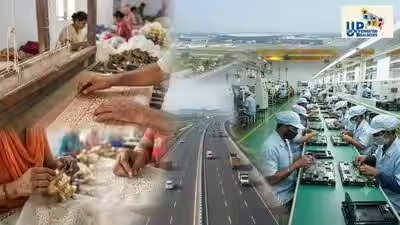
The One District One Product (ODOP) initiative, launched in January 2018, has emerged as a distinctive pillar of the government’s employment strategy. It rests on a simple observation: nearly every district in Uttar Pradesh has a traditional product, craft or skill that generations of artisans have preserved, but many of these producers lacked the design, technology and market access to turn their skills into stable incomes.ODOP identifies the signature product of each district and gives producers support in design, technology, branding, packaging, finance and marketing.Banarasi silk, Lucknow Chikankari, Bhadohi carpets, Moradabad brassware, Kannauj perfumes, Saharanpur woodcraft, Firozabad glassware and Agra leather products are among the products receiving focused attention.By connecting artisans and traditional manufacturers with larger domestic and international markets, ODOP has sought to turn inherited skills into commercially viable enterprises. According to Invest UP, ODOP products generated approximately Rs 93,000 crore in exports in 2024.The next phase, ODOP 2.0, places greater emphasis on quality, modern technology, e-commerce and international competitiveness.The initiative’s larger contribution lies in strengthening local production networks. When a district’s signature product finds new buyers, the benefits reach artisans, suppliers, transporters, packaging units and small traders, creating opportunities for workers and entrepreneurs within their own districts rather than in distant cities.
Investment and industrialisation: Expanding the employment base
Infrastructure development has been central to the state’s efforts to attract investment and create new employment centres. Expressways, airports, industrial corridors and logistics facilities have improved connectivity and made Uttar Pradesh more attractive for manufacturing and services.Good roads, reliable logistics and access to markets are often what decide whether a company sets up a factory in a state.The state has attracted investment proposals worth approximately Rs 50 lakh crore through investor summits and other initiatives.Ground Breaking Ceremonies have translated a substantial part of this pipeline into projects at various stages of implementation, which is the step that matters most for employment, since proposals create jobs only when they become operating units.Several clusters illustrate the direction of this expansion. Electronics and mobile-phone manufacturing in Noida and Greater Noida, the Defence Industrial Corridor across six nodes, and the emerging industrial region around the Noida International Airport are creating opportunities in manufacturing, engineering, logistics, aviation and allied services.Such industries also generate secondary employment in transport, construction, hospitality and ancillary supply chains.The government is also promoting investment beyond established industrial centres, with particular attention to Bundelkhand and Purvanchal. The aim is more balanced regional development, so that young people in every part of the state have access to opportunity.
Skills and employment connectivity
Jobs and investment alone are not enough unless young people have the skills employers want. The government has therefore strengthened vocational training, apprenticeship programmes, employment fairs and industry-linked skill development.The Rojgaar Sangam portal serves as a platform connecting jobseekers with private-sector vacancies, employers, campus placements, employment fairs and career guidance. By bringing both sides of the labour market onto one platform, it aims to reduce the gap between those looking for work and those looking for workers.Internship initiatives under the PM and CM programmes are also intended to give young people practical experience and improve their employability. Exposure to real workplaces helps graduates build confidence and professional skills that classroom learning alone cannot provide.The objective throughout is to bridge the gap between education and industry requirements, so that the state’s expanding economy has access to a skilled workforce.
From migration to opportunity
The significance of Uttar Pradesh’s employment transformation lies in the combination of government recruitment and private-sector expansion. The 9.5 lakh government appointments represent one dimension; the more than four crore employment opportunities attributed to MSMEs and private entrepreneurship represent the much larger livelihood-generating ecosystem.Both are needed: public jobs offer security and stability, while enterprise offers scale and dynamism.The challenge ahead is to ensure that investment commitments become operational projects, that employment opportunities translate into sustainable jobs, and that workers receive better incomes and working conditions. Numbers on paper matter less than the quality and durability of the livelihoods behind them.Nevertheless, the policy direction marks an important shift. Uttar Pradesh is seeking to move beyond an economy dependent on migration towards one capable of generating opportunities within its own districts.For a young person in eastern Uttar Pradesh, an artisan in the west or an aspiring entrepreneur in Bundelkhand, the larger promise is that employment and enterprise should increasingly be possible closer to home.


