








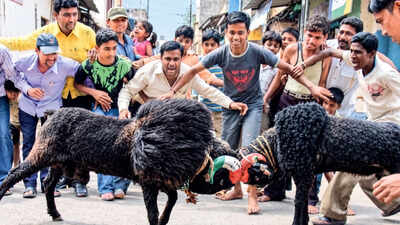
BENGALURU: In villages across north Karnataka, a champion ram’s fame can outlive its fighting career, and, in some cases, even its life.At Adavi Somapur in Gadag, a stone likeness of ‘Gadagina Gama Champion Rama’ stands at Beeralingeshwara temple, where devotees continue to worship the champion. In Belludi village, another memorial honours ‘Belludi Kaali Ram.’These memorials reflect an unusual culture of hero worship surrounding champion rams in north Karnataka. What begins as a rural ram fighting contest or ‘Tagaru Kaalaga,’ can turn the horned male sheep into a local celebrity, attracting devoted followers, valuable prizes, and even posthumous reverence.However, the popularity of these fights also brings allegations of animal cruelty and questions about their legality.One of the earliest known examples of this practice is the stone memorial built by Panduranga Bhandge for his champion ram, ‘Gadagina Gama Champion Rama.’Named after the legendary wrestler and strongman, the Great Gama, the ram won 50-60 tournaments during its active years between 2000 and 2007, accumulating 9 kg of silver, 70 grams of gold, and numerous cash prizes for its owner. Devastated by Gama’s death on Dec 30, 2007, Bhandge commissioned a stone replica, which was installed at the temple in 2010.In Belludi village of Harihar taluk, a similar stone memorial constructed in January 2026 honours ‘Belludi Kaali Ram.’ Owners Raghavendra DK and Mohan DK spent Rs 9 lakh on the memorial and an additional Rs 3 lakh on its inauguration — complete with food, rituals and a ram fighting tournament.Kaali, who died on Nov 25, 2024, drew crowds wherever it fought. When he died, fans from Karnataka, Andhra Pradesh and Tamil Nadu, many sporting tattoos of his name, arrived to pay their respects.The brothers say they have never calculated how much Kaali earned through its victories and popularity. The memorial, carved by sculptor Shakti from Tamil Nadu, features a detailed statue of Kaali at the centre, four ornate pillars at the corners, stone chains on the pillars, and carved elephants. Daily prayers are now conducted at the memorial.Commemorating a champion is not limited to stone memorials. In Haveri district, Mohammed Tabrez of Akkialur keeps the memory of his favourite ram, Mental Ninja, alive by organising an annual ram-fighting tournament in its honour. The names given to champion rams are another attraction.Owners often draw inspiration from local deities, legendary heroes, filmstars, and popular movies. Some of the popular names include Kalki, Sutagonda Sultan, Bachchan, Killer, Rockybhaai, Fighter, Titanic Hanumanthu, Kali, Toofan, Almatti Kichhu, Varada, Ranadheera, Benkichendu, and RTG Kariya Kodekal.
What do bouts involve?
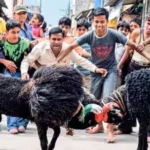
Bouts involve pitting two large-horned male sheep head-on in open grounds until one is declared the winner.A ram-fighting tournament usually requires six to seven rounds to decide a winner, depending on the strength of the animals. Some contests end within four or five rounds, while evenly matched rams may fight fiercely until the seventh and final round. The ram that knocks down its opponent is declared the winner.A ram unable to withstand or return attacks may flee the ring or stand silently without fighting for two or three rounds. In rare cases, rams collapse after suffering severe head injuries.Organisers nominate people with knowledge of ram fighting and experience in conducting such contests as judges, and they are usually paid an honorarium.Appointments are based on experience and knowledge rather than any specific qualification or professional background.Owners train their rams daily, often taking them on walks of 6-8 km. Their diets include green leaves, sprouted grains, eggs, milk and supplements. Maintenance can cost Rs 200-300 per animal per day. ams are categorised according to the number of teeth — two, four, six or eight — before being matched in contests.Enthusiasts pay anywhere between Rs 2 lakh and Rs 7.5 lakh to buy a champion ram with a good track record. Even ordinary rams fetch between Rs 10,000 and Rs 4 lakh, turning sheep rearing into a profitable business for farmers in north Karnataka.
A growing betting economy
Ram fighting is common in Dharwad, Gadag, Bagalkot, Davanagere, Vijayapura and Belagavi districts, and is also practised in parts of neighbouring Maharashtra.Spectators reportedly place bets ranging from Rs 5,000 to Rs 5 lakh per bout. “It has become a parallel betting economy during festival season,” said a senior police officer in Dharwad.Prize money has risen sharply over the past decade. Earlier, winners received between Rs 100 and Rs 10,000, along with household items. Today, cash awards can range from Rs 10,000 to Rs 4 lakh.Sangappa Handaragalla from RS Benal in Vijayapura district said, “My ram, named RN Benal Kariya, won several tournaments, and cash prizes worth Rs 3-4 lakh, besides motorcycles.” Baramappa G, who oversaw the Bilagi tournament, said, “We were the first ones to start this tradition. Thousands of people gather to witness the ram fight.”
Tradition, community & politics
Organisers describe these contests as a rural tradition and a way to bring communities together. Most tournaments are held discreetly in villages, away from cities, with organisers frequently changing venues to avoid police action. Participation cuts across communities and religions.Members of Somavamsha Sahasrarjun Kshatriya (SSK) community, also known as Savji or Pategars, are among those widely associated with organising such events.Pategar Pandurang Bhandge, a ram trainer from Gadag, popularly known as Babanna, said, “Breeding and training rams to compete in open grounds or designated rings is a very challenging task.” Organisers reject allegations of cruelty.“We rear sheep and rams like our own children and take great care if there are any health issues among them. It is just like wrestling,” said Baramappa G.There have been no reports of deaths in recent years, and injured animals get treated promptly, say organisers of these contests. Ram-fighting tournaments have also become platforms for local political visibility.Businessmen, aspiring politicians and sponsors fund events, often held during temple fairs and festivals such as Dasara and Diwali, to build their public profiles. Some gram panchayats issue formal letters, while organisers often rely on oral permissions.Police officials maintain that action will be taken where required. H T Shekhar, superintendent of police, Davanagere, and Yashoda Vantagodi, SP Haveri, said, “If there is permission, we won’t interfere but will keep an eye on betting activities. If ram-fighting tournaments are conducted without permission, these will be treated as illegal.”
These contests are illegal, says PETA
People for the Ethical Treatment of Animals (PETA) continues to push for legal action against ram-fighting events, citing multiple violations under Prevention of Cruelty to Animals (PCA) Act, 1960, and Bharatiya Nyaya Sanhita (BNS), 2023. Despite FIRs and police notices to prevent the spectacles last year, several were still reportedly conducted.Meet Ashar, legal adviser and director of cruelty response at PETA India, said the organisation had received complaints about nine ram-fighting events across Dharwad, Davanagere, Shivamogga and Haveri districts in January and February 2026.In 2025, whistleblower alerts helped prevent 14 ram fights and animal races across Belagavi, Dharwad, and Bagalkot districts.According to Ashar, “Rams forced to fight endure intense physical trauma as they engage in barbaric clashes, often resulting in deep wounds, broken bones, and internal injuries. The fights are so fierce that they pose a significant risk of death for the animals, with some succumbing to fatal injuries during the fights or later due to complications.”Despite legal scrutiny and animal welfare concerns, ram fighting continues to draw large crowds across north Karnataka. The contests that make champion rams famous remain at the centre of an increasingly sharp debate over rural tradition, animal welfare and the law.