








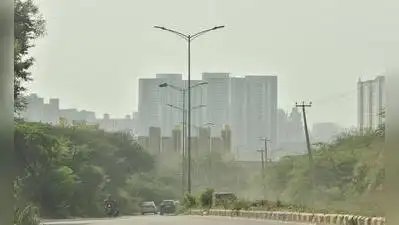
Gurgaon: It took just 101 days this year for Gurgaon to accumulate enough PM10 pollution to breach India’s annual air quality standard, with the city crossing the benchmark on April 11 — more than a month earlier than in 2025, when it did so on May 16, according to data shared by Centre for Research on Energy and Clean Air (CREA).The district was the second location in Haryana to record an overshoot day this year, after Ballabgarh, which crossed the benchmark on March 22. Historical data showed the district’s overshoot date was April 14 in 2021, April 17 in 2022, April 20 in 2023 and April 2 in 2024. This year’s crossing was earlier than in four of the previous five years, though later than in 2024.An overshoot day is calculated by tracking cumulative daily PM10 concentrations and dividing the total by 365. The date on which the result first reaches 60 micrograms per cubic metre (µg/m³), India’s annual PM10 standard, is considered the benchmark crossing date. It indicates that pollution accumulated up to that point is enough to push the annual average to the national limit, even if concentrations remain at zero for the rest of the year.Manoj Kumar of CREA said Haryana’s persistent pollution problem required action beyond the current city-specific approach, including expanding the coverage of National Clean Air Programme (NCAP).“PM10 pollution in Haryana is a persistent problem, not an isolated occurrence this year. Twenty-three of the state’s 24 cities have overshot the PM10 standard, reflecting a consistent pattern of pollution that requires action beyond the current city-specific approach. Yet, under the National Clean Air Programme (NCAP), only Faridabad has been included from Haryana. The upcoming revision of NCAP must expand its coverage to include all Haryana cities facing persistent air pollution, with clear targets and timelines to reduce pollution levels,” Kumar said.He added that the early crossing highlighted residents’ exposure to elevated pollution well before the winter season. Prolonged exposure, he said, increased the risk of adverse health effects, particularly among children, older adults and people with pre-existing health conditions.A separate CREA dataset tracking annual average PM10 concentrations up to Oct 17 found that Ballabgarh recorded the highest level among the 23 Haryana locations listed, at 194 µg/m³. Gurgaon’s average stood at 165 µg/m³, followed by Panipat at 166 µg/m³ and Faridabad at 144 µg/m³.Several other locations also recorded high particulate pollution. Kurukshetra and Sonipat reported 129 µg/m³ and 124 µg/m³, respectively, while Dharuhera and Yamunanagar recorded 124 µg/m³ and 123 µg/m³. Manesar stood at 119 µg/m³, Charkhi Dadri at 117 µg/m³ and Bahadurgarh at 116 µg/m³.Narnaul recorded 112 µg/m³, Sirsa 111 µg/m³, Kaithal 110 µg/m³ and Ambala 106 µg/m³. Hisar stood at 99 µg/m³, Karnal at 98 µg/m³, Fatehabad at 95 µg/m³, Bhiwani at 91 µg/m³, Jind at 90 µg/m³ and Rohtak at 89 µg/m³. Panchgaon and Palwal recorded 81 µg/m³ and 80 µg/m³, respectively.Mandikhera recorded an average of 73 µg/m³ by Oct 17, though the separate dataset tracking overshoot dates marked its status as “Not Exceeded”.India’s annual PM10 standard is 60 µg/m³ under the National Ambient Air Quality Standards notified in 2009. World Health Organization’s annual guideline is 15 µg/m³, a quarter of India’s limit.PM10 comprises inhalable particles with diameters of 10 micrometres or less that can enter the respiratory system. Exposure is associated with respiratory and cardiovascular problems, with the impact depending on factors such as concentration, duration and particle composition.The overshoot dates and annual averages measure different aspects of Haryana’s pollution burden. The former indicate when accumulated pollution reached the threshold for the annual standard, while the latter reflect average concentrations recorded up to Oct 17. Final annual averages will establish the full extent of the pollution burden in 2026.Dr Aakar Kapoor, founder, partner and consultant radiologist at City Imaging and Clinical Labs, Delhi, said rising PM10 levels could cause persistent coughing, throat irritation, wheezing, breathlessness and chest tightness. Prolonged exposure could worsen asthma, impair lung function and increase cardiovascular risks.Children, teenagers and young working professionals were also vulnerable, particularly those with allergies or pre-existing respiratory conditions, he said. Repeated exposure during childhood was especially concerning because it could affect lung development.