










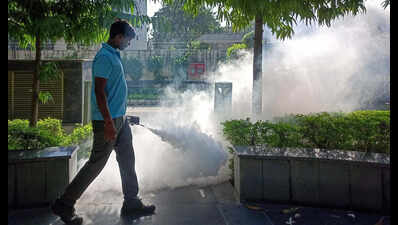
Gurgaon: Anticipating a rise in dengue and malaria cases in the coming months, the health department on Friday began a city-wide fever survey that will be conducted from the 1st to the 15th of every month till October, an official said. The survey for the month of May has already begun, he added.The move comes after Gurgaon recorded an unusually wet April this year. The city received 23.8 mm rainfall against the normal 7.7 mm, a 209% surplus, according to IMD. Health officials said the excess pre-monsoon rain, coupled with rising humidity, could create favourable breeding conditions for mosquitoes earlier than usual.About 102 teams have been deployed for the survey.“Our teams will be checking all areas and specifically where cases were reported in past years, besides identifying water-holding containers that can act as breeding grounds for disease-carrying mosquitoes,” said district surveillance officer Dr Jai Prakash.He added that while there is no reason to panic right now, all residents should exercise caution. “At present there is no clustering of fever cases, but people need to be cautious. We have established a centre through which doctors can call their patients daily to check their status in case anyone is found positive,” he said.Officials said apart from house-to-house fever surveillance, all positive larval breeding sites will be geo-tagged to build a database for regular monitoring through the monsoon. These hotspots will be compared with previous years’ surveys to identify recurring clusters and potential outbreak intersections. The teams will also intensify checks in dengue-prone localities and past hotspots to ensure breeding is curbed before peak season.Dengue cases in Haryana generally begin rising from May onward and intensify between July and Oct. The state has seen fluctuating but substantial vector-borne disease burdens in recent years. Haryana reported 11,835 dengue cases and 54 malaria cases in 2021, followed by 8,996 dengue and 50 malaria cases in 2022. In 2023, the state logged 8,081 dengue and 85 malaria cases. In 2025, Haryana reported 2,033 dengue cases, indicating that while numbers were lower than peak outbreak years, the disease remained a significant seasonal threat.In Gurgaon, dengue has remained a recurring concern despite year-to-year variation. The city reported 440 dengue cases in 2022, 276 cases and one death in 2023, 186 cases in 2024, and 64 cases in 2025. Health officials said the lower tally last year should not lead to complacency, particularly given this year’s wetter-than-normal pre-monsoon conditions.While malaria outbreaks are relatively uncommon in Gurgaon compared with dengue, surveillance is critical as malaria cases are typically reported between Feb and Sept. Doctors advised residents to seek immediate medical care if they experience persistent fever, nausea, rash, body ache or unusual fatigue, and urged households to regularly empty coolers, flower pots, rooftop containers and other stagnant water sources.