







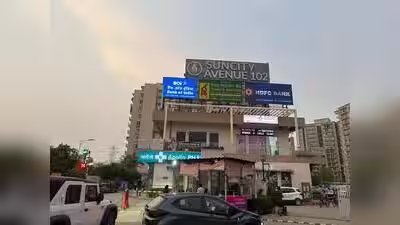
Gurgaon: Nearly 800 families in Suncity Avenue in Sector 102 can breathe easy after a civil court restrained Dakshin Haryana Bijli Vitran Nigam from disconnecting power to residential units over a disputed demand of around Rs 97 lakh.The order comes amid a dispute between the discom and the developer, Suncity Projects Pvt Ltd. The society’s RWA approached the court in July after the discom sought recovery of the disputed amount, which the association said had been generated during the mandatory five-year maintenance period between 2019 and 2024 by the shops maintained by the developer.The possibility of disconnection distressed residents because Suncity Avenue is an affordable group-housing society without DG or other power backup for individual units.The RWA’s advocate, Seema Nain, said, “The issue escalated when the discom clubbed the Rs 97 lakh arrears and penalty with the society’s June bill, taking the total demand close to Rs 1.17 crore. It was a huge amount and the discom refused to accept the undisputed portion of the monthly bill separately.”She added the demand came after a vigilance inspection by DHBVN at the society in Sept 2025 to examine its commercial billing pattern. The RWA had informed the developer about the inspection.In its petition, the RWA also questioned the single-point supply mechanism being applied in the society. In this system, the discom issues a single connection to the society and raises a consolidated bill for the society. The builder distributes electricity to individual flats and recovers charges through sub-meters.The Nigam, represented by advocate BP Sharma, opposed the plea, arguing that the RWA was not its consumer and that no demand had been raised against it. He also submitted that its dispute with the builder was already pending and that any grievance against an order in those proceedings should be pursued through the appropriate appellate remedy.But in an order passed on Aug 24, civil judge (junior division) Jasmeet Singh noted that the alleged Rs 97-lakh dues arose from a dispute between DHBVN and Suncity Projects and that, at this stage, no evidence has been placed before the court to establish that the RWA or residents were liable for the amount. The court also pointed out that access to electricity has been recognised by the Supreme Court as an important facet of the right to life under Article 21 of the Constitution.It noted that disconnecting power at this stage could have consequences for a large number of families while the underlying dispute over the alleged dues could be adjudicated between the concerned parties in accordance with law.The court, however, made it clear that its interim order does not finally decide who is liable for the alleged Rs 97 lakh dues. The matter is next listed for Oct 8, 2026.Meanwhile, an official of DHBVN said that the court order will be complied with.PS Matthew, representative of Suncity Projects, said the disputed demand was based on an incorrect calculation of the common load. “The dispute relates to the calculation of common load under DHBVN’s circular, which specifies that it should be within 15% of the total sanctioned load. The circular also defines what constitutes common-area load and commercial services. We contended that certain loads, including lifts and sewage treatment-related systems, which should have been considered as domestic load, have been treated as commercial load. This has resulted in the common load being calculated beyond the prescribed 15% limit and led to additional commercial charges. We had already approached the appropriate consumer grievance forum, which is the designated platform for such matters. However, before the issue could be taken up there, the RWA approached the civil court.”He added: “We will abide by the court’s decision and have no objection to paying whatever amount is legally determined to be payable after the calculation is carried out strictly as per the applicable circular. We are also willing to cooperate in getting the calculation re-examined. If any amount is found payable by us, we will make the payment. At the same time, residents should not be asked to pay any amount that is not legally due from them.”