









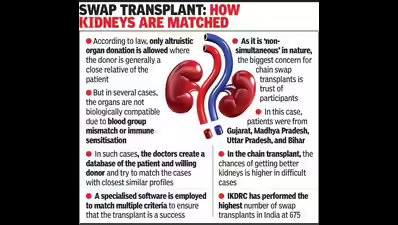
Ahmedabad: Surgeons at the Institute of Kidney Diseases and Research Centre (IKDRC) in Ahmedabad completed a six-day marathon medical procedure on Saturday, establishing a new Indian record for kidney swap chain transplants. The procedure involved 11 chronic kidney disease patients and 11 donors drawn from four states, surpassing IKDRC’s own previous record of 10 paired kidney transplants set last year.The patients and donors spoke different languages and practised different religions, but were united by the common purpose of giving patients who could no longer be sustained through dialysis a chance at a new life. Dr Vivek Kute, Professor of Nephrology at IKDRC and a recently appointed member of the National SWAP Transplantation Expert Committee of the Govt of India, said, “Many of these patients had been waiting for a compatible kidney for two to three years. While living donor transplants remain the most common method, swap or paired transplants — where the kidney of Donor A goes to Patient B and the kidney of Donor B to Patient A — significantly reduce waiting periods and resolve the problem of incompatible kidneys among relatives.”“These people had never met before, but when the chain was completed, they were connected by the knowledge that a stranger had given their loved one a new life,” he added.The transplant chain carried several notable features. Four of the 11 recipients were women, and four of the 11 donors were husbands of women who needed the transplant — both figures significantly higher than typical ratios, according to Dr. Kute.Four of the 11 transplants were performed using robotic surgery, a higher proportion than in previous chain transplants at the centre, said Dr Pranjal Modi, director of IKDRC.“Among the recipients was a young boy suffering from aplastic anaemia, a condition in which the bone marrow fails to produce sufficient blood cells. Having been on dialysis with poor results, he received a matching kidney after nine months of searching, and his post-operative condition is reported to be good. A majority of the surgeries were performed under govt healthcare initiatives,” he said.