











Ahmedabad: Corporate bank accounts equipped with ‘bulk mode’ facilities are allegedly at the centre of an interstate cyberfraud busted by Cyber Centre of Excellence (CCoE) in Gandhinagar. Six people have been arrested under Operation Mule Hunt 2.0 after senior police officers were tipped off about the group’s activities.Investigators said the team moved in when the suspects had assembled to obtain and verify online access to bank accounts and detained them before further transfers could be routed through the accounts.Preliminary scrutiny of the seized bank account details on the National Cybercrime Reporting Portal and inter-agency coordination platforms linked the accounts to complaints involving about Rs 1.5 crore. Investigators identified 22 acknowledgement numbers across the country, including six from Gujarat. Police said two of the 22 cases were “digital arrest” frauds registered in Maharashtra.Officials said ‘bulk mode’ is a banking facility generally available on corporate and certain current accounts that allows users to process multiple transactions in a single batch. Because it enables rapid movement of funds, such accounts are often targeted by cybercriminals, police said.
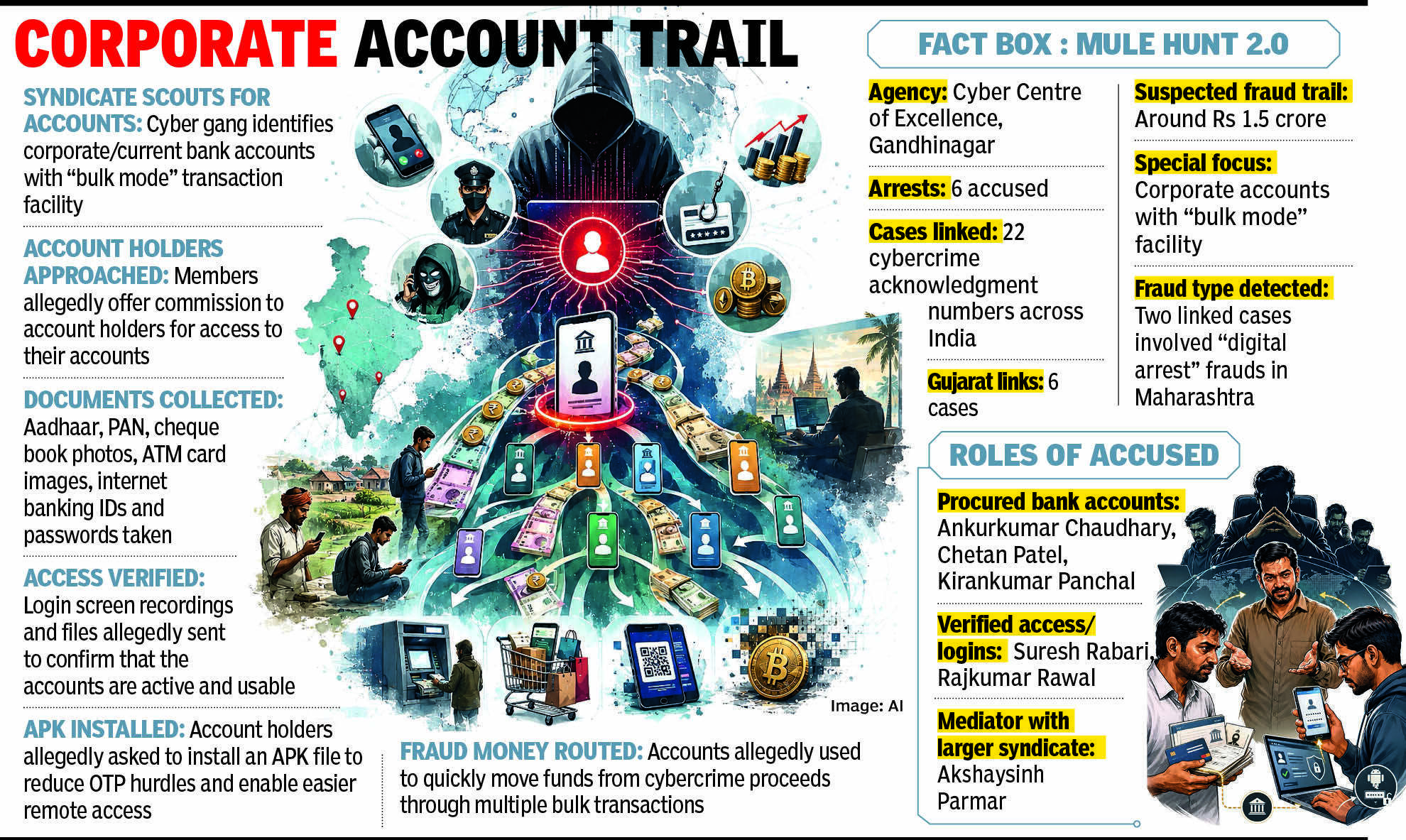
How cybercrooks used bank accounts with bulk mode facility to route scam money
The arrested accused have been identified as Ankurkumar Chaudhary of Gadha in Mehsana, Chetan Patel of Adarsh Nagar Society in Visnagar, Kirankumar Panchal of New Sai Bagh in Nana Chiloda, Akshaysinh Parmar of Mumbai, and Suresh Rabari and Rajkumar Rawal, both residents of Nikol.According to police, Chaudhary, Patel, and Panchal allegedly procured bank accounts and passed them on to the syndicate. Rabari and Rawal allegedly verified access by sending login screen recordings and other related files, while Parmar is accused of acting as the link between the local operatives and the larger interstate network.Police said the syndicate operated by pooling members and targeting corporate ‘bulk mode’ bank accounts. The group allegedly identified suitable accounts, then approached account holders with commission to gain their cooperation. Victims were persuaded to hand over Aadhaar and PAN details, cheque book photos, ATM card front-and-back images, and internet banking IDs and passwords. These credentials were forwarded to the syndicate for use in fraudulent transactions. Members then verified whether logins worked and ensured continued access.To minimise repeated OTP authentication, account holders were reportedly instructed to install an APK file on their mobile phones. Investigators suspect the application enabled remote access to the devices, making it easier for the syndicate to operate the accounts without repeatedly seeking verification.